
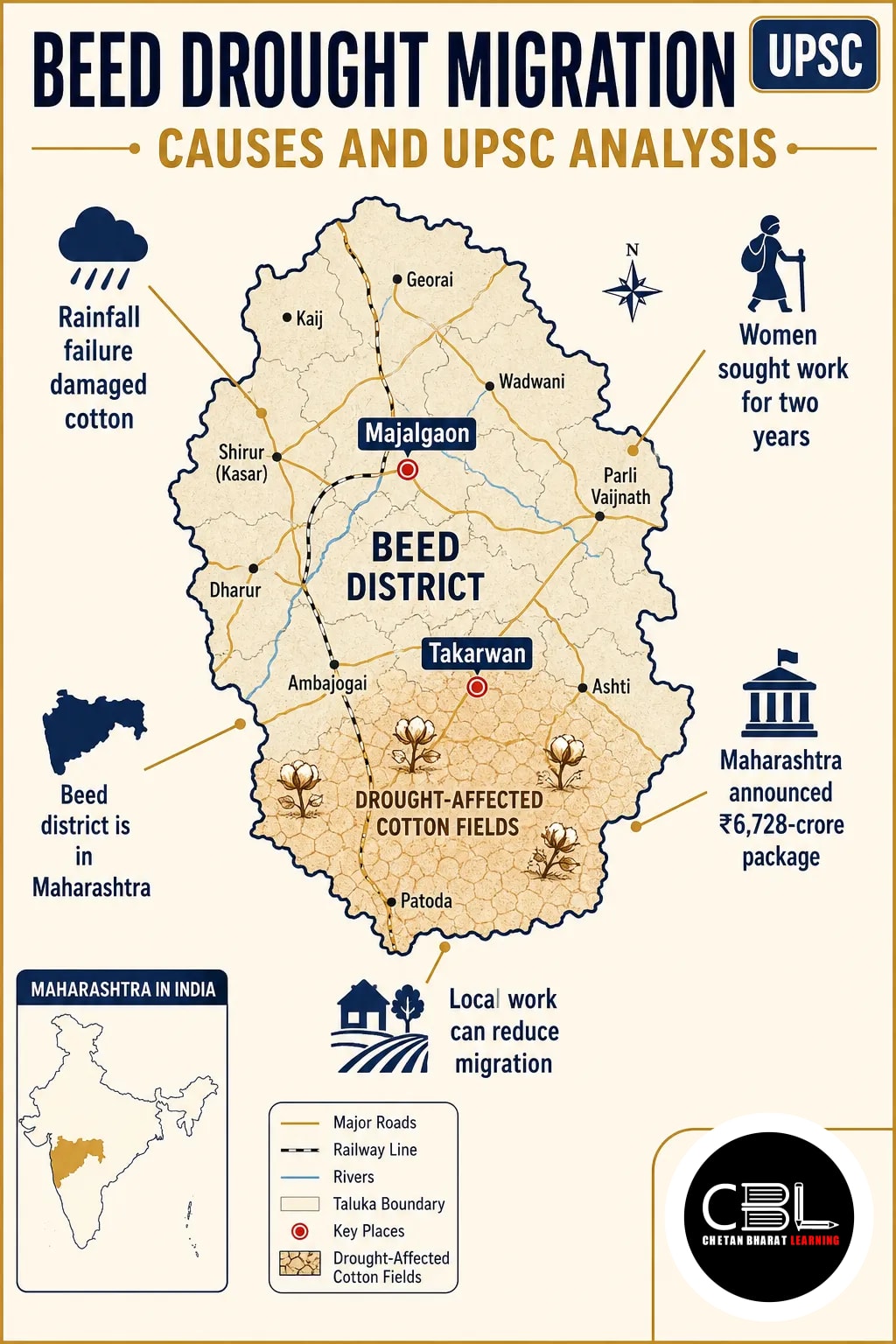
Beed drought migration has brought crop losses and rural employment gaps into focus in Maharashtra. The district offers a case study for geography and environment current affairs, especially the links between rainfall, livelihoods and public relief.
Quick answer: Beed drought migration reflects livelihood distress in Maharashtra’s Beed district in 2026. Rainfall failure has damaged cotton, while women in Takarwan say they have struggled for employment guarantee work for two years. Maharashtra has announced a ₹6,728-crore package; its delivery matters because affected families need income and local work.
Where is the distress and what happened?
The reported distress centres on Beed district in Maharashtra, including Majalgaon and Takarwan village. In Majalgaon, inadequate rain has left cotton plants stunted and with few bolls. Consequently, a harvest that should provide farm income and picking work has weakened.
| Location or measure | Reported fact |
|---|---|
| Majalgaon | Vanita Chauhan’s family has a four-acre field with drought-affected cotton. |
| Takarwan | Women say they have sought employment guarantee work for two years. |
| Maharashtra response | The State announced a ₹6,728-crore package. |
The source excerpt does not specify the package’s components or how much has reached Beed. Therefore, its announcement should not be treated as proof of relief delivery.
Why does drought lead to distress migration?
Drought can push households to migrate when local farming and wage work cannot sustain them. A rainfall shock first reduces crop output; it can then reduce demand for labour during harvesting and other farm operations.
In Beed, the cotton example shows the first link in this chain. Meanwhile, Takarwan women say they want work locally so they do not have to migrate to feed their families. Distress migration here refers to movement driven by an urgent lack of livelihood options, rather than a freely chosen opportunity.
However, migration outcomes differ across households. Land access, savings, alternative work and the availability of timely assistance can influence whether a family stays or leaves. The available source does not quantify the number of migrants or identify their destinations.
Why do women and rural workers face particular risks?
Women farmers and labourers face a double pressure when crop income falls and local wage work is scarce. The reported experience of Takarwan women makes access to work, not merely the existence of a scheme, central to the policy question.
- Farm livelihoods: A poor cotton harvest reduces the income a cultivating household can earn; it can also limit picking work.
- Local employment: When public work is unavailable or inaccessible, households have fewer ways to replace lost earnings.
- Care and mobility: Migration decisions can disrupt household care arrangements; therefore, local work can be valuable even when migration remains an option.
- Inclusion: Relief design must consider labourers as well as cultivators, because crop losses and lost wages affect them differently.
These are analytical risks, not claims that every household in Beed experienced each outcome. The available account gives no district-wide gender breakdown of losses.
What is the role of employment guarantees and drought relief?
Employment guarantees and drought relief can support incomes while households recover from agricultural losses. Takarwan women say earlier employment guarantees have not provided the work they sought. The source also records their intention to seek work under VB-G RAM G; it does not provide the scheme’s full name or operational details.
As statutory background, the Mahatma Gandhi National Rural Employment Guarantee Act, 2005, provides for a legal guarantee of wage employment to rural households whose adult members volunteer for unskilled manual work. The guarantee is up to 100 days per household in a financial year, subject to the Act’s provisions. The source does not establish how that framework relates to VB-G RAM G.
For analysis, the gap between a formal entitlement and work received matters. Registration of demand, timely allocation of work, wage payment and accessible grievance channels are distinct stages. Therefore, an assessment should examine each stage rather than assume that an announced programme has reached all applicants.
How can policy reduce future vulnerability?
A combined strategy should address immediate income loss and the water risks behind repeated crop stress. The following are policy options, not measures confirmed in the announced package.
- Deliver local work: Record employment demand promptly and monitor work allocation and wage payments, so families can make informed choices about migration.
- Track relief delivery: Publish eligibility rules, spending and beneficiary data; consequently, communities can distinguish allocations from assistance received.
- Include wage workers: Design support for households that lose farm work, alongside assistance for affected cultivators.
- Conserve water: Plan watershed and soil-moisture works around local catchments; also maintain assets after construction.
- Reduce crop risk: Assess crop choices and water use against local conditions, while ensuring that farmers can access relevant advice.
Overall, Beed drought migration shows why a relief package must be judged by delivery, livelihood coverage and durable water management. A programme that addresses only one of these dimensions can leave households exposed to the next shock.
Source: The Hindu, 15 November 2026
Asked in UPSC: Previous Year Questions
- UPSC CSE Mains 2020 (GS Paper I): Critically examine whether river interlinking can address the interrelated problems of droughts, floods and interrupted navigation.
- UPSC CSE Mains 2016 (GS Paper I): How do micro-watershed development projects help water conservation in drought-prone and semi-arid regions of India?
UPSC links drought to water-management choices, so revise both watershed approaches and their limitations.
Punjab PCS and Haryana HCS may test this case through rural employment, water conservation and district-level relief administration. Candidates can also compare how local institutions identify affected cultivators and wage workers, without assuming identical conditions across states.
Prelims Practice Corner
Mains Practice Questions
Frequently Asked Questions
Why are people in Beed facing pressure to migrate?
Mainly because drought has damaged farm livelihoods while villagers say local employment guarantees have not met their needs. Women in Takarwan say they want work locally to avoid leaving for subsistence.
How much drought assistance has Maharashtra announced?
Maharashtra announced a ₹6,728-crore package. However, the available source does not specify its components or the amount delivered in Beed.
Which crop illustrates the drought’s impact in Majalgaon?
Cotton illustrates the impact. Because of inadequate rain, plants in the reported four-acre field were stunted and had few bolls.
Related Current Affairs
Preparing for UPSC, PCS or HCS?
Talk to a mentor at Chetan Bharat Learning, Chandigarh. Free guidance on choosing the right exam and building a study plan.
Chat on WhatsAppCall 97793 53345UPSC / IAS / PCS coaching in Chandigarh · Trusted by aspirants across Punjab & Haryana









Leave a Reply
You must be logged in to post a comment.