
Introduction
India’s transition towards clean energy has gained significant momentum over the past decade. As the country seeks to reduce dependence on fossil fuels and achieve ambitious climate goals, solar energy has emerged as the backbone of India’s renewable energy strategy. Today, solar power contributes nearly 30% of the country’s installed electricity generation capacity, making it one of the fastest-growing segments of the energy sector.
To accelerate this transformation, the government has launched flagship initiatives such as the PM Surya Ghar Muft Bijli Yojana and the PM-KUSUM Scheme. These programmes aim to promote decentralized solar power generation among households and farmers while supporting India’s broader energy security and sustainability objectives.
Although both schemes have recorded notable achievements, their progress remains uneven across states. High upfront installation costs, varying state-level incentives, and awareness gaps continue to limit their full potential. As India’s electricity demand rises rapidly, strengthening these solar schemes has become increasingly important.
India’s Solar Energy Revolution
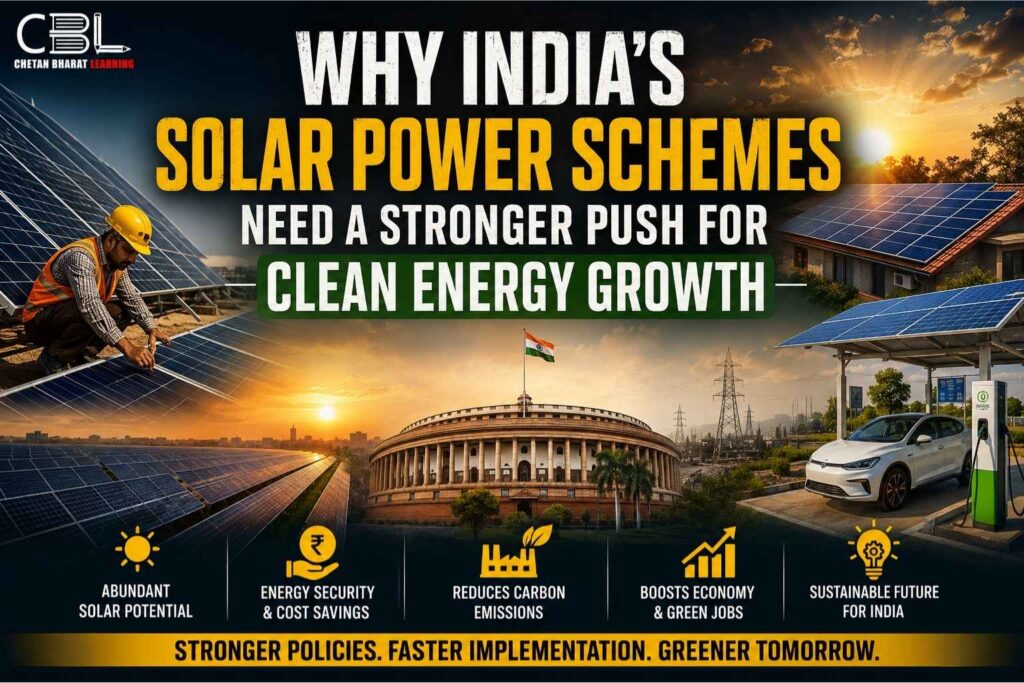
India has become one of the world’s leading renewable energy markets. Over the last few years, the country has added more than 50 GW of solar capacity and continues to attract significant domestic and international investment.
The growth of solar energy is driven by several factors. Falling solar panel prices, government incentives, improved technology, and climate commitments have encouraged large-scale adoption. Solar power is also helping India diversify its energy mix while reducing carbon emissions.
Unlike traditional power generation, solar energy can be deployed at multiple levels—from large utility-scale solar parks to rooftop systems installed on homes, schools, businesses, and farms. This flexibility makes solar energy an essential component of India’s clean energy future.
Understanding PM Surya Ghar Muft Bijli Yojana
The PM Surya Ghar Muft Bijli Yojana is one of the government’s most ambitious rooftop solar programmes.
The scheme aims to provide rooftop solar installations to one crore households across India. Beneficiaries receive financial support and subsidies to install solar panels on their homes, reducing electricity bills while promoting renewable energy adoption.
One of the major attractions of the programme is the promise of free electricity generation for households. Families can generate their own electricity, reduce dependence on conventional power sources, and contribute surplus energy to the grid under net metering arrangements.
States such as Gujarat, Maharashtra, Uttar Pradesh, and Rajasthan have shown strong performance under the scheme, demonstrating how policy support and public awareness can significantly boost adoption.
PM-KUSUM Scheme: Empowering India’s Farmers
The PM-KUSUM (Pradhan Mantri Kisan Urja Suraksha Evam Utthan Mahabhiyan) scheme focuses on the agricultural sector.
Agriculture remains one of India’s largest electricity-consuming sectors, particularly due to irrigation requirements. The PM-KUSUM scheme seeks to reduce farmers’ dependence on diesel-powered pumps and conventional electricity by promoting solar-powered irrigation systems.
Farmers can install standalone solar pumps, solarize existing pumps, and even establish small solar plants on their land. This not only reduces energy costs but also creates an additional source of income through the sale of surplus electricity.
The scheme plays a dual role by supporting rural development and advancing India’s renewable energy goals simultaneously.
Progress Achieved So Far
Both flagship solar programmes have made significant contributions toward expanding decentralized solar generation.
The rooftop solar segment has witnessed substantial growth, with lakhs of households adopting solar systems under the PM Surya Ghar initiative. Similarly, PM-KUSUM has facilitated the installation of solar pumps and decentralized solar capacity across rural India.
These achievements indicate increasing public acceptance of solar technology and demonstrate the effectiveness of targeted government interventions.
However, the overall performance remains below long-term targets, highlighting the need for further policy improvements and implementation support.
Uneven Performance Across States
A closer examination reveals significant regional differences in implementation.
States such as Gujarat, Maharashtra, Kerala, and Rajasthan have emerged as leaders in rooftop solar adoption. These states benefit from supportive policies, better awareness, efficient administrative systems, and stronger distribution networks.
In contrast, several states continue to lag behind despite possessing substantial solar potential. Lower awareness levels, weaker implementation mechanisms, and financial constraints often contribute to slower adoption rates.
The variation highlights the importance of state-level governance and local policy support in determining the success of renewable energy programmes.
Why Adoption Remains Slow in Some Regions
One of the biggest barriers to solar adoption is the high upfront installation cost.
Although subsidies significantly reduce expenses, many households and farmers still struggle to arrange the initial investment required for solar systems. Financing options remain limited in several regions, particularly in rural areas.
Awareness also plays a critical role. Many potential beneficiaries are either unaware of available schemes or uncertain about the application process, technical requirements, and long-term benefits.
Administrative delays, approval procedures, and coordination challenges between agencies can further discourage adoption.
As a result, despite attractive subsidies and long-term savings, many eligible consumers remain hesitant to switch to solar power.
Rising Electricity Demand and the Need for Solar Expansion
India’s electricity demand is growing rapidly due to urbanization, industrial expansion, digital infrastructure, and rising living standards.
Meeting this demand through conventional energy sources alone would increase fuel imports, environmental degradation, and energy security risks. Renewable energy, particularly solar power, offers a sustainable solution.
Experts believe that a significant share of India’s future electricity requirements can only be met through accelerated deployment of solar and other renewable energy technologies.
Distributed solar generation also reduces pressure on transmission infrastructure while improving energy access in remote areas.
Solar Energy and India’s Climate Goals
India has committed to ambitious climate and renewable energy targets under global climate agreements.
Expanding solar capacity is essential for reducing greenhouse gas emissions and supporting the transition toward a low-carbon economy. Solar energy helps replace fossil-fuel-based electricity generation and contributes to cleaner air and improved public health outcomes.
The success of schemes such as PM Surya Ghar and PM-KUSUM will therefore play a crucial role in determining whether India can achieve its long-term sustainability objectives.
Economic Benefits of Solar Power
Beyond environmental advantages, solar power creates significant economic opportunities.
The solar industry generates employment across manufacturing, installation, maintenance, financing, and research sectors. Increased domestic solar production can also reduce dependence on imported energy resources.
For households, rooftop solar systems lower electricity expenses and improve energy independence. For farmers, solar-powered irrigation reduces operating costs while creating opportunities for additional income generation.
The cumulative economic impact extends beyond individual beneficiaries and contributes to national growth and energy resilience.
What More Needs to Be Done?
To maximize the impact of solar schemes, policymakers may need to focus on improving accessibility and affordability.
Expanding low-interest financing options can help households and farmers overcome upfront cost barriers. Simplifying application procedures and increasing awareness campaigns can encourage wider participation.
Strengthening coordination between central and state governments will also be essential. States that have demonstrated successful implementation models can provide valuable lessons for regions that continue to face challenges.
Investments in grid modernization, energy storage systems, and domestic solar manufacturing will further support long-term growth.
Why This Topic Matters for UPSC Aspirants
Solar power schemes are highly relevant for UPSC preparation because they connect multiple syllabus areas including:
- Indian Economy
- Environment and Ecology
- Renewable Energy
- Agriculture
- Climate Change
- Government Schemes
- Sustainable Development
Questions related to renewable energy initiatives, solar missions, climate commitments, and energy security frequently appear in both UPSC Prelims and Mains examinations.
FAQs
What is PM Surya Ghar Muft Bijli Yojana?
It is a government scheme that promotes rooftop solar installations for households through subsidies and financial support.
What is the PM-KUSUM Scheme?
PM-KUSUM helps farmers install solar pumps and decentralized solar power systems to reduce energy costs and improve income opportunities.
Why is solar energy important for India?
Solar energy enhances energy security, reduces carbon emissions, lowers electricity costs, and supports sustainable development.
Which states are leading in rooftop solar adoption?
Gujarat, Maharashtra, Kerala, and Rajasthan are among the top-performing states in rooftop solar implementation.
Why is adoption slow in some areas?
High upfront costs, limited awareness, financing challenges, and administrative hurdles continue to affect adoption rates.
Conclusion
India’s solar power journey represents one of the most important components of its clean energy transition. Programmes such as the PM Surya Ghar Muft Bijli Yojana and PM-KUSUM have demonstrated the potential of decentralized solar generation to transform both urban and rural energy consumption patterns.
However, achieving national renewable energy targets will require more than ambitious schemes. Addressing affordability concerns, improving implementation efficiency, and expanding public awareness will be critical for unlocking the full benefits of solar power. As electricity demand continues to rise, strengthening these flagship solar programmes can help India build a cleaner, more secure, and sustainable energy future.
Related Current Affairs
Preparing for UPSC, PCS or HCS?
Talk to a mentor at Chetan Bharat Learning, Chandigarh. Free guidance on choosing the right exam and building a study plan.
Chat on WhatsAppCall 97793 53345UPSC / IAS / PCS coaching in Chandigarh · Trusted by aspirants across Punjab & Haryana
Leave a Reply
You must be logged in to post a comment.