

UPSC Mapping
| Prelims | Governance & Technology |
|---|---|
| Mains | GS Paper 2 (Governance & International Relations) |
Key Facts
| Key Change | AI Omnibus simplifies compliance |
|---|---|
| Core Approach | Risk-based regulation |
What is EU AI Regulation?
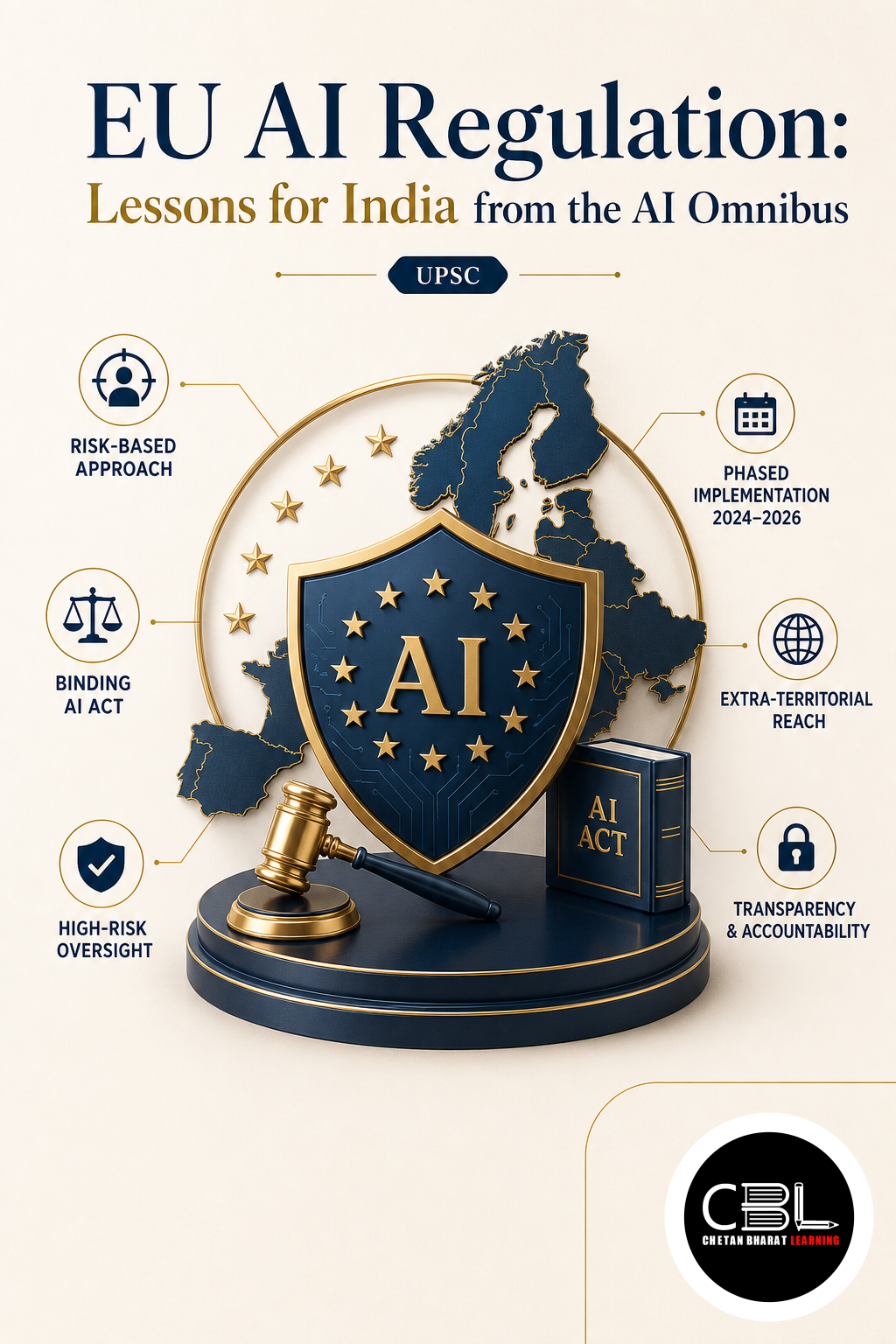
EU AI Regulation is a landmark legal framework, the EU AI Act, which classifies AI applications based on risk: unacceptable risk (prohibited), high risk (strict obligations), limited/transparency risk, and minimal/no risk. The AI Omnibus, which entered into force on July 27, modifies parts of the Act, extending some deadlines and simplifying compliance requirements. This is not a retreat from regulation but an admission that AI is changing faster than laws can normally change.
For India, this offers important lessons on how to regulate AI without slowing innovation. The EU’s response shows that even carefully designed regulations must be capable of adjustment. Regulation must be a continuing process of learning and adaptation.
Why is EU AI Regulation in News?
EU AI Regulation is in the news because the AI Omnibus has simplified implementation, providing more time for companies and regulators to prepare for high-risk AI rules. The EU has recognised that regulatory frameworks must be capable of learning and adapting to technological change.
This has implications for India, which has so far followed a different path—focusing on responsible AI, innovation, and sector-specific governance rather than a comprehensive AI law. For more details, refer to this PIB release.
Key Features of EU AI Regulation
- Risk-Based Approach: Regulation depends on potential harm, with higher risk leading to stronger safeguards.
- Prohibited AI Practices: Certain harmful AI applications are banned outright.
- High-Risk Obligations: AI affecting health, safety, and fundamental rights faces strict compliance requirements.
- Transparency Requirements: Users must know when they are interacting with AI.
- Regulatory Sandboxes: Controlled environments for testing new technologies under supervision.
Challenges in EU AI Regulation
- Implementation: Compliance has proved difficult, requiring simplification.
- Technology Speed: Generative AI, LLMs, and autonomous systems are evolving faster than the regulatory cycle.
- Compliance Costs: Large companies can afford compliance, but start-ups may struggle.
- Regulatory Capacity: Regulators need expertise in technology, law, ethics, and cybersecurity.
- Global Coordination: Different regulatory approaches across jurisdictions create compliance challenges.
Way Forward for EU AI Regulation
To make EU AI Regulation workable, the EU has adopted a more flexible approach, extending deadlines and simplifying rules. Regulatory sandboxes allow experimentation under supervision, helping regulators understand new technologies and refine rules.
For India, the lessons are clear: good regulation must be capable of learning; regulation needs an escape valve; compliance must be proportionate; simplification must not mean deregulation; and institutional capacity is essential. India should create a framework that protects citizens while allowing experimentation. For international best practices, refer to the OECD AI Policy Observatory.
Prelims Practice Corner
Q1. What is the EU AI Omnibus?
(a) A new AI law
(b) A modification simplifying the EU AI Act
(c) A ban on AI
(d) A trade agreement
Answer: (b) A modification simplifying the EU AI Act.
Q2. What is a regulatory sandbox?
(a) A physical testing facility
(b) A controlled environment for testing new technologies under supervision
(c) A legal loophole
(d) A tax incentive
Answer: (b) A controlled environment for testing new technologies under supervision.
Q3. How does the EU AI Act classify AI risks?
(a) By company size
(b) By potential harm
(c) By country of origin
(d) By data usage
Answer: (b) By potential harm.
Q4. What is a key lesson for India from the EU’s AI reset?
(a) Ban all AI
(b) Regulation must be capable of learning and adapting
(c) Only regulate big tech
(d) No regulation is needed
Answer: (b) Regulation must be capable of learning and adapting.
Q5. What is India’s current approach to AI governance?
(a) Comprehensive AI law
(b) Responsible AI, innovation, and sector-specific governance
(c) Ban on AI
(d) No regulation
Answer: (b) Responsible AI, innovation, and sector-specific governance.
Mains Practice Questions
Q1. Discuss the key lessons from the EU’s AI regulation reset for India’s AI governance framework. (250 words, 15 marks)
Answer Structure:
- Intro: Introduce the EU AI Omnibus and its significance.
- Body: Discuss the risk-based approach, regulatory sandboxes, and the need for adaptive regulation. Analyse lessons for India: capacity building, proportionality, and institutional readiness. Suggest a framework balancing innovation and safety.
- Conclusion: Emphasise the need for a flexible, learning-oriented regulatory regime.
Q2. What is a regulatory sandbox and why is it important for AI governance? (150 words, 10 marks)
Answer Structure:
- Intro: Define a regulatory sandbox.
- Body: Explain that it allows testing of new technologies under regulatory supervision, enabling experimentation, risk identification, and rule refinement. Important for start-ups and innovation.
- Conclusion: Conclude that sandboxes are essential for adaptive regulation.
FAQs on EU AI Regulation
What is the EU AI Act?
It is a landmark law classifying AI applications by risk, with higher risk leading to stricter regulation.
What is the AI Omnibus?
It is a modification that simplifies the EU AI Act, extending deadlines and easing compliance requirements.
What is India’s AI governance approach?
India has focused on responsible AI, innovation, and sector-specific governance rather than a comprehensive law.
Related Current Affairs
Preparing for UPSC, PCS or HCS?
Talk to a mentor at Chetan Bharat Learning, Chandigarh. Free guidance on choosing the right exam and building a study plan.
Chat on WhatsAppCall 97793 53345UPSC / IAS / PCS coaching in Chandigarh · Trusted by aspirants across Punjab & Haryana
Leave a Reply
You must be logged in to post a comment.