
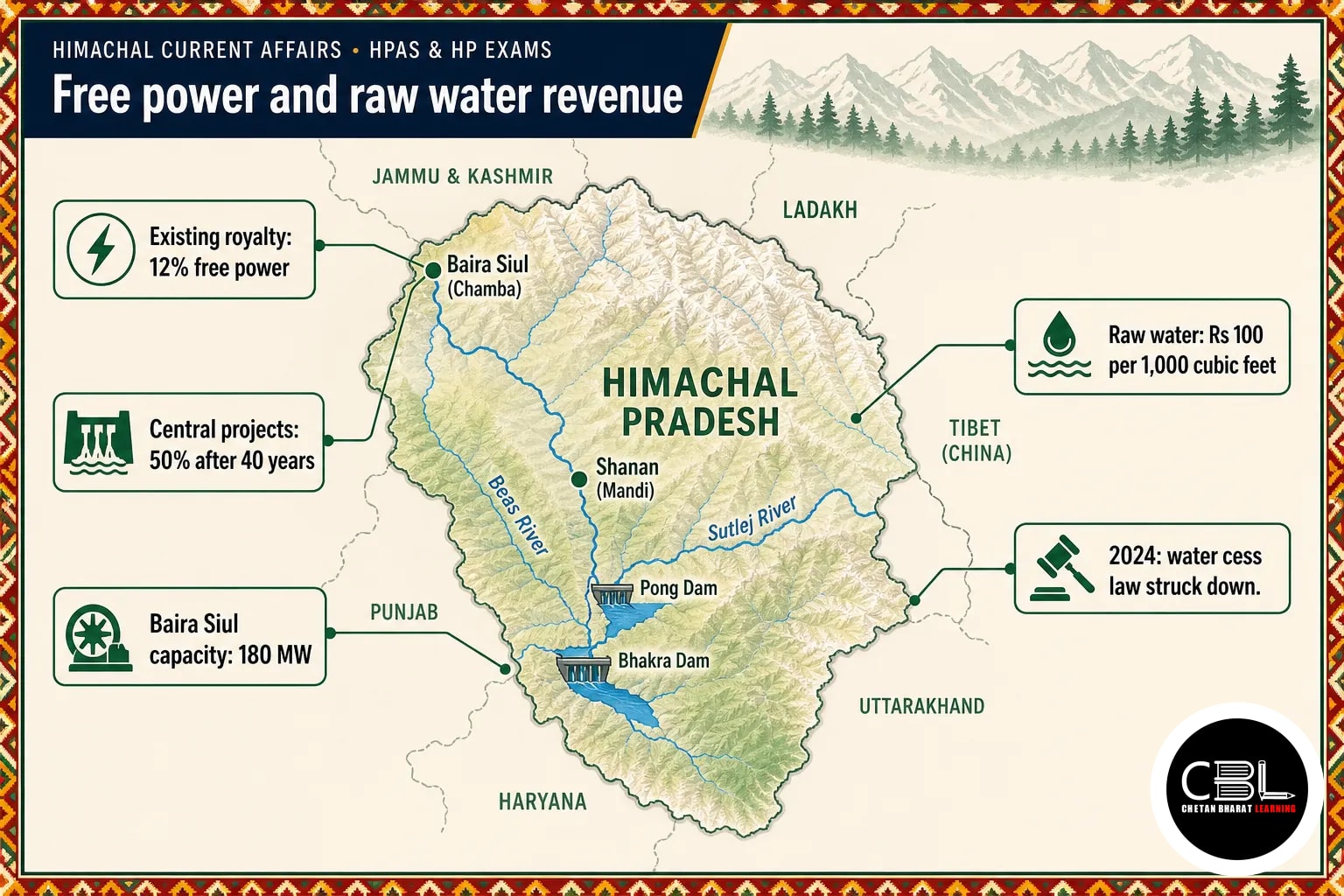
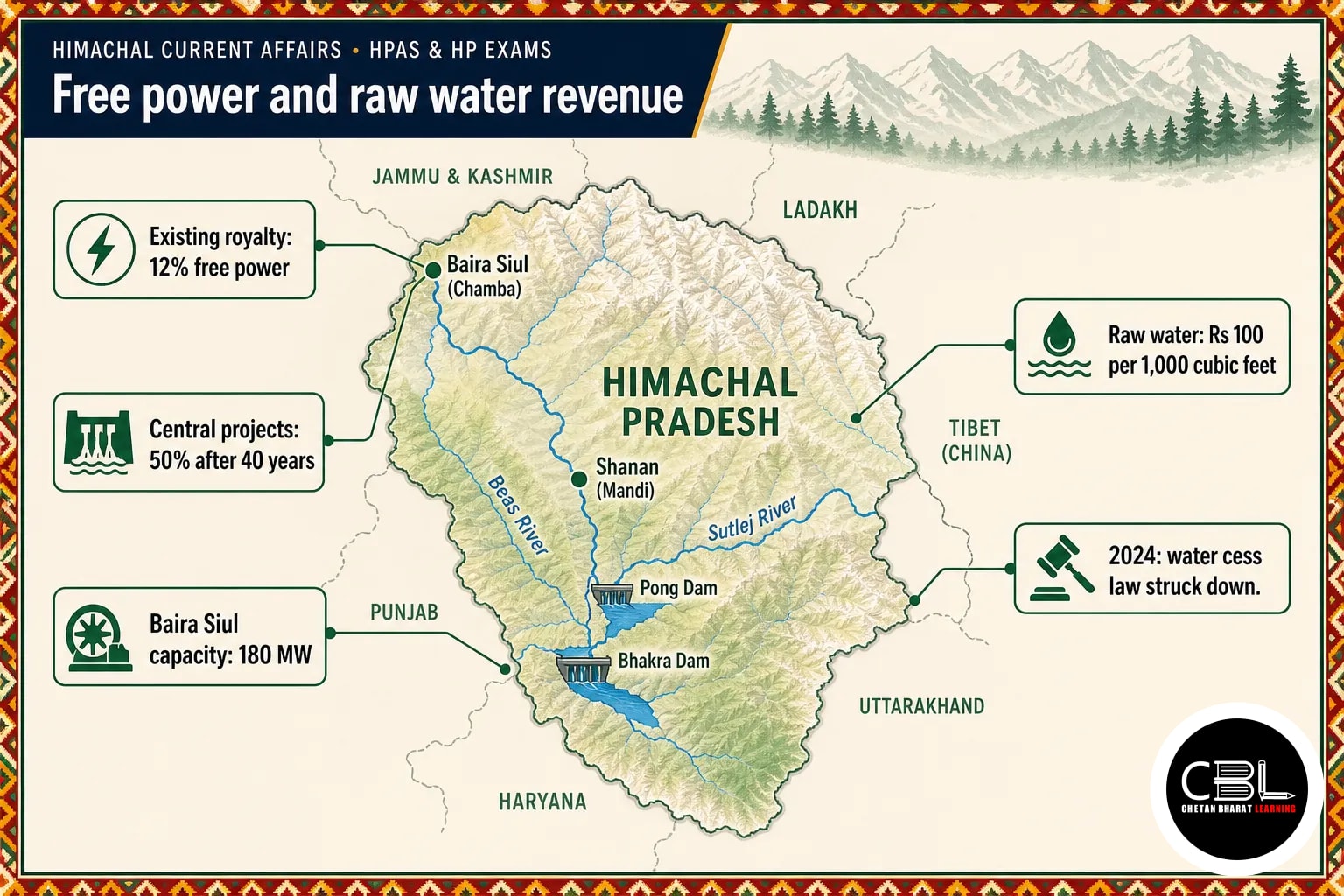
In 2026, Himachal Pradesh moved to raise revenue from hydropower and surplus raw water. On 13 November, the state cabinet amended its energy policy to secure 50% free power from central public sector undertaking projects after 40 years. It also set a uniform raw-water sale rate. The move followed a June request to the Union government for higher royalty, including from the Baira Siul project in Chamba.
Timeline: from cess to royalty
- Mar2024Cess struck down
The Himachal Pradesh High Court struck down the state’s 2023 hydropower water cess law.
- 2025reportedProjects cancelled
The cabinet cancelled 194 stalled hydro projects and set terms for future small projects.
- 16 Jun2026Royalty request
The Chief Minister sought 50% free power from Baira Siul in talks with the Union Power Minister.
- Sept2026Revenue rises
Annual free-power revenue rose from about Rs 1,900 crore to over Rs 2,400 crore.
- 13 Nov2026Policy amended
The cabinet adopted a 50% royalty provision and a uniform surplus raw-water sale rate.
- The Baira Siul hydropower project is in Chamba district.
- Baira Siul has an installed capacity of 180 MW.
- The state amended the Swaran Jayanti Energy Policy 2021 in November 2026.
- The uniform surplus raw-water rate is Rs 100 per 1,000 cubic feet.
- The High Court struck down the hydropower water cess law in March 2024.
What is Himachal’s hydropower revenue model?
Himachal receives 12% free power from hydro projects as royalty. The state can earn revenue from this electricity; by September 2026, it was retaining more control over its free-power share.
The November 2026 amendment seeks 50% free power from central public sector undertaking projects after 40 years. Separately, the cabinet fixed a sale rate for surplus raw water, with periodic revisions linked to the Wholesale Price Index.
Why it matters
Future projects up to 5 megawatts will provide 1% free power for the Local Area Development Fund, alongside 12% royalty. The fund connects project benefits with local development.
Free-power revenue rose from about Rs 1,900 crore to over Rs 2,400 crore a year. Raw-water sales offer another revenue route.
Higher royalty from central projects involves the state and Union government. In June 2026, Himachal sought a higher share from Baira Siul.
- River: Bhakra Dam is on the Sutlej River.
- Dam: Pong Dam is on the Beas River.
- Project: Shanan power project is at Joginder Nagar in Mandi district.
Key data
| Point | Details |
|---|---|
| Existing free power | 12% hydropower royalty |
| November policy amendment | 50% free power from central public sector undertaking projects after 40 years |
| Baira Siul | 180 megawatts; Chamba; 50% free power sought in June 2026 |
| Surplus raw water | Rs 100 per 1,000 cubic feet; periodic Wholesale Price Index revision |
| Small-project terms | Future projects up to 5 megawatts: 12% free power plus 1% for the Local Area Development Fund |
| November allotments | 222 pending solar and 13 hydro allotments above 25 megawatts cancelled; 20 projects to be re-tendered |
| Water cess | 2023 hydropower cess law struck down by the High Court in March 2024 |
Way forward
- Engage project owners: Work with the Union government and central undertakings on implementing the revised royalty provision.
- Publish accounts: Report free-power receipts, sales and local development allocations transparently.
- Protect river systems: Assess ecological flows and cumulative impacts before hydropower decisions.
- Price water transparently: Publish raw-water sale terms and periodic index-linked revisions.
- Review stalled projects: Use clear criteria for re-tendering and consult affected communities.
HPAS Mains practice questions
Explain Himachal Pradesh’s 2026 hydropower royalty and raw-water pricing measures. (150 words)
Answer pointers:
- Introduce free power as a state revenue source.
- Explain the 50% provision for central projects after 40 years.
- State the surplus raw-water rate and index-linked revision.
- Conclude with transparent implementation and ecological safeguards.
Critically examine Himachal’s revised hydropower revenue model. (250 words)
Answer pointers:
- Introduce the shift towards greater returns from power and water.
- Discuss revenue potential and local development benefits.
- Examine implementation, intergovernmental and ecological concerns.
- Conclude with consultation, transparent accounts and river protection.
As SDM of Joginder Nagar in Mandi, how would you address community concerns around a hydropower project? (150 words)
Answer pointers:
- Identify affected settlements and their concerns.
- Consult residents, project authorities and relevant departments.
- Track local development commitments and environmental compliance.
- Publish action taken and establish a grievance mechanism.
Discuss how legislative competence under Article 246 relates to Himachal’s hydropower revenue choices. (150 words)
Answer pointers:
- Introduce Article 246 and the Seventh Schedule.
- Note the High Court’s 2024 decision on the water cess law.
- Distinguish a statutory cess from free-power royalty and water sales.
- Conclude with legally sound design and Centre-state coordination.
For Himachal Pradesh Administrative Service (HPAS) prelims and Himachal Pradesh Rajya Chayan Aayog (HPRCA) papers, memorise 12%, 50%, 40 years and the raw-water rate. For mains, distinguish royalty, water sales and the struck-down cess.
MCQ Practice Corner
Q1. Consider the following statements about Himachal’s November 2026 measures:
1. The energy policy amendment seeks 50% free power from central public sector undertaking projects after 40 years.
2. The uniform rate applies to the sale of surplus raw water.
3. The raw-water rate is Rs 100 per cubic foot.
Which statements are correct?
(a) 1 and 2 only (b) 2 and 3 only (c) 1 and 3 only (d) 1, 2 and 3
Show answer
Answer: (a) because the rate is Rs 100 per 1,000 cubic feet, not per cubic foot.
Q2. Which event preceded the November 2026 energy policy amendment?
(a) The 2024 High Court decision on the hydropower water cess (b) The 2026 raw-water rate revision (c) The 1971 Swaran Jayanti Energy Policy (d) The introduction of the 2023 cess in 2026
Show answer
Answer: (a) because the High Court struck down the cess law in March 2024.
Q3. Baira Siul hydropower project is in which district?
(a) Mandi (b) Chamba (c) Kinnaur (d) Solan
Show answer
Answer: (b) because Baira Siul is in Chamba district.
Q4. What is the installed capacity of Baira Siul?
(a) 5 MW (b) 25 MW (c) 110 MW (d) 180 MW
Show answer
Answer: (d) because Baira Siul has an installed capacity of 180 megawatts.
Frequently Asked Questions
What is the new hydropower royalty provision in Himachal Pradesh?
The November 2026 policy amendment seeks 50% free power from central public sector undertaking projects after 40 years. Himachal had sought a higher share from Baira Siul in June 2026.
What is Himachal’s rate for surplus raw water?
The uniform sale rate is Rs 100 per 1,000 cubic feet. It is to be revised periodically using the Wholesale Price Index.
What happened to Himachal’s hydropower water cess?
The Himachal Pradesh High Court struck down the 2023 water cess law in March 2024. The November 2026 measures address free-power royalty and surplus raw-water sales.
Sources: The Tribune, The Chenab Times, Himtimes, ANI
Related Current Affairs
More Himachal topics for HPAS & HP exams
Preparing for UPSC, PCS or HCS?
Talk to a mentor at Chetan Bharat Learning, Chandigarh. Free guidance on choosing the right exam and building a study plan.
Chat on WhatsAppCall 97793 53345UPSC / IAS / PCS coaching in Chandigarh · Trusted by aspirants across Punjab & Haryana



Leave a Reply
You must be logged in to post a comment.