

UPSC Mapping
| Prelims | Mains |
|---|---|
| Geography & Environment | GS Paper III (Disaster Management) |
Quick Facts
| Regional knowledge body | ICIMOD (HQ: Kathmandu) |
|---|---|
| Core hazard types | Flash flood, GLOF, avalanche flood |
| Key trigger mix | Extreme rain + cryosphere instability |
| High-risk setting | Narrow valleys, steep slopes, fast rivers |
What is Himalayan flash floods?
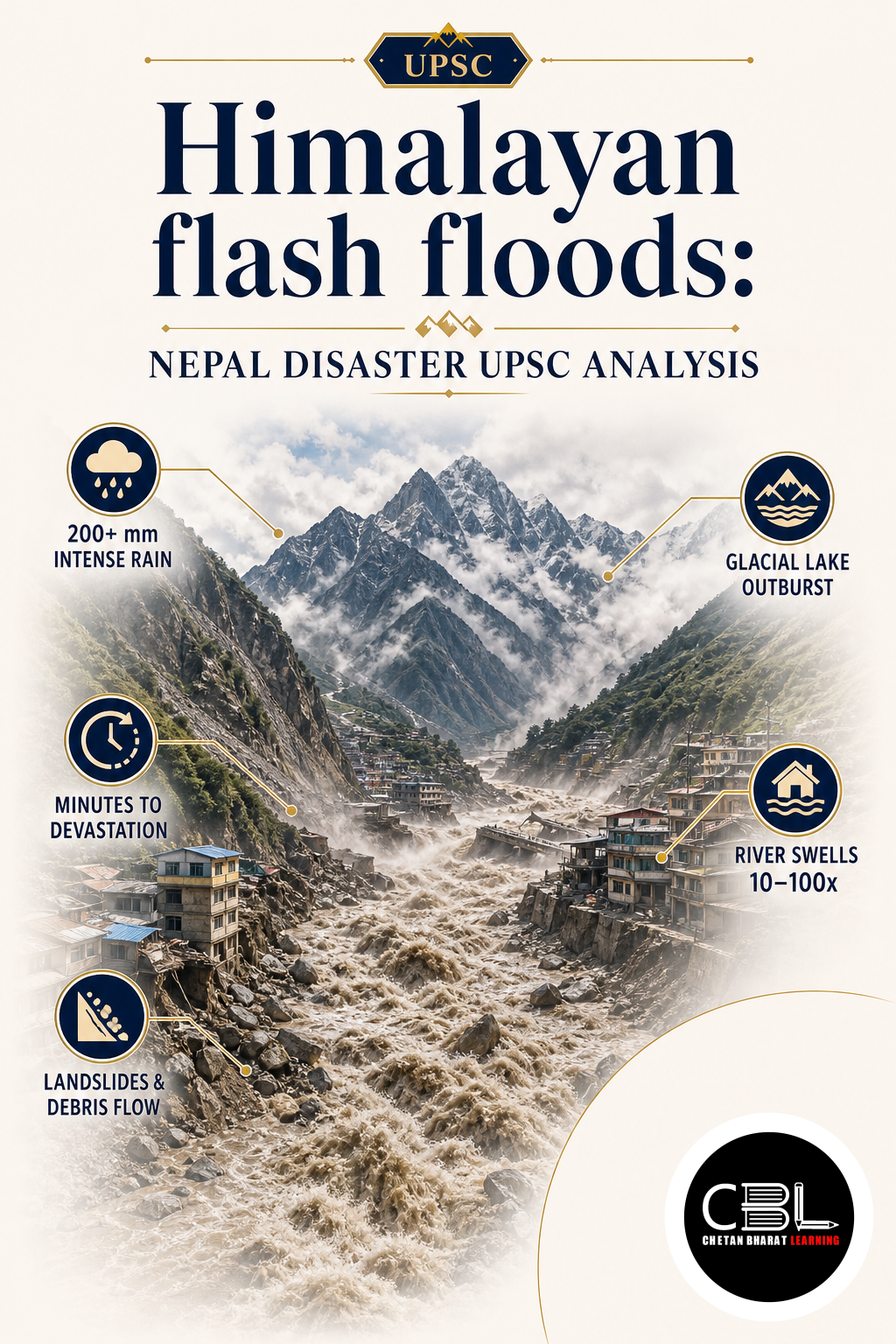
Himalayan flash floods are sudden, high-energy surges of water and debris in steep mountain catchments, often reaching settlements with little lead time. News reports sometimes call the fast flood wave a “Himalayan tsunami”, but it is not an ocean tsunami; it is a rapid run-off and debris-flow phenomenon driven by terrain and triggers.
UPSC often tests the process difference between a rainfall flash flood, a glacial lake outburst flood (GLOF), and an avalanche flood. A GLOF follows sudden lake drainage when a moraine or ice dam fails, while an avalanche flood can occur when an ice-rock avalanche or landslide hits water or snow, rapidly displacing it and entraining debris downstream.
Why is it in News?
Recent flooding in Nepal’s mountain river valleys led to significant losses and many missing persons, including Indians as per media reports. The event revived attention on Himalayan vulnerability, where steep slopes, fragile geology, and concentrated infrastructure in valley bottoms amplify impacts.
The UPSC relevance also comes from cascading disasters: one trigger can create multiple hazards, such as slope failure, river blockage, and then a sudden downstream surge. Regional science bodies track such risks across the Hindu Kush Himalaya, and aspirants can follow risk and cryosphere work through ICIMOD.
Key Features
In exam answers, describe Himalayan flash floods as a multi-hazard event shaped by the mountains’ hydrology, geology, and human exposure.
- Short response window: Intense rainfall or sudden release from upstream can raise river levels within minutes to hours in narrow valleys.
- High sediment and debris load: Fast flow entrains boulders, logs, and landslide material, increasing destructive force beyond water volume alone.
- Flash Flood vs GLOF vs avalanche flood: Rainfall floods depend on cloudbursts and run-off, GLOFs depend on lake breach mechanics, and avalanche floods follow mass movement into snow or water.
- Cascading chain potential: Landslides can dam rivers, form temporary lakes, and then burst to create a larger downstream surge.
- Cross-border river implications: Transboundary basins can transmit flood waves downstream, making information sharing and warning dissemination critical.
For Prelims, remember that GLOF is specifically linked to a glacial lake breach, not every mountain flood. For Mains, link hazard type to the right instrument: hydromet monitoring for rainfall floods, cryosphere and lake monitoring for GLOF, and slope-stability assessment for avalanche-related events.
Challenges
Key constraints arise from data gaps, terrain limits, and the pace of infrastructure expansion in fragile zones.
- Monitoring blind spots: High-altitude basins have sparse gauges, difficult telecom connectivity, and seasonal access constraints for instrument maintenance.
- Forecasting complexity: Extreme rain, snowmelt, lake dynamics, and slope failures interact, reducing the skill of single-model predictions.
- Exposure concentration: Roads, hydropower assets, and towns often sit on floodplains and alluvial fans due to limited flat land.
- Community last-mile alerting: Sirens, SMS warnings, and evacuation drills may not reach migrant workers and tourists.
- Governance across borders: Data standards and real-time sharing protocols vary by country, complicating joint response.
For answer enrichment, connect this to India’s disaster-management architecture and recurring mountain hazards covered in the environment and ecology tracker. Use examples like evacuation planning, resilient bridges, and slope-safe road design to show actionable understanding.
Climate change can raise risk in multiple ways without making every single event attributable. Warming can intensify extreme precipitation, alter snow-to-rain patterns, and destabilise high slopes by changing freeze-thaw cycles, which increases the probability of compounding events.
Way Forward
A practical way forward is to build a cascading-disaster lens into planning: map hotspots where lakes, unstable slopes, and settlements align; then prioritise monitoring, safe zoning, and evacuation routes. India and Nepal can strengthen joint protocols for upstream-to-downstream warnings in shared basins, including standard message formats and multilingual dissemination for travellers.
Policy design should also shift from post-disaster relief to risk-informed development: slope-stability audits for roads, resilient bridge standards, redundancy in telecom, and trained local responders. For India-specific institutional tools and guidance relevant to UPSC, refer to the NDMA framework documents and connect them with state capacity, financing, and community preparedness.
Prelims Practice Corner
Q1. Which of the following best describes a GLOF?
- (a) Urban flood caused by blocked drains
- (b) River flood due to cyclone storm surge
- (c) Sudden release of water from a glacial lake
- (d) Flood caused only by groundwater rise
Answer: (c) A GLOF follows sudden drainage of a glacial lake due to dam failure or breach.
Q2. In mountain valleys, flash floods often become more destructive mainly because they:
- (a) Carry negligible sediment
- (b) Move slowly over wide plains
- (c) Entrain boulders and debris in steep channels
- (d) Occur only in winter
Answer: (c) Steep gradients allow fast flows to carry heavy debris, increasing impact force.
Q3. The term ‘cascading disaster’ refers to:
- (a) A single hazard with no secondary effects
- (b) One event triggering a chain of interconnected hazards
- (c) Disaster limited to coastal regions
- (d) A hazard that is always man-made
Answer: (b) Cascading disasters involve domino-like interactions, such as landslide-dam and outburst flood.
Q4. ICIMOD is best described as:
- (a) A UN peacekeeping force
- (b) A regional knowledge centre for the Hindu Kush Himalaya
- (c) A global nuclear regulator
- (d) A bilateral river tribunal
Answer: (b) ICIMOD is a regional intergovernmental knowledge and learning centre focused on the HKH region.
Q5. Which is the most appropriate first response priority during a sudden mountain flood warning?
- (a) Wait for water to recede before moving
- (b) Move to higher ground and avoid river crossings
- (c) Drive along the river to record videos
- (d) Stand under bridges for shelter
Answer: (b) Evacuation to higher ground and avoiding channels reduces exposure to fast flood waves and debris.
Mains Practice Questions
Q1. Distinguish between rainfall-induced flash floods, GLOF and avalanche-related floods in the Himalayas. Explain why such events often become cascading disasters. (10 marks)
Answer Structure:
- Intro: Define mountain flash floods and the idea of a high-energy flood wave.
- Body: (1) Trigger mechanism for each type; (2) role of dams/lakes/slope failure; (3) debris load and valley confinement; (4) how landslide-dams and subsequent breaches create cascading impacts.
- Conclusion: Stress multi-hazard monitoring and integrated early warning as the key takeaway.
Q2. Discuss how climate change and development patterns can amplify disaster risk in the Himalayas. Suggest a cooperative framework for India and Nepal to reduce losses from sudden floods. (15 marks)
Answer Structure:
- Intro: Frame the Himalaya as a climate-sensitive, infrastructure-dense, transboundary risk zone.
- Body: (1) extreme precipitation and snow/rain shifts; (2) cryosphere instability and slope processes; (3) exposure from valley-bottom development; (4) monitoring and last-mile alert gaps; (5) bilateral steps: data sharing, joint SOPs, community warnings, resilient standards.
- Conclusion: Link risk reduction to safer development and stronger regional resilience.
FAQs on Himalayan flash floods
Is a ‘Himalayan tsunami’ the same as a tsunami?
No. The phrase is used informally for a sudden, powerful flood surge in valleys, not for an ocean-generated tsunami. In UPSC answers, describe the process as rapid run-off and debris flow driven by mountain terrain.
Why are GLOFs considered high-risk even if they are local events?
A lake breach can release a large pulse of water that accelerates through steep channels and picks up debris. This can damage bridges, hydropower assets, and settlements far downstream in a short time.
What should aspirants emphasise in a Mains answer on mountain floods?
Focus on hazard differentiation, cascading mechanisms, and specific solutions like monitoring networks, land-use zoning, resilient infrastructure standards, and community-based early warnings. Add a transboundary angle when rivers and warnings must cross national borders.
Related Current Affairs
Preparing for UPSC, PCS or HCS?
Talk to a mentor at Chetan Bharat Learning, Chandigarh. Free guidance on choosing the right exam and building a study plan.
Chat on WhatsAppCall 97793 53345UPSC / IAS / PCS coaching in Chandigarh · Trusted by aspirants across Punjab & Haryana
Leave a Reply
You must be logged in to post a comment.