
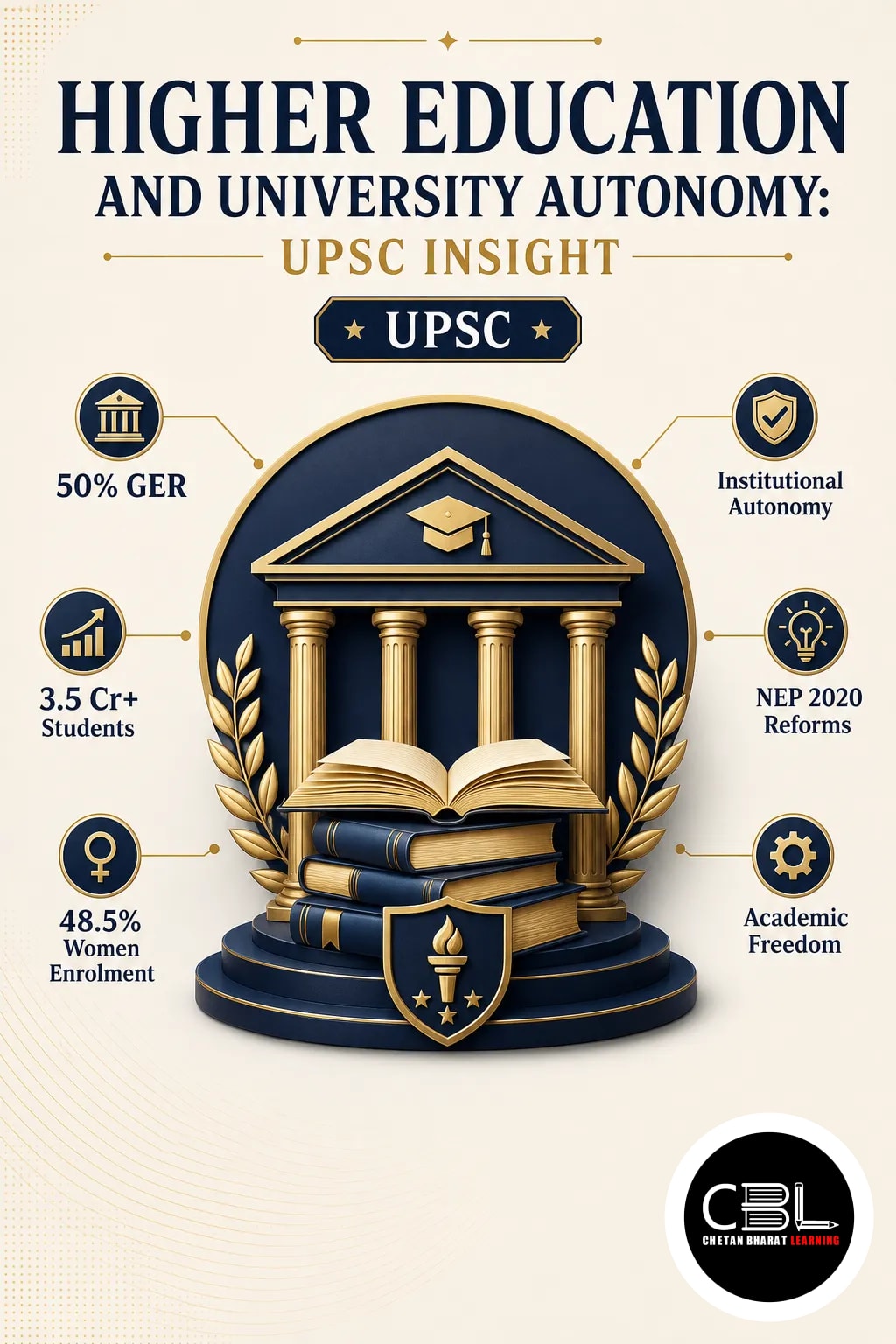
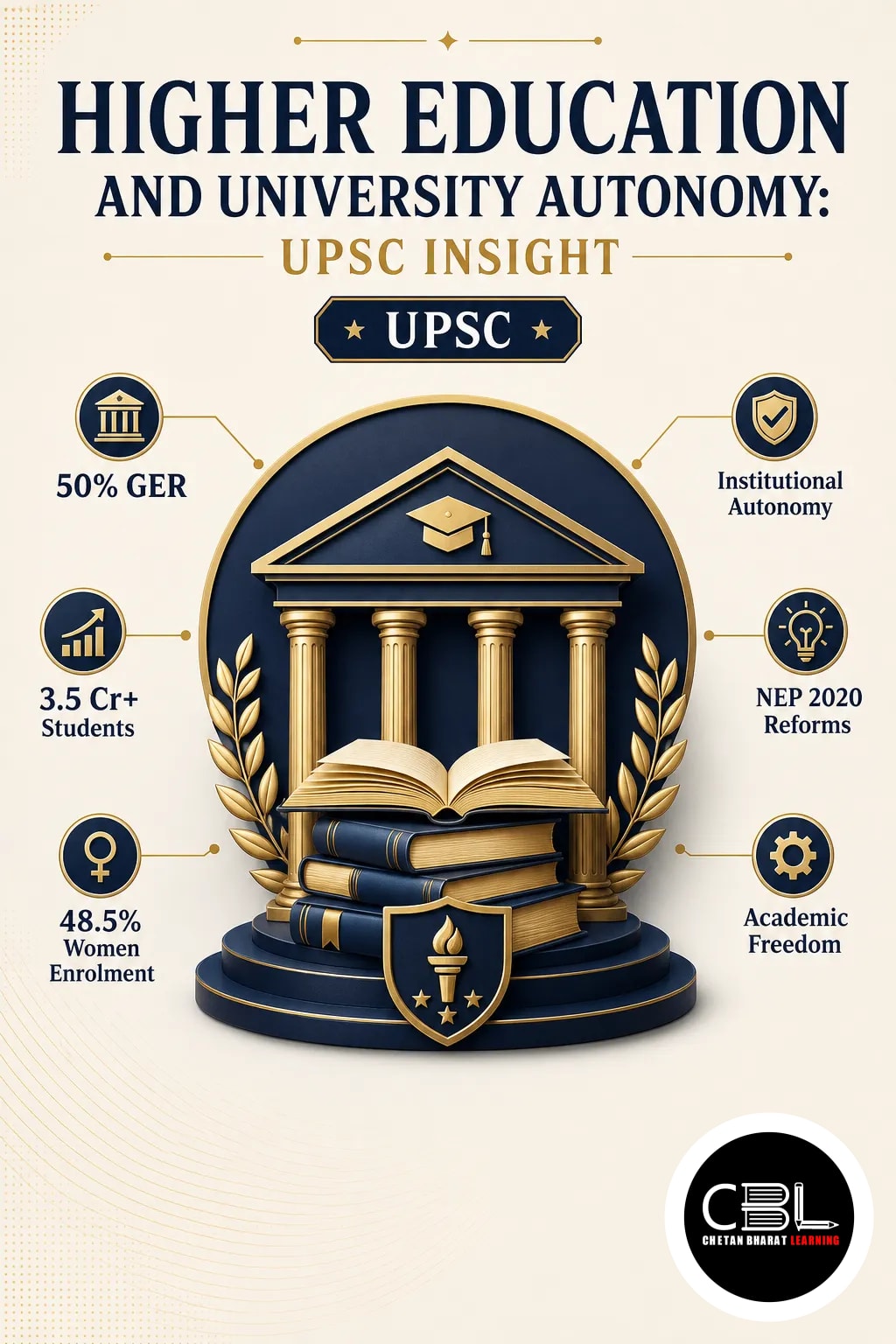
Higher education is at the centre of a fresh debate on current affairs in education, as critics question whether standardised testing is weakening universities. The concern is that academic judgement, not just scores, should shape admissions and appointments.
What is Higher Education?
Higher education covers colleges, universities, and specialised institutions that build advanced knowledge, research, and professional skills. In India, it also includes the constitutional and regulatory framework that shapes admissions, faculty selection, and academic standards.
The present debate is not about abandoning testing altogether. It is about restoring space for institutions to assess merit in ways suited to different disciplines.
Why in News?
A recent opinion piece argues that the growing dependence on uniform exams is distorting university life. It says that multiple-choice, score-driven selection can miss reasoning, originality, and disciplinary depth.
The article links this trend to the broader problem of institutional autonomy. It suggests that universities should regain the power to judge candidates through departmental processes and informed academic review.
Key Features
- Centralised testing culture has expanded beyond a narrow recruitment purpose into admissions and appointments across disciplines.
- Uniform format rewards familiarity with exam technique more than depth of reading or disciplinary thinking.
- Department-led evaluation can better judge candidates for literature, physics, history, or other fields than a single all-India score.
- Academic judgement allows peers to assess whether a student or teacher truly fits a subject’s demands.
- Autonomous universities can preserve intellectual diversity by admitting different kinds of talent.
- Meaningful interviews and viva voce can test scholarship, reasoning, and the ability to engage with ideas.
Challenges
- Over-reliance on metrics reduces complex academic quality to marks, counts, and scores.
- Publication inflation can create a market for papers instead of a market for ideas.
- Weak supervision can make doctoral work and viva voce rituals mechanical rather than rigorous.
- One-size-fits-all testing may favour candidates good at pattern-based preparation, not broader scholarship.
- Institutional networking can still influence appointments, even when formal criteria appear strict.
- Disciplinary imbalance may arise when STEM-style indicators dominate posts meant for the wider university.
Way Forward
Universities need a better balance between transparency and discretion. Admissions and appointments should use clear criteria, but they should also leave room for peer review, interviews, and discipline-specific methods.
Regulators can improve integrity by simplifying the scoring culture and focusing on actual scholarship. At the same time, institutions must protect the freedom to evaluate talent in context, because higher education grows when judgment is trusted.
Static constitutional context also matters. Education is on the Concurrent List, while the state and Centre both shape policy through law and regulation.
Universities can therefore be supported through law, but they cannot thrive if every decision is reduced to a uniform test.
Source: The Hindu, October 18, 2026
- Innovation ecosystem: Bridging the lab to market gap (2 Sep 2026)
- Classical Language Centres: Five New Institutions (9 Oct 2026)
This topic is useful for state PCS questions on education governance, university administration, and regulatory reforms. It can also appear under the broader theme of autonomy of public institutions and quality in higher education.
FAQ
Why is university autonomy important?
Autonomy lets universities judge merit according to discipline-specific needs. It also protects intellectual diversity, which a single national exam cannot fully capture.
What is the main problem with excessive standardised testing?
It can reward exam technique more than deep understanding. In higher education, that may narrow academic quality to what is easiest to count.
How does this topic matter for UPSC?
It connects education policy, constitutional governance, and institutional reform. UPSC may ask about UGC regulation, academic freedom, and the role of universities in national development.
Related Current Affairs
Preparing for UPSC, PCS or HCS?
Talk to a mentor at Chetan Bharat Learning, Chandigarh. Free guidance on choosing the right exam and building a study plan.
Chat on WhatsAppCall 97793 53345UPSC / IAS / PCS coaching in Chandigarh · Trusted by aspirants across Punjab & Haryana
Leave a Reply
You must be logged in to post a comment.