

UPSC Mapping
| Prelims | G77, NAM, BRICS, UNGA and South-South Cooperation |
|---|---|
| Mains | GS Paper II – International Relations and Global Institutions |
| Current Forum | 81st UN General Assembly |
|---|---|
| Major Regions | Asia, Africa, Latin America and Caribbean |
| Leading Platforms | G77, NAM, BRICS and G20 |
| Indian Initiative | Voice of Global South Summit |
What is Global South?
Global South is a broad political and economic expression covering many developing countries across Asia, Africa, Latin America and the Caribbean. It does not describe a precise geographical bloc because several participating countries lie north of the Equator. The concept instead reflects shared experiences involving colonialism, unequal development and limited influence within institutions created after the Second World War.
The term gained wider usage during the later twentieth century as an alternative to labels such as the Third World. Its members differ significantly in political systems, income levels, resources, population and strategic interests. Their cooperation generally develops around common concerns such as development finance, debt sustainability, technology access, climate justice and equitable participation in global governance.
Why is Global South in News?
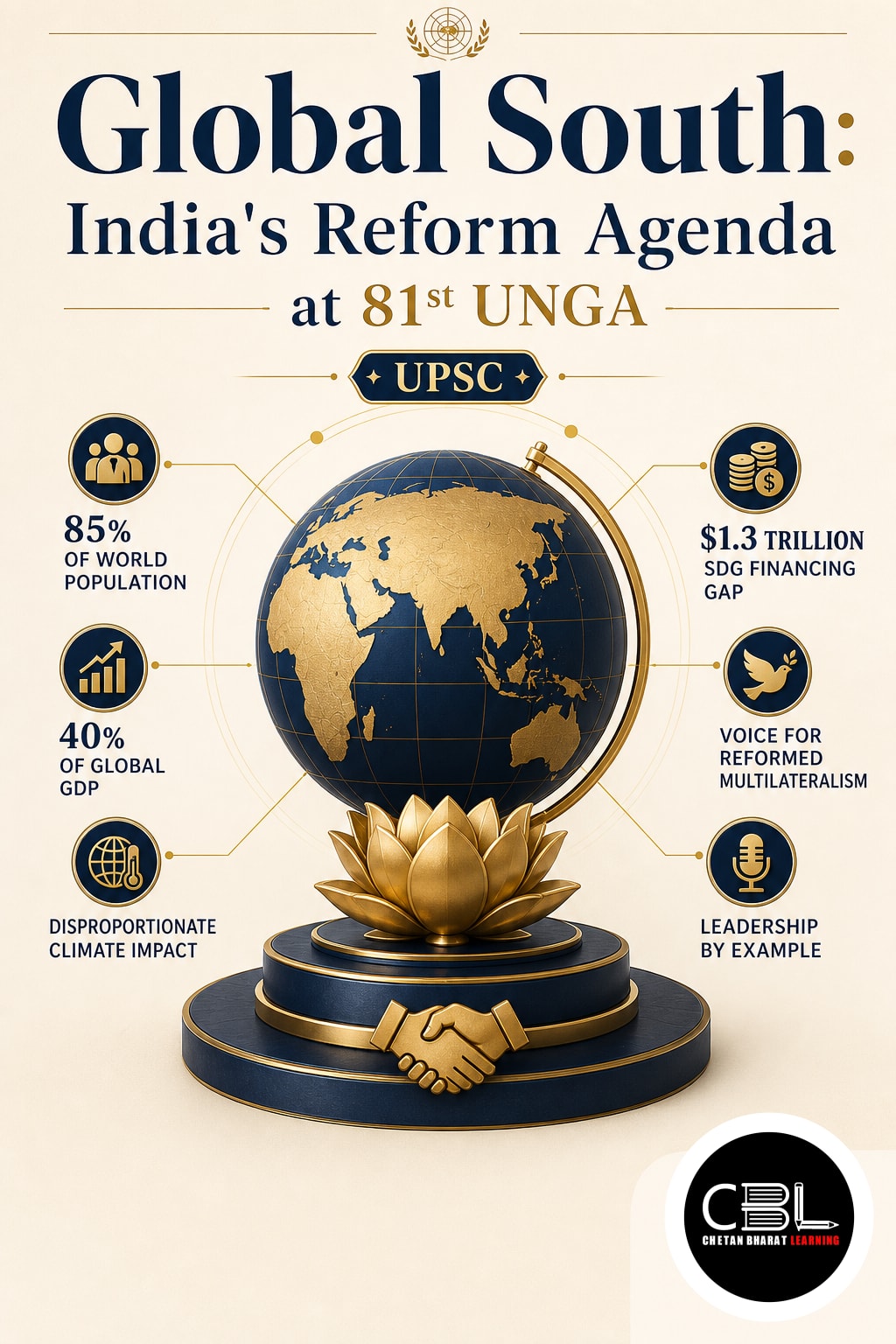
Global South priorities returned to attention when India’s External Affairs Minister addressed a meeting of like-minded developing countries and their partners alongside the 81st UNGA. India argued that developing societies require greater agency rather than merely receiving decisions shaped elsewhere. The intervention emphasised institutional representation, responsive multilateralism and practical cooperation on development challenges.
The discussion comes as developing economies contribute an increasingly important share of global production and merchandise trade. Their formal influence within financial and security institutions has not expanded at the same pace. India’s diplomatic approach, outlined through the Ministry of External Affairs, seeks to place development concerns and institutional reform at the centre of international negotiations.
Key Features
- Shared historical experience: Many participating countries experienced colonial rule, externally controlled trade and unequal resource extraction, shaping their continuing demands for sovereignty, policy autonomy and a fairer international economic order.
- Development-centred diplomacy: Members prioritise poverty reduction, food and energy security, affordable finance, resilient infrastructure, public health and technology access alongside conventional security and geopolitical questions.
- Diverse cooperative platforms: G77, NAM, BRICS, regional organisations and the G20 allow developing countries to coordinate positions without requiring every member to support an identical foreign policy agenda.
- Growing economic importance: Global South economies account for over two-fifths of world output and a substantial share of merchandise trade, yet financial vulnerabilities continue to restrict their policy choices.
- Indian leadership role: India uses its democratic credentials, development partnerships and strategic autonomy to connect differing interests while advocating reform without demanding rigid alignment against developed countries.
Challenges
- Unequal institutional power: Voting shares and leadership structures within major financial institutions often reflect older economic arrangements, while permanent membership of the UN Security Council remains unchanged despite contemporary geopolitical shifts.
- Debt and financing pressures: High borrowing costs, currency volatility and debt-servicing obligations can reduce fiscal space for education, health, climate adaptation and infrastructure in vulnerable developing economies.
- Limited negotiating capacity: Smaller countries may lack specialised diplomats, financial experts and technical data needed to participate effectively in complex negotiations involving taxation, digital governance, trade and climate finance.
- Internal diversity: Commodity exporters, manufacturing economies, least-developed countries and emerging powers frequently hold different positions on tariffs, energy transition, security partnerships and the design of development assistance.
- Fragmented cooperation: Overlapping forums may produce declarations without sustained implementation, making coordination, measurable outcomes and institutional continuity essential concerns within contemporary global affairs.
Way Forward
Global South cooperation should move from periodic consultations towards coordinated positions on debt, taxation, climate finance, digital public infrastructure and technology transfer. Platforms such as G77, BRICS and the Voice of Global South Summit can identify a practical common minimum agenda. Stronger research networks and negotiating support can help smaller economies participate on more equal terms.
Reform efforts should pursue broader representation within the UN Security Council and greater voice within international financial institutions. Countries can also expand South-South trade, regional connectivity, local-currency mechanisms and diversified supply chains without creating a closed economic bloc. Evidence published by UN Trade and Development supports a renewed focus on development policy, equitable finance and institutional agency.
Prelims Practice Corner
Q1. The expression used for developing countries across Asia, Africa, Latin America and the Caribbean primarily represents what?
(a) A military alliance (b) A treaty-based customs union (c) A broad political-economic category (d) A United Nations agency
Answer: (c) It is a broad category based on shared developmental and historical experiences.
Q2. Which of the following is primarily a grouping of developing countries within the United Nations system?
(a) G7 (b) G77 (c) OECD (d) NATO
Answer: (b) The G77 coordinates the economic and developmental interests of developing countries.
Q3. The Voice of Global South Summit is principally associated with which country?
(a) India (b) Canada (c) Japan (d) Germany
Answer: (a) India initiated the summit to gather and amplify developing-country perspectives.
Q4. Which issue is commonly associated with demands for reform of international financial institutions?
(a) Greater voting representation (b) Abolition of all currencies (c) Elimination of central banks (d) Creation of a world legislature
Answer: (a) Developing countries seek voting and governance arrangements reflecting contemporary economic realities.
Q5. South-South cooperation generally refers to collaboration among which countries?
(a) Developing countries (b) Arctic states only (c) Permanent UNSC members (d) European Union members
Answer: (a) It covers cooperation among developing countries through trade, technology and capacity-building.
Mains Practice Questions
Q1. Economic importance has not translated into proportionate institutional influence for developing countries. Discuss. (15 marks)
Answer Structure:
Intro: Mention the growing contribution of developing economies to global output and trade.
Body: Examine voting power, UNSC representation, debt, negotiating capacity, internal diversity and institutional fragmentation.
Conclusion: Recommend representative institutions supported by coordinated and practical developmental priorities.
Q2. Evaluate India’s role in strengthening the collective voice of developing countries in global governance. (10 marks)
Answer Structure:
Intro: Introduce India as a bridge between emerging economies and established global institutions.
Body: Cover the Voice summit, G20 presidency, BRICS, development partnerships, strategic autonomy and reform advocacy.
Conclusion: Link India’s credibility with inclusive leadership and delivery-oriented cooperation.
FAQs on Global South
Is this grouping a formal international organisation?
No, it is a broad political-economic category rather than a treaty-based organisation. Countries coordinate through platforms including G77, NAM, BRICS and regional institutions.
Why do developing countries demand multilateral reforms?
They argue that existing representation and voting structures reflect earlier economic and political realities. Reform could provide developing economies with greater influence over security, finance and development decisions.
What role does India seek to perform?
India seeks to amplify developing-country priorities through consultation, diplomatic coordination and practical development partnerships. Its approach combines institutional reform with cooperation on technology, finance, health and resilient infrastructure.
Related Current Affairs
Preparing for UPSC, PCS or HCS?
Talk to a mentor at Chetan Bharat Learning, Chandigarh. Free guidance on choosing the right exam and building a study plan.
Chat on WhatsAppCall 97793 53345UPSC / IAS / PCS coaching in Chandigarh · Trusted by aspirants across Punjab & Haryana
Leave a Reply
You must be logged in to post a comment.