

Important for
Developed By
- DRDO
- Surface-to-Air
- Up to 25 km
- First Export Customer: Armenia
What is Akash Missile System?
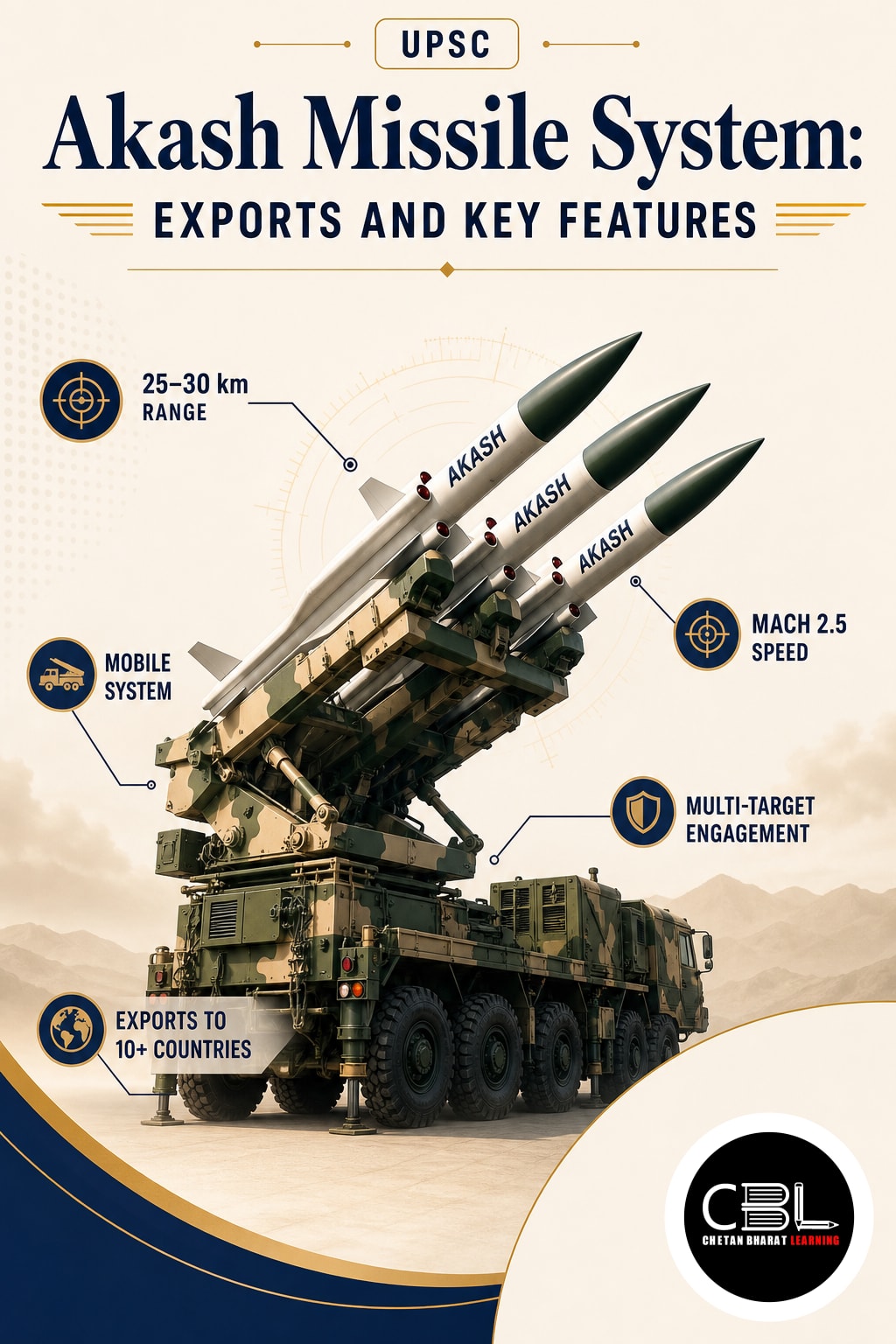
The Akash Missile System is an indigenously developed, mobile, short-range surface-to-air missile system designed to defend important military installations and operational areas against aerial attacks. DRDO developed it under the Integrated Guided Missile Development Programme (IGMDP), launched in 1983.
The system can engage targets such as fighter aircraft, helicopters and unmanned aerial vehicles. The standard Akash missile has an engagement range of approximately 4.5–25 km and can engage targets at altitudes reaching about 20 km, depending on operational conditions.
Akash was inducted into the Indian Air Force in 2014 and the Indian Army in 2015. It forms part of India’s layered air defence architecture, providing protection against short-range aerial threats.
Bharat Dynamics Limited (BDL) manufactures the missiles, while Bharat Electronics Limited (BEL) contributes radars and associated electronic systems. Other Indian public and private enterprises also participate in production, integration and maintenance.
Why in News?
On 1 October 2026, Defence Secretary Rajesh Kumar Singh confirmed that India had exported the Akash air defence system to Tajikistan and Turkmenistan, expanding its presence in Central Asia.
Armenia was the first foreign customer of Akash and had acquired multiple missile batteries. The subsequent exports to two Central Asian countries demonstrate growing international demand for India’s indigenous defence platforms.
The development was reported by The Times of India on 2 October 2026, citing the Defence Secretary’s confirmation.
The Union Cabinet had already approved exports of the Akash system in December 2020. The decision also established an institutional mechanism to accelerate approvals for exports of major indigenous defence platforms.
These exports hold significance for India’s defence manufacturing ecosystem and its strategic engagement with Central Asia. They also illustrate the transition from importing foreign military equipment towards developing and exporting selected indigenous defence technologies.
Key Features
- Surface-to-air capability: Akash is designed to intercept aerial threats rather than attack ground targets. It provides short-range protection to vulnerable military assets and strategic locations.
- Supersonic speed: The missile travels faster than the speed of sound, allowing rapid engagement of hostile aerial targets within its operational envelope.
- Multi-target engagement: The system can track and engage multiple aerial targets simultaneously using integrated surveillance, tracking and fire-control equipment.
- Rajendra radar: The standard Akash system uses the Rajendra three-dimensional Passive Electronically Scanned Array (PESA) radar for target tracking and missile guidance.
- Command guidance: The standard missile receives guidance commands from ground-based control systems, allowing the missile to adjust its flight towards an assigned target.
- Mobile deployment: Launchers, radars and control equipment are mounted on mobile platforms, allowing relocation and deployment according to operational requirements.
- Electronic counter-countermeasures: The system incorporates features intended to maintain operational effectiveness in the presence of hostile electronic interference.
- Indigenous manufacturing: DRDO developed the technology with Indian defence industries. The Ministry of Defence reported over 96% indigenous content when approving exports in 2020.
Major Variants of Akash
| Variant | Key Feature |
|---|---|
| Akash | Standard surface-to-air missile with approximately 25 km range and ground-based command guidance. |
| Akash Prime | Uses an indigenous active Radio Frequency seeker, combining command guidance with seeker-based terminal guidance for improved accuracy. |
| Akash-NG | Next-generation system with a canisterised configuration, indigenous RF seeker, multifunction radar and longer-range engagement capability. |
DRDO successfully completed the user evaluation trials of Akash-NG in December 2025. The trials included interception of targets under different range and altitude conditions, supporting progress towards induction.
The official DRDO product profile confirms the system’s mobile configuration, simultaneous target engagement capability and operational deployment with the Indian armed forces.
Challenges
- Changing aerial threats: Modern combat environments increasingly involve drones, cruise missiles and rapidly evolving aircraft technologies, requiring continuous improvements in air defence systems.
- Limited engagement range: The standard Akash system provides short-range air defence and must operate alongside other systems for comprehensive protection.
- Electronic warfare: Hostile jamming and sophisticated electronic countermeasures create challenges for radar detection, tracking and communications.
- Research requirements: Developing advanced seekers, radars, propulsion technologies and guidance systems requires sustained investment in defence research.
- Export competition: Indian manufacturers compete with established international defence companies offering integrated systems, financing arrangements and long-term maintenance contracts.
- Maintenance and support: International customers require training, spare parts, technical assistance and reliable logistical support throughout the system’s operational life.
Way Forward
India should continue investing in indigenous missile technology, advanced radar systems and seeker development. Sustained cooperation among DRDO, public-sector manufacturers, private industry and academic institutions can improve domestic technological capabilities.
The development and testing of Akash Prime and Akash-NG demonstrate the importance of continuous modernisation. Improved detection, accuracy and operational flexibility can help address evolving aerial threats.
Defence exports also require efficient production, quality assurance, after-sales maintenance and transparent approval procedures. The Ministry of Defence’s December 2020 announcement outlines the government’s framework for facilitating exports of the Akash system.
Expanding domestic research and industrial capacity can strengthen supply-chain resilience and generate opportunities for skilled employment. Related developments in technological investment can be studied through the analysis of India’s research and development expenditure.
The international expansion of the Akash Missile System reflects India’s progress in indigenous defence manufacturing. Its long-term significance will depend on continued technological innovation, reliable production and sustained cooperation with partner countries.
Prelims Practice Corner
Q1. The Akash missile system was developed under which programme?
- (a) National Quantum Mission
- (b) Mission Shakti
- (c) Integrated Guided Missile Development Programme
- (d) Gaganyaan Programme
Answer: (c) Akash was developed by DRDO under the Integrated Guided Missile Development Programme, which began in 1983.
Q2. Consider the following statements: 1. Akash is a surface-to-air missile system. 2. The standard Akash system uses ground-based command guidance. 3. Akash is designed primarily for attacking naval vessels. Which statements are correct?
- (a) 1 and 2 only
- (b) 2 and 3 only
- (c) 1 and 3 only
- (d) 1, 2 and 3
Answer: (a) Statements 1 and 2 are correct. Akash is an air defence system intended to intercept aerial targets, not primarily a naval strike missile.
Q3. Which country was the first foreign customer of India’s Akash air defence system?
- (a) Tajikistan
- (b) Turkmenistan
- (c) Vietnam
- (d) Armenia
Answer: (d) Armenia was the first foreign customer of Akash, followed by exports to Tajikistan and Turkmenistan.
Q4. Which radar is associated with the standard Akash missile system?
- (a) Rohini Doppler Radar
- (b) Rajendra PESA Radar
- (c) Green Pine Radar
- (d) Swordfish Long Range Tracking Radar
Answer: (b) The Rajendra Passive Electronically Scanned Array radar is used for target tracking and guidance in the standard Akash system.
Q5. Consider the following statements about Akash variants: 1. Akash Prime incorporates an indigenous active RF seeker. 2. Akash-NG is a next-generation system with a canisterised configuration. 3. Akash-NG uses the same guidance arrangement as the original Akash without technological changes. Which statements are correct?
- (a) 1 and 3 only
- (b) 2 and 3 only
- (c) 1 and 2 only
- (d) 1, 2 and 3
Answer: (c) Statements 1 and 2 are correct. The newer variants incorporate technological improvements, including indigenous RF seekers and updated guidance and radar capabilities.
Mains Practice Questions
Q1. India’s indigenous missile development programmes have strengthened national security and defence manufacturing. Discuss with reference to the Akash air defence system. (15 marks)
Answer Structure:
- Intro: Introduce Akash as an indigenous surface-to-air missile system developed by DRDO under IGMDP.
- Body: Discuss technological features, multi-target engagement, indigenous production, military modernisation, Akash Prime and Akash-NG, export opportunities and development challenges.
- Conclusion: Emphasise sustained research, industrial cooperation and modernisation to strengthen domestic defence capabilities.
Q2. Examine how indigenous defence exports can strengthen India’s technological capabilities and strategic partnerships. Illustrate with the Akash missile system. (10 marks)
Answer Structure:
- Intro: Explain the significance of indigenous defence exports for technological self-reliance and international cooperation.
- Body: Cover exports to Armenia, Tajikistan and Turkmenistan, India’s defence manufacturing ecosystem, employment, diplomatic engagement, global competition and maintenance requirements.
- Conclusion: Highlight the importance of quality manufacturing, sustained innovation and reliable long-term partnerships.
Frequently Asked Questions
What is the Akash missile system and who developed it?
Akash is an indigenous short-range surface-to-air missile system developed by DRDO under the Integrated Guided Missile Development Programme. It protects strategic locations and military assets from aircraft and other aerial threats.
Which countries have imported India’s Akash air defence system?
Armenia was the first foreign customer of Akash. In October 2026, India’s Defence Secretary confirmed that the system had also been exported to Tajikistan and Turkmenistan.
What is the difference between Akash, Akash Prime and Akash-NG?
The standard Akash uses ground-based command guidance and has a range of approximately 25 km. Akash Prime incorporates an indigenous active RF seeker for improved accuracy, while Akash-NG is a next-generation system with updated radar, seeker and deployment capabilities.
Related Current Affairs
Preparing for UPSC, PCS or HCS?
Talk to a mentor at Chetan Bharat Learning, Chandigarh. Free guidance on choosing the right exam and building a study plan.
Chat on WhatsAppCall 97793 53345UPSC / IAS / PCS coaching in Chandigarh · Trusted by aspirants across Punjab & Haryana
Leave a Reply
You must be logged in to post a comment.