

UPSC Mapping
- Prelims: Economy
- Mains: GS Paper 3
Quick Facts
| Introduced | 2004 by RBI |
|---|---|
| Annual Limit | USD 250,000 per person |
| Regulatory Basis | FEMA |
Article
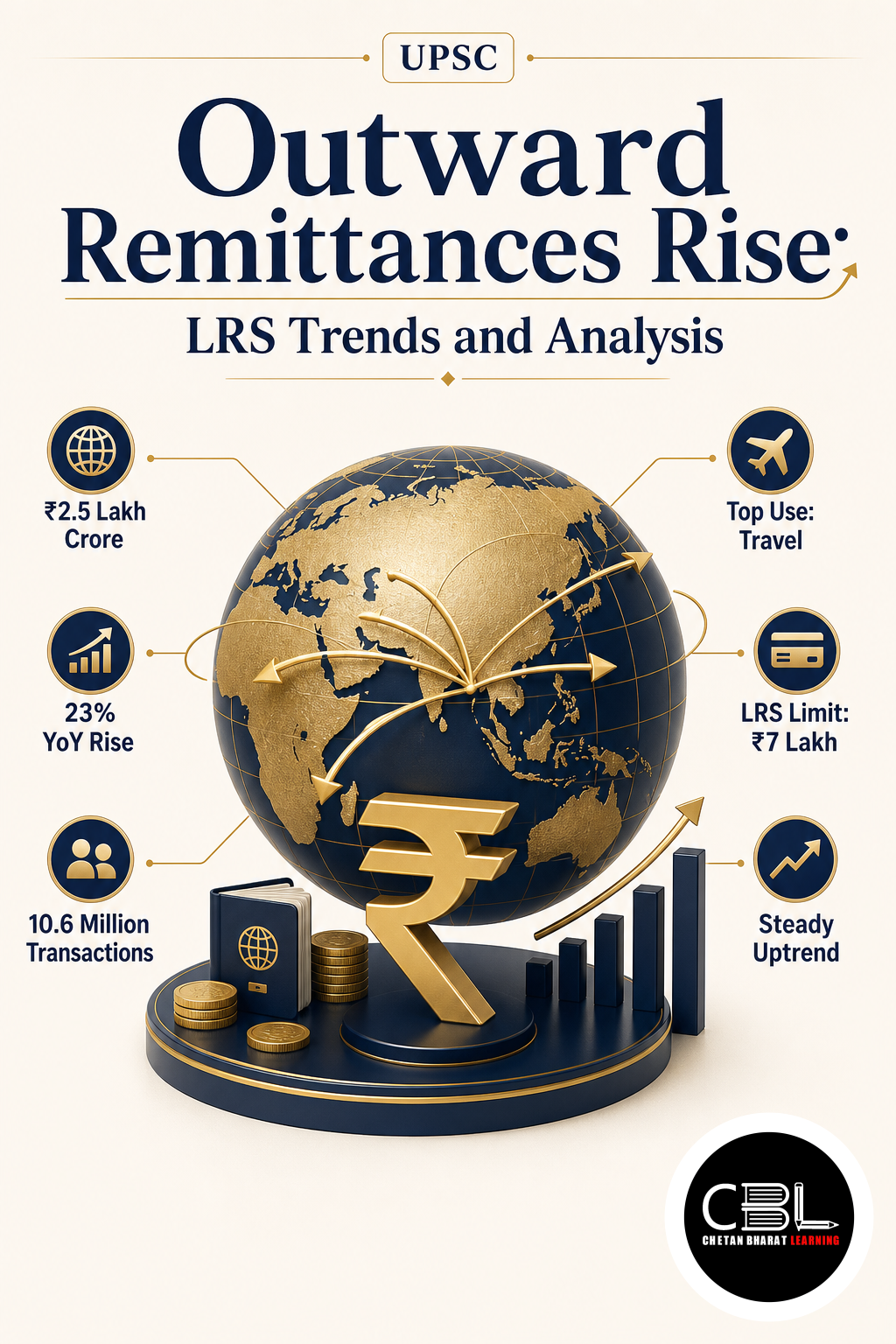
India’s outward remittances rose significantly in June 2026, driven by travel and overseas investments, according to RBI data. Total transfers increased 6.46% month-on-month to $2.55 billion, highlighting growing global financial integration.
For more on economic indicators, visit our daily current affairs archive.
What are Outward Remittances?
Outward remittances refer to transfers of funds by resident individuals to foreign countries for permitted current or capital account transactions. The Liberalised Remittance Scheme (LRS) of the RBI facilitates these transfers, allowing up to $250,000 per financial year.
This scheme, introduced in 2004, is a key pillar of India’s capital account liberalisation. It enables residents to invest abroad, pay for education, travel, and medical treatment, and support family members overseas.
Why are Outward Remittances in News?
The RBI’s latest data for June 2026 shows a sharp rise in outward remittances, reaching $2.55 billion, a 6.46% increase over May. Travel-related transfers accounted for more than half of total remittances, with education-related travel rising 15.4% and investments in equity and debt up 25.6%.
This surge reflects increased global mobility and investment appetite among Indian residents. According to a PIB release, the RBI monitors these flows to ensure macroeconomic stability and compliance with foreign exchange regulations.
Key Features of Outward Remittances under LRS
- Comprehensive Coverage: Permits both current account (travel, education, medical) and capital account (equity, debt, property) transactions.
- Unified Limit: The $250,000 annual ceiling applies to all transactions combined, not per category.
- Ease of Process: Authorised dealers (banks) handle remittances with minimal documentation.
- Wide Eligibility: All resident individuals, including minors (with guardian consent), can remit under LRS.
- Prohibited Uses: Remittances are not allowed for lottery, gambling, or purchasing foreign currency for speculative purposes.
Challenges and Concerns with Rising Outward Remittances
While rising outward remittances reflect economic prosperity, they also pose certain challenges. For a broader understanding of capital flow management, refer to our analysis on current account deficit trends.
- Capital Flight Concerns: Large outflows could put pressure on the rupee and foreign exchange reserves, especially during global uncertainty.
- Macroeconomic Impact: Sustained high remittances may widen the current account deficit, affecting external stability.
- Regulatory Leakages: Ensuring compliance and preventing misuse of the scheme for money laundering remains a challenge.
- Volatility: Sudden spikes or drops in remittances can disrupt balance of payments projections.
- Inequality: The scheme primarily benefits wealthier individuals, potentially widening domestic disparities.
Way Forward for Managing Outward Remittances
To balance benefits and risks, the RBI must continue monitoring trends while ensuring policy flexibility. Streamlining reporting mechanisms and enhancing awareness about permissible uses can improve compliance.
Promoting productive investments—such as in education and healthcare—over speculative outflows can enhance long-term gains. As suggested by a RBI circular, periodic reviews of the LRS limit and guidelines are essential to align with evolving economic conditions.
Prelims Practice Corner
Q1. What is the annual limit for outward remittances under the Liberalised Remittance Scheme (LRS) for resident individuals?
(a) $100,000 (b) $250,000 (c) $500,000 (d) $1,000,000
Answer: (b) The LRS allows remittances up to USD 250,000 per financial year.
Q2. Which of the following is NOT permitted under the LRS?
(a) Investment in overseas equity (b) Purchase of immovable property abroad (c) Remittance for lottery winnings (d) Educational expenses
Answer: (c) Remittances for lottery or gambling are prohibited under LRS.
Q3. In June 2026, what was the largest component of outward remittances under LRS?
(a) Investment in equity (b) Travel (c) Gifts (d) Medical treatment
Answer: (b) Travel-related remittances accounted for more than half of total LRS outflows.
Q4. The Liberalised Remittance Scheme was introduced by the RBI in which year?
(a) 1999 (b) 2004 (c) 2010 (d) 2015
Answer: (b) The LRS was introduced in 2004.
Q5. Outward remittances under LRS are governed by which legislation?
(a) RBI Act, 1934 (b) FEMA, 1999 (c) SEBI Act, 1992 (d) Banking Regulation Act, 1949
Answer: (b) The LRS operates under the Foreign Exchange Management Act (FEMA), 1999.
Mains Practice Questions
Q1. “Rising outward remittances under the LRS reflect both opportunities and challenges for the Indian economy.” Discuss. (15 Marks)
Answer Structure:
- Intro: Define LRS and its significance in India’s capital account liberalisation.
- Body: Discuss benefits (portfolio diversification, global exposure) and risks (capital flight, CAD impact, regulatory concerns). Include recent trends and RBI’s balancing role.
- Conclusion: Suggest policy measures to harness benefits while mitigating risks.
Q2. Examine the role of the RBI in regulating cross-border capital flows through schemes like LRS. (10 Marks)
Answer Structure:
- Intro: Briefly describe the RBI’s mandate in managing foreign exchange.
- Body: Explain the LRS framework, monitoring mechanisms, and recent adjustments. Discuss the trade-off between liberalisation and macroeconomic stability.
- Conclusion: Emphasise the need for dynamic regulation in a globalised economy.
FAQs on Outward Remittances
What is the Liberalised Remittance Scheme (LRS)?
The LRS is a RBI scheme that allows resident individuals to remit up to $250,000 per financial year for any permitted current or capital account transaction, including travel, education, investment, and gifts.
Why did outward remittances increase in June 2026?
The rise was driven by increased travel, especially for education, and a surge in overseas equity and debt investments, reflecting growing global mobility and investment appetite.
Can LRS remittances be used for real estate purchase abroad?
Yes, LRS permits remittances for purchasing immovable property abroad, subject to the overall annual limit and compliance with foreign exchange regulations.
Related Current Affairs
Preparing for UPSC, PCS or HCS?
Talk to a mentor at Chetan Bharat Learning, Chandigarh. Free guidance on choosing the right exam and building a study plan.
Chat on WhatsAppCall 97793 53345UPSC / IAS / PCS coaching in Chandigarh · Trusted by aspirants across Punjab & Haryana
Leave a Reply
You must be logged in to post a comment.