
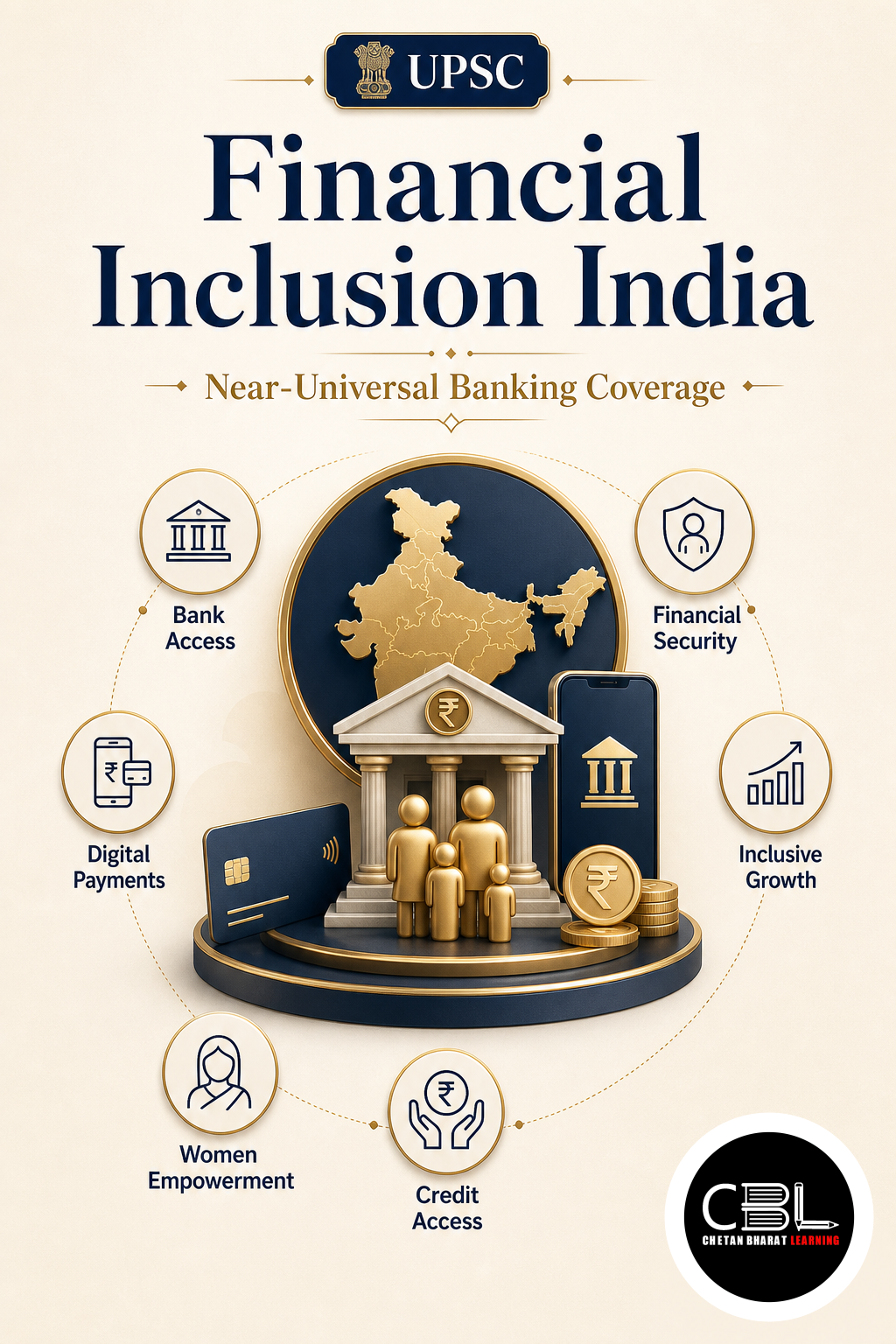
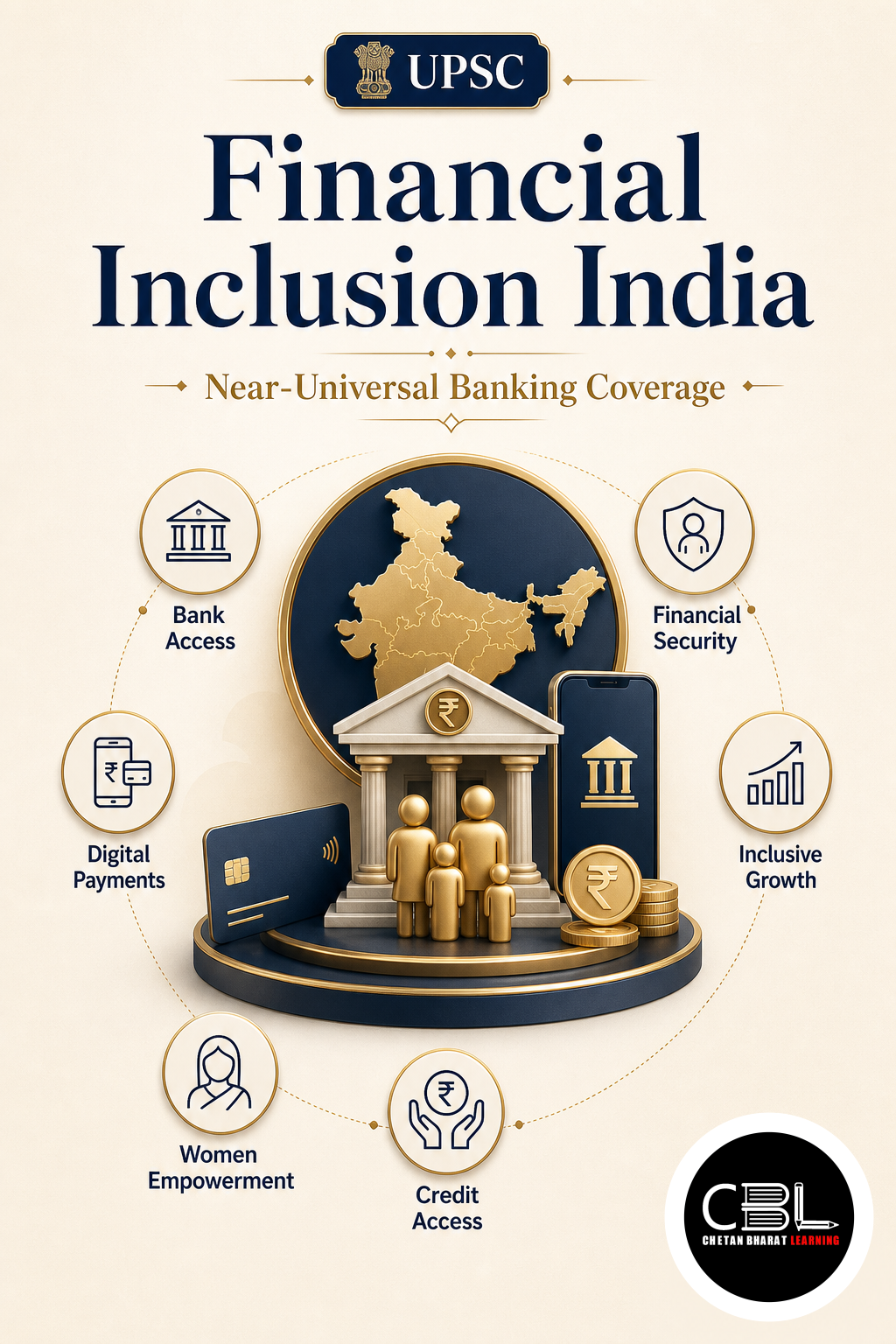
UPSC Mapping
- Prelims: PMJDY, Business Correspondents, IPPB
- Mains: GS Paper III – Indian Economy & Financial Inclusion
Quick Facts
| Coverage | 99.92% of inhabited villages |
|---|---|
| Bank Branches | 1.81 lakh |
| Business Correspondents | 17.36 lakh |
| PMJDY Accounts | 58.77 crore |
Article
What is Financial Inclusion India?
Financial Inclusion India refers to ensuring affordable access to formal banking, credit, savings, insurance and digital financial services for every citizen. The recent achievement of banking access within a 5 km radius for nearly all inhabited villages highlights the country’s progress toward inclusive development.
Banking services are delivered through a combination of bank branches, Business Correspondents (Bank Saathis) and India Post Payments Bank (IPPB) centres. This multi-channel approach improves last-mile connectivity, especially in rural and remote regions.
Why is Financial Inclusion India in News?
According to the Government, India has achieved 99.92% banking coverage for inhabited villages within a 5 km radius. This milestone reflects significant expansion of banking infrastructure and sustained efforts toward financial inclusion.
The achievement has been supported by a wide banking network, PM Jan Dhan Yojana, digital banking initiatives and Business Correspondents. Details are available through the Press Information Bureau.
Key Features
- Extensive Banking Network: The country has around 1.81 lakh bank branches serving urban and rural populations.
- Business Correspondents: About 17.36 lakh Bank Saathis provide essential banking services in branchless and remote areas.
- India Post Payments Bank: Nearly 1.65 lakh IPPB centres strengthen last-mile banking access.
- PM Jan Dhan Yojana: Around 58.77 crore accounts with deposits exceeding ₹3.12 lakh crore demonstrate growing use of formal banking.
- Branch Expansion Policy: RBI allows eligible banks to open branches without prior approval, subject to establishing 25% of new branches in unbanked rural areas.
Challenges
- Digital Literacy: Many rural customers require greater awareness of digital banking services.
- Cyber Fraud: Expanding digital transactions increases the need for stronger cyber security measures.
- Last-mile Service Quality: Banking infrastructure must continue improving in remote regions.
- Credit Accessibility: Small farmers and micro-enterprises still face challenges in accessing affordable institutional credit.
- Financial Awareness: Continued education is necessary for safe and responsible use of banking services.
Way Forward
India can further strengthen Financial Inclusion India by expanding digital infrastructure, enhancing cyber resilience and improving financial literacy. Integrating digital platforms such as Jan Samarth Portal, KRISHIKA and the Kisan Rin Portal can improve access to agricultural credit.
Cyber security initiatives like the India Digital Payment Intelligence Corporation (IDPIC), which uses AI, Machine Learning and Big Data Analytics for fraud detection, along with RBI’s awareness campaigns, will help build greater trust in digital banking.
Related Current Affairs
Preparing for UPSC, PCS or HCS?
Talk to a mentor at Chetan Bharat Learning, Chandigarh. Free guidance on choosing the right exam and building a study plan.
Chat on WhatsAppCall 97793 53345UPSC / IAS / PCS coaching in Chandigarh · Trusted by aspirants across Punjab & Haryana
Leave a Reply
You must be logged in to post a comment.