
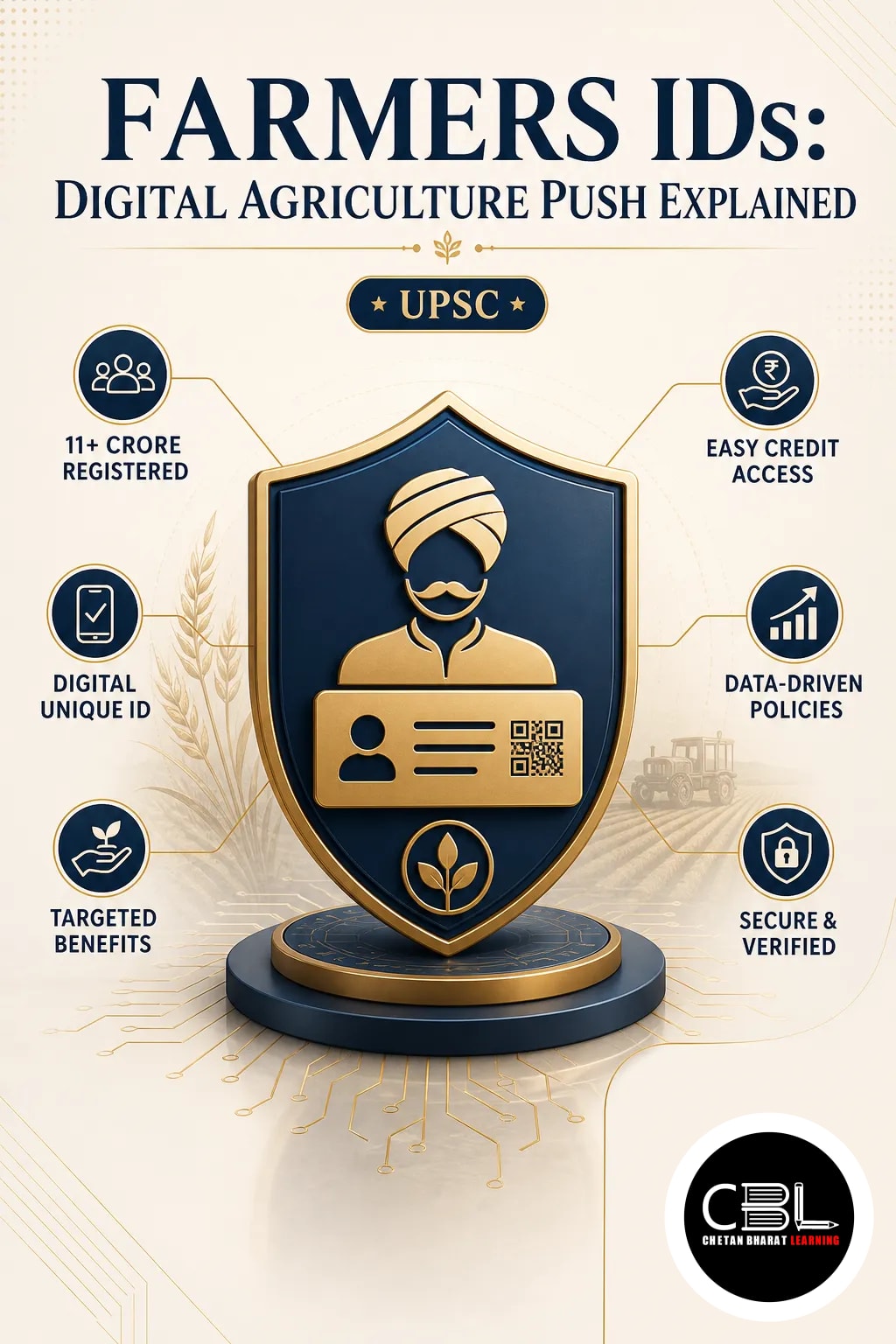
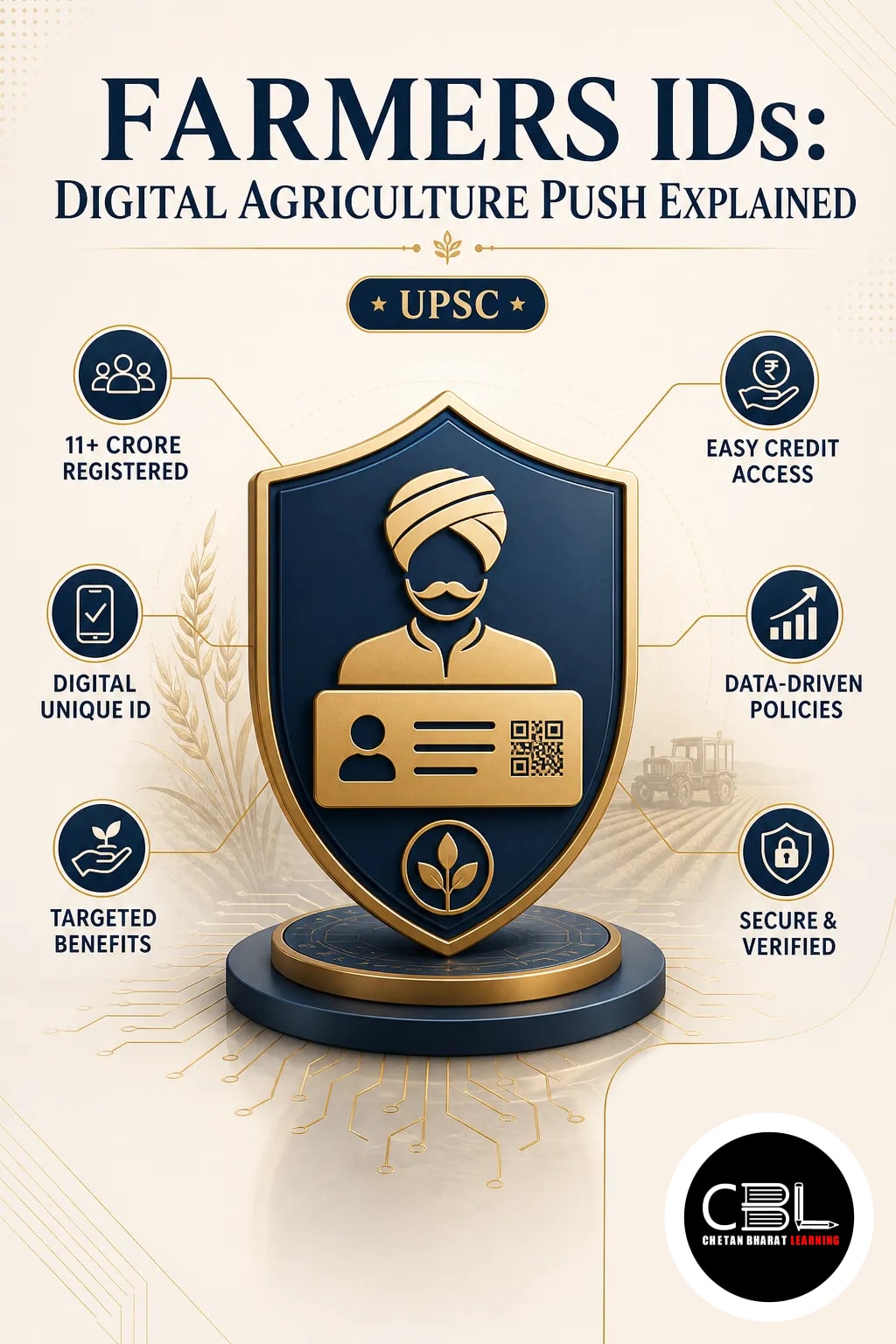
Farmers IDs have become a major part of India’s digital agriculture push, with agriculture governance updates now focusing on unique identification for cultivators. The reported expansion to 11 crore farmers signals a large-scale shift in how farm records, benefits, and service delivery may be organised.
What is Farmers IDs?
Farmers IDs refer to unique digital identities assigned to cultivators for use in agricultural databases and service delivery systems. In practice, such IDs can help the state link a farmer to land records, subsidy channels, and scheme eligibility.
This idea fits the broader move toward agri-stack style digital public infrastructure. It aims to reduce duplication, improve verification, and make agricultural data easier to use for policy.
Why in News?
The report says the government has given unique IDs to 11 crore farmers under a major digital agriculture push. This marks a large-scale attempt to build a unified identity base for farm-related administration.
Such coverage matters because agricultural schemes often depend on accurate beneficiary records. A common digital identity can also support faster targeting and cleaner data matching across departments.
Key Features
- Unique identification – Each registered farmer gets a distinct ID, helping avoid repeat entries and record overlap.
- Scheme linkage – The ID can be used to connect a farmer with subsidies, advisories, and welfare benefits.
- Digital recordkeeping – It supports more organised storage of farm-related information in electronic form.
- Service targeting – Officials can identify eligible farmers more quickly when benefits are designed around verified records.
- Policy planning – Better data can help governments understand landholding patterns, cropping needs, and service gaps.
Challenges
- Data accuracy – If land records or personal details are incomplete, the ID system may carry errors.
- Coverage gaps – Tenant farmers, sharecroppers, and women farmers may remain under-recorded in some areas.
- Digital divide – Farmers with limited internet access or low digital literacy may struggle to use linked services.
- Privacy concerns – Large datasets raise questions about security, consent, and responsible data sharing.
- Inter-department coordination – The system will work well only if revenue, agriculture, and welfare databases remain aligned.
Way Forward
India should ensure that farmers IDs remain updated through regular verification and local-level support. The system must also include grievance redressal so farmers can correct wrong or missing entries.
Alongside scale, the government needs strong data protection, better interoperability, and inclusion of small and marginal farmers. That will make the digital agriculture push more useful for both welfare delivery and long-term planning.
Source: Indian Express India, 24 Oct 2026
- Agri Welfare Portal 2026: Features and UPSC Analysis (21 Oct 2026)
- Agrivision 2026 Convention: Key Highlights (15 Oct 2026)
This topic is relevant for state PCS because Punjab and Haryana have large agrarian populations and extensive subsidy-based administration. Questions may connect farmers IDs with land record reforms, e-governance, and improved delivery of agricultural schemes at the district level.
FAQ
Are farmers IDs the same as land titles?
No. Farmers IDs identify the cultivator, while land titles relate to ownership or recorded rights. The two systems can be linked, but they serve different administrative purposes.
Why are farmers IDs useful for welfare schemes?
They can help the government verify beneficiaries more efficiently and reduce duplicate or incorrect entries. This can improve subsidy delivery, advisories, and record-based planning.
What is the main concern with large farmer databases?
The main concerns are accuracy, exclusion, and privacy. If records are incomplete or poorly updated, the system may miss vulnerable farmers or create wrong linkages.
Related Current Affairs
Preparing for UPSC, PCS or HCS?
Talk to a mentor at Chetan Bharat Learning, Chandigarh. Free guidance on choosing the right exam and building a study plan.
Chat on WhatsAppCall 97793 53345UPSC / IAS / PCS coaching in Chandigarh · Trusted by aspirants across Punjab & Haryana
Leave a Reply
You must be logged in to post a comment.