

UPSC Mapping
- Prelims: Economy
- Mains: GS Paper 2 & GS Paper 3
Quick Facts
| Graduate Unemployment | 13% (20.4% for women) |
|---|---|
| Enrolment in Generic Degrees | 2 crore+ (BA, BSc, BCom) |
| NEET Youth (15–29) | 8.7 crore (11% of population) |
What is Education-Employment Mismatch?
Education-employment mismatch occurs when workers’ qualifications, skills, or training do not align with the requirements of their jobs. This can manifest as overqualification, underqualification, or skill gaps relative to industry demands.
The NITI Aayog report highlights that India’s higher education system faces a fundamental disconnect between what is taught and what the labour market demands. Outdated curricula and an overwhelming inclination toward generic degree programmes with weak job linkages contribute significantly to this problem.
Why Is It in the News?
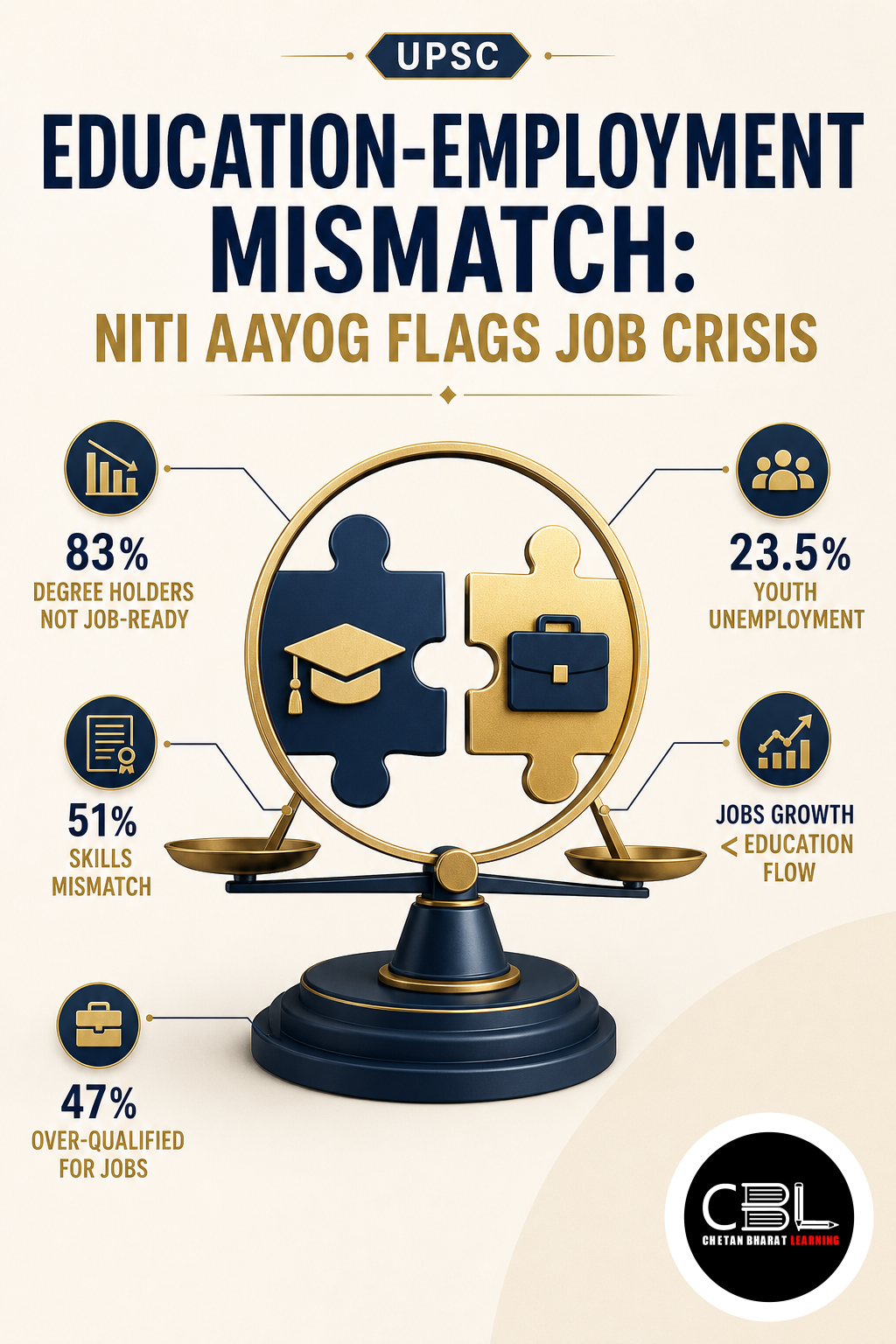
The NITI Aayog report Reimagining Skilling for Viksit Bharat cites Economic Survey 2024-25 data showing only 8.25% of graduates work in roles aligned to their qualifications. Finance Minister Nirmala Sitharaman has called for a revamp of the skilling architecture to bridge this divide.
Key Features of India’s Education-Employment Challenge
- Generic Degree Overload: Over 2 crore students pursue BA, BSc, and BCom programmes with limited job linkages.
- Skill Gap: A mismatch between acquired skills and employer demands, especially in digital and practical domains.
- Low Employability: Only 8.25% of graduates are in jobs matching their qualifications.
- Social Stigma: Vocational training and ITI programmes are viewed as ‘second-tier’, deterring technical skill uptake.
- Awareness Deficit: Lack of information on suitable courses and training programmes.
Challenges in Addressing the Mismatch
- Outdated Curriculum: Institutional curricula are often misaligned with evolving industry needs.
- Quality Disparities: Wide variations in educational standards across institutions.
- Fragmented Skill Ecosystem: Multiple uncoordinated skilling schemes across ministries.
- Digital Divide: Limited digital infrastructure in rural areas hampers skill delivery.
- Gender Disparity: Higher unemployment among female graduates (20.4%).
Way Forward
Transition from supply-driven to demand-driven, outcome-linked models. Align curricula with industry needs, expand apprenticeships, and promote vocational training. Strengthen public-private partnerships and leverage technology. Focus on specialised, job-linked programmes in growth sectors such as green industries and electric vehicles.
Prelims Practice Corner
-
According to the NITI Aayog report, what percentage of graduates are employed in roles aligned with their qualifications?
- 8.25%
- 13%
- 20.4%
- 90%
Answer: (a) 8.25%
-
What is the unemployment rate among graduate women in India?
- 3.2%
- 13%
- 20.4%
- 25%
Answer: (c) 20.4%
-
What does NEET stand for?
- National Entrance Eligibility Test
- Not in Education, Employment or Training
- National Employment and Education Training
- New Education and Employment Targets
Answer: (b) Not in Education, Employment or Training
-
Which factor contributes to the mismatch?
- Over-reliance on vocational training
- Outdated curriculum and weak industry linkages
- Excessive focus on technical education
- High enrolment in skill development programmes
Answer: (b) Outdated curriculum and weak industry linkages
-
What is the average starting salary difference with skilling?
- Rs 5,000
- Rs 7,000
- Rs 10,000
- Rs 15,000
Answer: (b) Rs 7,000
Mains Practice Questions
-
“India’s education-employment mismatch threatens its demographic dividend and requires urgent systemic reforms.” Discuss. (15 Marks)
Structure: Intro (define mismatch), Body (causes, consequences, policy responses), Conclusion (recommend comprehensive approach).
-
Examine the role of NITI Aayog in addressing India’s skilling challenges. (10 Marks)
Structure: Intro (mandate), Body (recommendations, demand-driven models, industry linkages), Conclusion (need for coordination).
FAQs on Education-Employment Mismatch
- What is education-employment mismatch? It occurs when qualifications and skills do not align with job requirements, leading to overqualification, underqualification, or skill gaps.
- Why is it a concern for UPSC? It impacts India’s demographic dividend, economic growth, and social stability—key topics in GS Papers 2 & 3.
- What are NITI Aayog’s recommendations? Shift to demand-driven skilling, specialised job-linked programmes, stronger apprenticeships, and reduce stigma around vocational training.
Related Current Affairs
Preparing for UPSC, PCS or HCS?
Talk to a mentor at Chetan Bharat Learning, Chandigarh. Free guidance on choosing the right exam and building a study plan.
Chat on WhatsAppCall 97793 53345UPSC / IAS / PCS coaching in Chandigarh · Trusted by aspirants across Punjab & Haryana
Leave a Reply
You must be logged in to post a comment.