
UPSC Mapping
| Prelims | Economy & Social Justice |
|---|---|
| Mains | GS Paper 3 (Economic Development & Social Justice) |
Quick Facts
| Demographic Dividend | Large working-age population |
|---|---|
| Key Requirement | Skills + Education + Productive Employment |
Article
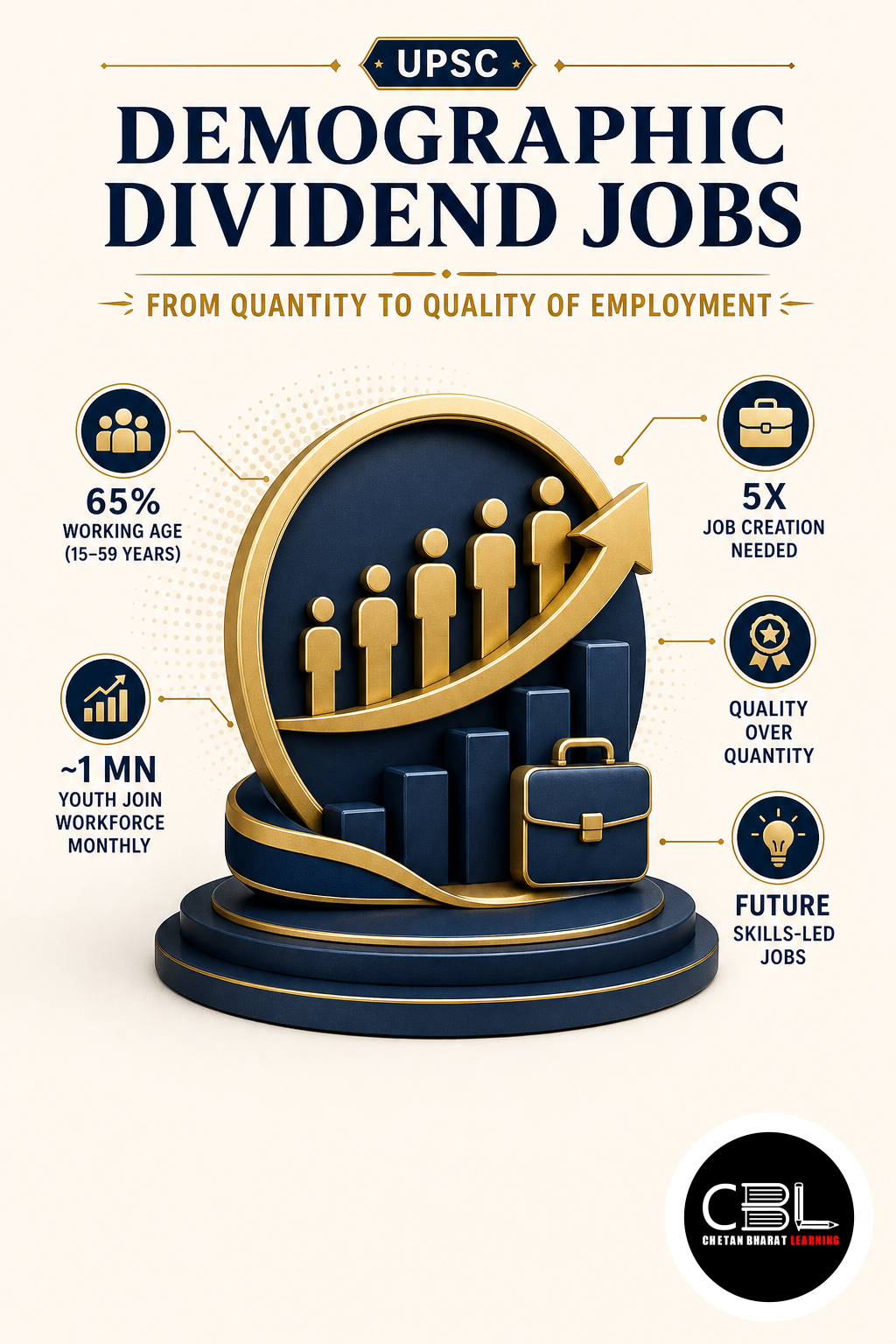
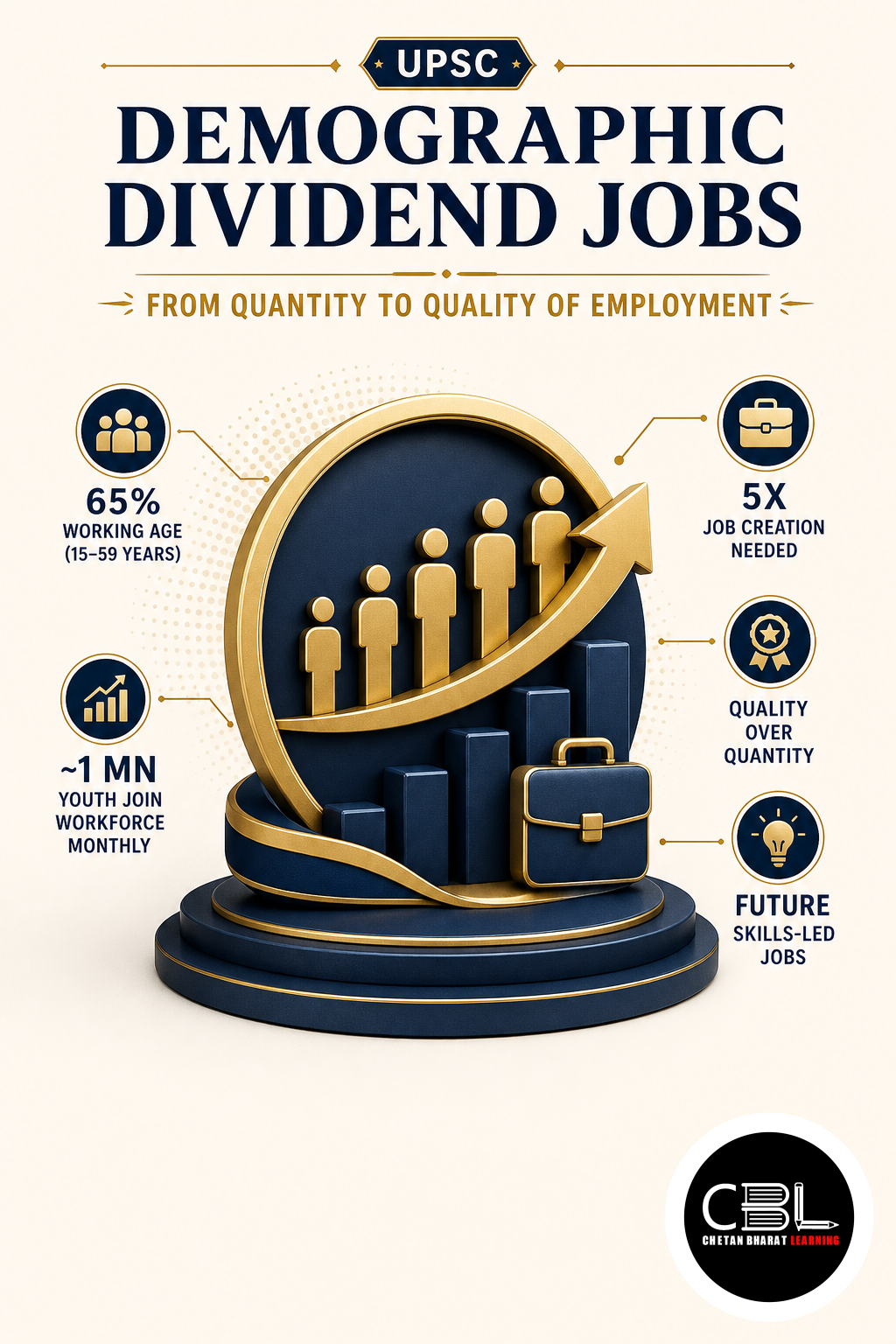
Demographic Dividend Jobs refers to the employment potential of India’s large young population. The demographic dividend offers economic growth when the share of the working-age population is large compared to dependants. However, realising this potential requires quality education, relevant skills, and productive employment—otherwise it can become a demographic burden.
Why is it in the News?
The topic has gained prominence due to the gap between youth aspirations and available jobs. Many educated young Indians lack the skills demanded by industry. The shift from agriculture to services and manufacturing is not generating enough formal, productive employment. Debate has moved from ‘how many jobs’ to ‘what kind of jobs’, focusing on job quality, underemployment, wage levels, skill mismatches, and formalisation.
Key Features
- Quality over Quantity: Emphasis on formal, well-paid, and productive jobs.
- Skills Mismatch: Education and training often do not align with industry needs.
- Informality: A large share of employment is informal, lacking social security.
- Underemployment: Many workers are in roles below their skill level.
- Regional Disparities: Job creation is uneven across states.
Challenges
- Education-Employment Gap: Curricula are often outdated and misaligned with market requirements.
- Skill Mismatch: Graduates frequently lack practical and technical competencies.
- Informal Economy: Most jobs are informal, offering low wages and no social security.
- Gender Gap: Women’s labour force participation remains low.
- Job Quality: Even newly created jobs are often of poor quality.
Way Forward
India must reform education to make it industry-relevant, expand vocational training, and promote formalisation. Simplifying labour laws can encourage formal job creation while protecting worker rights. Promoting labour-intensive sectors—such as textiles, tourism, and construction—can boost employment. Strengthening social security for informal workers through schemes like e-Shram is essential.
Prelims Practice Corner
- Q1. What is the demographic dividend?
- (a) Population decline
- (b) Economic growth from a large working-age population
- (c) Increase in elderly population
- (d) High dependency ratio
Answer: (b)
- Q2. What is job quality?
- (a) Number of jobs
- (b) Formal, well-paid, and productive employment
- (c) Only public sector jobs
- (d) Only high-tech jobs
Answer: (b)
- Q3. What is a key reason for the education-employment gap?
- (a) Too many jobs
- (b) Curricula not matching industry needs
- (c) Low literacy
- (d) High dropout rates
Answer: (b)
- Q4. Which scheme registers informal sector workers?
- (a) PMJDY
- (b) e-Shram
- (c) UPI
- (d) GeM
Answer: (b)
- Q5. Why is women’s labour force participation important?
- (a) It reduces the population
- (b) It boosts economic growth and reduces inequality
- (c) It increases dependency
- (d) It has no impact
Answer: (b)
Mains Practice Questions
- Q1. Discuss the challenges in converting India’s demographic dividend into quality employment. (250 words, 15 marks)
Answer Structure: Intro; Body: education-employment gap, skill mismatch, informality, gender gap; Conclusion: need comprehensive employment strategy.
- Q2. What is the difference between employment and employability? (150 words, 10 marks)
Answer Structure: Intro: define both; Body: employment vs employability; Conclusion: employability as foundation for quality employment.
FAQs
- What is the demographic dividend? Economic growth potential from a large working-age population, requiring education and employment.
- Why is job quality important? Quality jobs (formal, well-paid, productive) are essential for sustainable growth and reducing inequality.
- What is the education-employment gap? The mismatch between what is taught in education and what is needed in the job market.
Related Current Affairs
Preparing for UPSC, PCS or HCS?
Talk to a mentor at Chetan Bharat Learning, Chandigarh. Free guidance on choosing the right exam and building a study plan.
Chat on WhatsAppCall 97793 53345UPSC / IAS / PCS coaching in Chandigarh · Trusted by aspirants across Punjab & Haryana
Leave a Reply
You must be logged in to post a comment.