
UPSC Mapping
| Exam | Topic |
|---|---|
| Prelims | Economy & Governance |
| Mains | GS Paper 3 (Economic Development & Governance) |
| Key Concept | Expertise vs Accountability |
|---|---|
| Risk Mitigation | Disclosure, recusal, transparency |
What is Deep Tech Fund India?
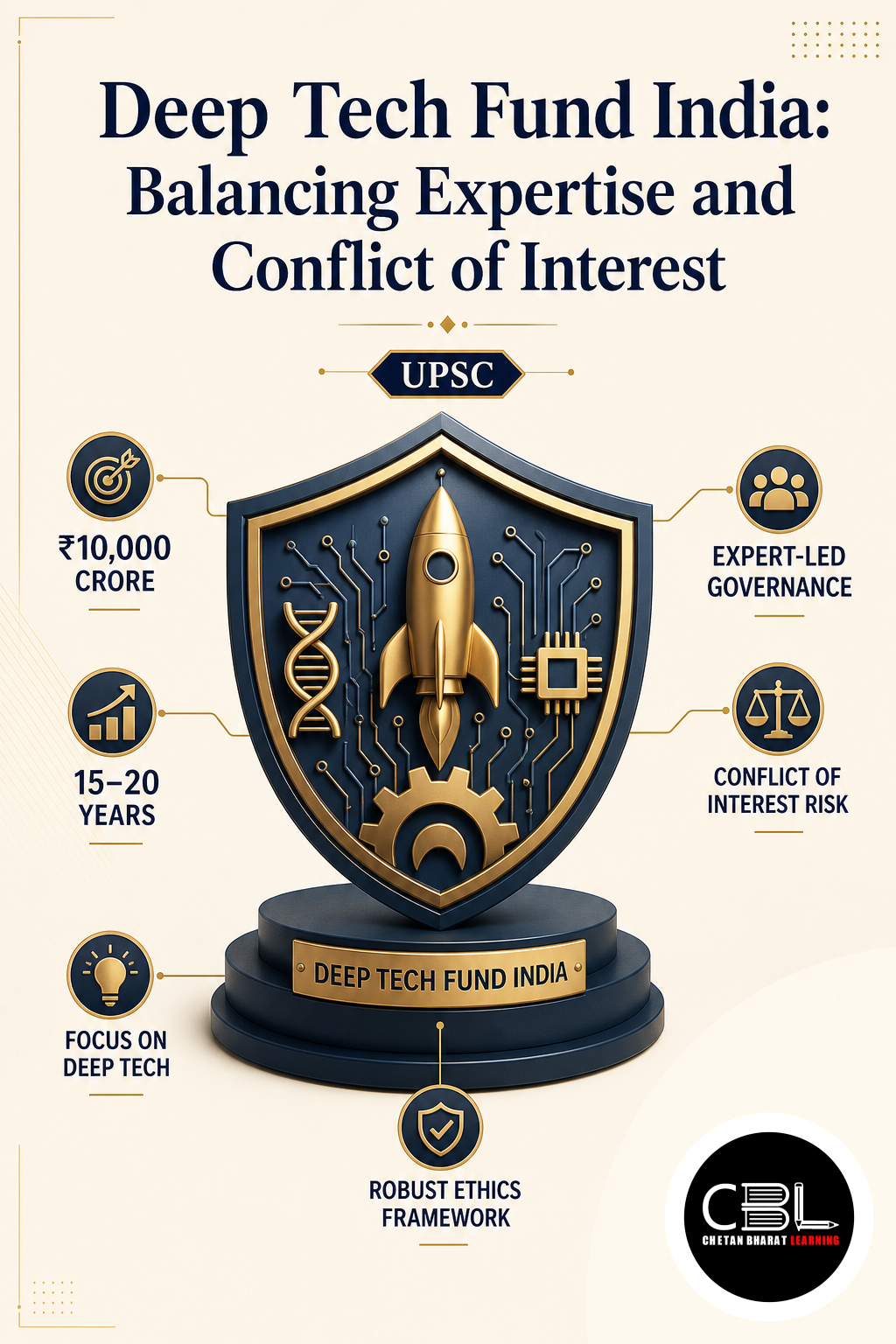
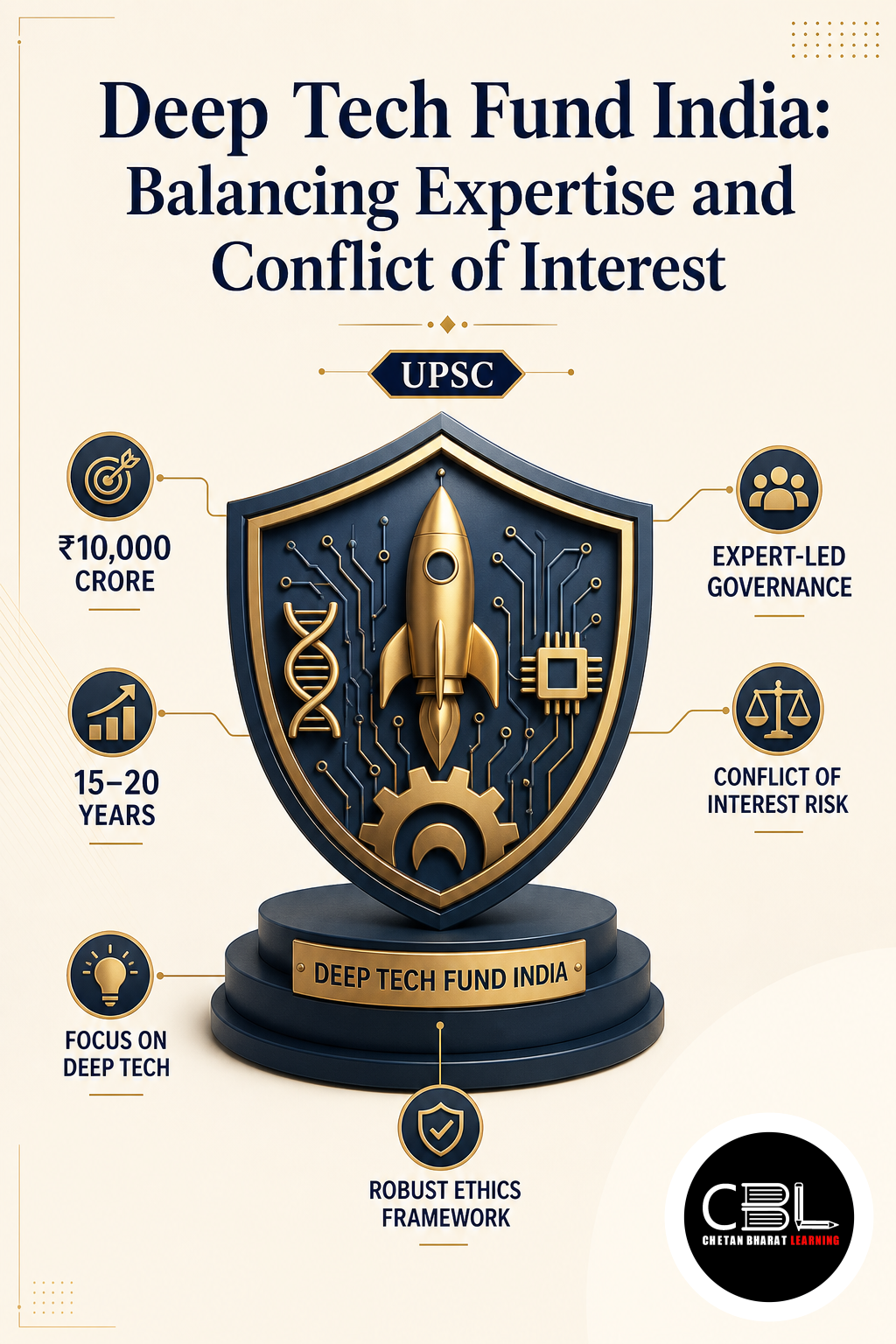
Deep Tech Fund India refers to the government’s Research and Development Innovation (RDI) Fund, designed to support deep-tech sectors such as semiconductors, AI, biotech, and advanced materials. Deep tech is based on scientific and engineering innovation, but commercialising it requires long-term capital and patient investment. Private investors often avoid high-risk, long-gestation technologies, creating a funding gap that government funds aim to fill.
The RDI Fund brings together technical experts to evaluate proposals, but their industry connections raise concerns about potential conflicts of interest. The core dilemma is balancing the need for specialised expertise with the need for accountability and transparency.
Why is Deep Tech Fund India in News?
Deep Tech Fund India is in the news because of the debate over the industry connections of its members. Experts argue that deep-tech sectors require specialised technical knowledge to distinguish genuine innovation from hype, but networks may create conflict-of-interest risks.
The solution is not to remove experts but to create safeguards such as disclosure, recusal, transparent criteria, independent oversight, and accountability. The fund also has a 50% project-finance limit to ensure private investors have ‘skin in the game’.
Key Features of Deep Tech Fund India
- Expertise-Driven: Relies on technical experts for investment decisions.
- Risk-Sharing: 50% project-finance limit ensures private co-investment.
- Conflict-of-Interest Safeguards: Disclosure, recusal, transparent criteria, independent oversight.
- Focus on Deep Tech: Targets sectors with long gestation and high risk.
- Public-Private Partnership: Government capital acts as a catalyst, not a replacement for private investment.
Challenges in Deep Tech Fund India
- Conflict of Interest: Experts may have ties to companies seeking funding.
- Information Asymmetry: Government officials may lack the technical knowledge to evaluate deep-tech proposals.
- Accountability: Ensuring transparent and fair allocation of public funds.
- Risk Perception: Deep tech is inherently risky; failure may be politically sensitive.
- Private Investment: Ensuring the 50% co-financing rule is adhered to and private partners remain committed.
Way Forward for Deep Tech Fund India
To strengthen Deep Tech Fund India, the government should implement robust conflict-of-interest policies, including mandatory disclosure, recusal procedures, and independent oversight committees. Transparent selection criteria and periodic audits can enhance accountability.
Promoting a culture of due diligence and risk assessment can improve decision-making. The 50% co-financing rule should be enforced to ensure private sector accountability. Ultimately, the fund must balance the need for technical expertise with public trust.
Prelims Practice Corner
Q1. What is the key dilemma in the Deep Tech Fund India?
- (a) Insufficient funding
- (b) Balancing expertise with conflict-of-interest risks
- (c) Lack of interest from private investors
- (d) Poor technology
Answer: (b) The debate is over expertise versus accountability.
Q2. What is the project-finance limit under the RDI Fund?
- (a) 25%
- (b) 50%
- (c) 75%
- (d) 100%
Answer: (b) The government limit is 50% to ensure shared risk.
Q3. Why are experts needed for deep-tech funding?
- (a) To reduce costs
- (b) To evaluate technical feasibility and innovation
- (c) To market products
- (d) To manage logistics
Answer: (b) Experts help distinguish genuine innovation from hype.
Q4. What is a recommended safeguard for conflict of interest?
- (a) No private sector involvement
- (b) Disclosure and recusal
- (c) Only government officials decide
- (d) Random selection
Answer: (b) Disclosure and recusal are key safeguards.
Q5. What is the purpose of the 50% co-financing rule?
- (a) To reduce government spending
- (b) To ensure private investors have ‘skin in the game’
- (c) To prioritise large companies
- (d) To increase funding
Answer: (b) It encourages private due diligence and shared risk.
Mains Practice Questions
Q1. Discuss the governance challenges in public funding of deep-tech sectors in India, with reference to the RDI Fund. (250 words, 15 marks)
Answer Structure:
- Intro: Introduce deep tech and the RDI Fund.
- Body: Discuss the expertise-accountability dilemma, conflict-of-interest concerns, and the need for safeguards. Analyse the 50% co-financing rule and the role of independent oversight.
- Conclusion: Suggest clear policies for disclosure and recusal to balance expertise and transparency.
Q2. What is deep tech, and why does it require government support? (150 words, 10 marks)
Answer Structure:
- Intro: Define deep tech as technology based on scientific and engineering innovation.
- Body: Explain that deep tech requires long-term, high-risk capital that private investors may avoid. Government support can bridge the funding gap and help commercialise breakthrough technologies.
- Conclusion: Conclude that public funding is essential for technological sovereignty.
FAQs on Deep Tech Fund India
What is deep tech?
It is technology based on scientific and engineering innovation, often requiring long-term, high-risk investment.
Why is the RDI Fund controversial?
Concerns over industry connections of expert members and potential conflicts of interest.
What is the 50% project-finance limit?
The government provides up to 50% of project finance, ensuring private investors share the risk.
Related Current Affairs
Preparing for UPSC, PCS or HCS?
Talk to a mentor at Chetan Bharat Learning, Chandigarh. Free guidance on choosing the right exam and building a study plan.
Chat on WhatsAppCall 97793 53345UPSC / IAS / PCS coaching in Chandigarh · Trusted by aspirants across Punjab & Haryana
Leave a Reply
You must be logged in to post a comment.