

UPSC Mapping
Important for
- Prelims: European Rivers, Danube Delta, Tributaries, Black Sea
- Mains: GS Paper I – World Geography & Important Rivers
Quick Facts
| Length | Approximately 2,850 km |
|---|---|
| Origin | Confluence of Brigach and Breg, Germany |
| Outfall | Black Sea via Danube Delta |
| Rank | Europe’s Second-Longest River |
What is the Danube River?
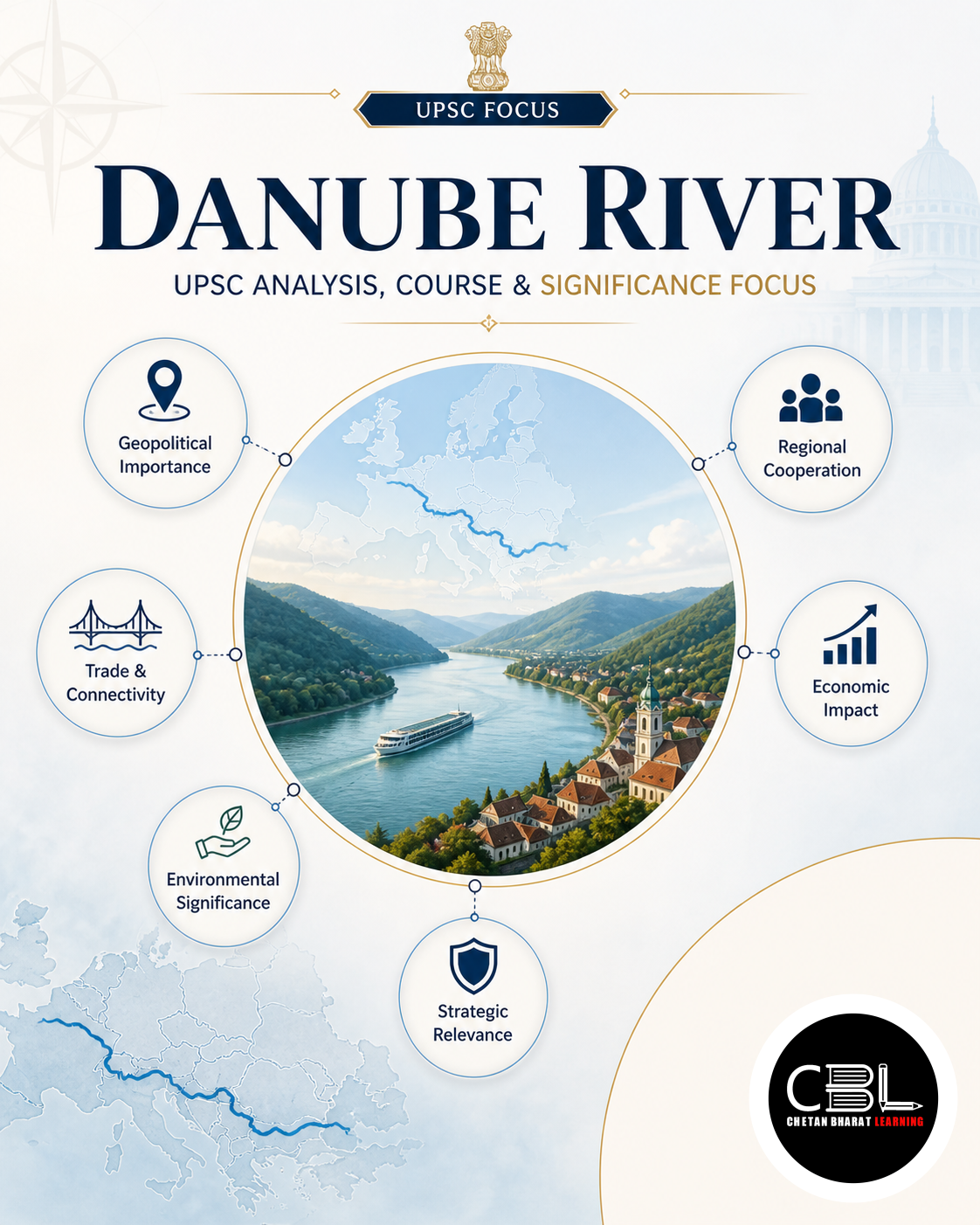
The Danube River is the second-longest river in Europe after the Volga River. It originates from the confluence of the Brigach and Breg rivers near Donaueschingen in Germany’s Black Forest and flows for nearly 2,850 km before emptying into the Black Sea through the Danube Delta.
The river passes through or forms part of the boundary of 10 European countries—Germany, Austria, Slovakia, Hungary, Croatia, Serbia, Bulgaria, Romania, Moldova and Ukraine. It is one of the world’s most international rivers and has immense geographical, ecological and economic importance.
Why is Danube River in News?
The Danube River recently made headlines after unusually low water levels in northern Bulgaria exposed the remains of a mammoth believed to be thousands of years old. Scientists attribute the low water levels partly to prolonged dry conditions affecting several European rivers.
The development also underlines the growing impact of climate variability on river ecosystems, navigation and water resources across Europe. More information on European natural heritage is available through the UNESCO World Heritage Centre.
Key Features of the Danube River
The Danube is among the most strategically important river systems in the world.
- International river: It flows through ten European countries, more than any other major river in the world.
- Major tributaries: Important tributaries include the Inn, Drava, Sava, Tisza, Prut and Siret rivers.
- European capitals: The river flows through four national capitals—Vienna, Bratislava, Budapest and Belgrade.
- Danube Delta: The river forms the Danube Delta in Romania before entering the Black Sea. The delta covers about 4,300 sq km and is recognised as a UNESCO World Heritage Site because of its exceptional biodiversity.
- Navigation: Through the Rhine–Main–Danube Canal, the river connects the North Sea with the Black Sea, creating one of Europe’s most important inland waterways.
Historical and Economic Significance
The Danube has influenced the political, cultural and economic development of Central and Southeastern Europe for more than two millennia.
- Ancient civilisation: Greek sailors explored the river as early as the sixth century BCE.
- Roman frontier: It served as the northern boundary of the Roman Empire for centuries.
- Trade corridor: The river became an important commercial route linking inland Europe with the Black Sea.
- Modern transport: Major ports such as Vienna, Budapest, Belgrade and Regensburg facilitate international trade.
- Regional integration: The Danube supports tourism, fisheries, agriculture and cross-border economic cooperation.
Challenges
The Danube River faces multiple environmental and developmental pressures.
- Climate change: Increasing droughts and heatwaves are reducing river discharge and affecting navigation.
- Pollution: Industrial, agricultural and urban waste threaten water quality and aquatic ecosystems.
- Habitat degradation: Wetlands and floodplains continue to face pressure from infrastructure development.
- Biodiversity conservation: Protecting the Danube Delta requires coordinated international efforts.
- Water management: Sustainable use of shared water resources demands cooperation among riparian countries.
Way Forward
Integrated river basin management, climate adaptation strategies and stronger international cooperation are essential for preserving the Danube’s ecological and economic importance. Sustainable navigation, pollution control and habitat restoration should remain policy priorities.
Protecting the Danube Delta and improving transboundary water governance will help safeguard biodiversity while supporting trade and livelihoods across Europe. Additional information is available through the International Commission for the Protection of the Danube River.
Prelims Practice Corner
Q1. The Danube River drains into which water body?
(a) Mediterranean Sea (b) Baltic Sea (c) Black Sea (d) North Sea
Answer: (c) The Danube drains into the Black Sea through the Danube Delta.
Q2. The Danube River originates in:
(a) Alps (b) Black Forest, Germany (c) Carpathian Mountains (d) Pyrenees
Answer: (b) It originates near Donaueschingen in Germany’s Black Forest.
Q3. Which canal connects the Danube with the Rhine River?
(a) Kiel Canal (b) Rhine–Main–Danube Canal (c) Corinth Canal (d) Suez Canal
Answer: (b) The Rhine–Main–Danube Canal links the North Sea and the Black Sea.
Q4. Which of the following capitals is situated on the Danube River?
(a) Prague (b) Vienna (c) Warsaw (d) Madrid
Answer: (b) Vienna is one of the four national capitals located on the Danube.
Q5. The Danube Delta is recognised as a:
(a) Ramsar Site only (b) UNESCO World Heritage Site (c) Biosphere Reserve of India (d) Global Geopark
Answer: (b) The Danube Delta is a UNESCO World Heritage Site known for its biodiversity.
Mains Practice Questions
Q1. Examine the geographical and economic significance of the Danube River in Europe. (10 marks)
Answer Structure
Intro: Introduce the Danube River.
Body: Discuss course, tributaries, navigation, trade and regional integration.
Conclusion: Highlight its strategic importance in Europe.
Q2. Discuss the environmental challenges facing international river systems with reference to the Danube River. (15 marks)
Answer Structure
Intro: Explain the importance of transboundary rivers.
Body: Cover climate change, pollution, biodiversity conservation and international cooperation.
Conclusion: Emphasise integrated river basin management.
FAQs on Danube River
- Where does the Danube River originate?
- The Danube originates from the confluence of the Brigach and Breg rivers near Donaueschingen in Germany’s Black Forest.
- Into which sea does the Danube River drain?
- The Danube empties into the Black Sea through the Danube Delta in Romania and Ukraine.
- Why is the Danube River important for UPSC?
- The Danube is important because it is Europe’s second-longest river, flows through multiple countries, supports major capitals, forms a UNESCO-listed delta and is frequently asked in world geography and mapping questions.
Related Current Affairs
Preparing for UPSC, PCS or HCS?
Talk to a mentor at Chetan Bharat Learning, Chandigarh. Free guidance on choosing the right exam and building a study plan.
Chat on WhatsAppCall 97793 53345UPSC / IAS / PCS coaching in Chandigarh · Trusted by aspirants across Punjab & Haryana
Leave a Reply
You must be logged in to post a comment.