
Cyclone Murasu formed on 1 November, after the earlier Andhra cyclone coverage. The new development is the deep depression’s intensification into a named cyclonic storm. For related concepts, see geography and environment current affairs.
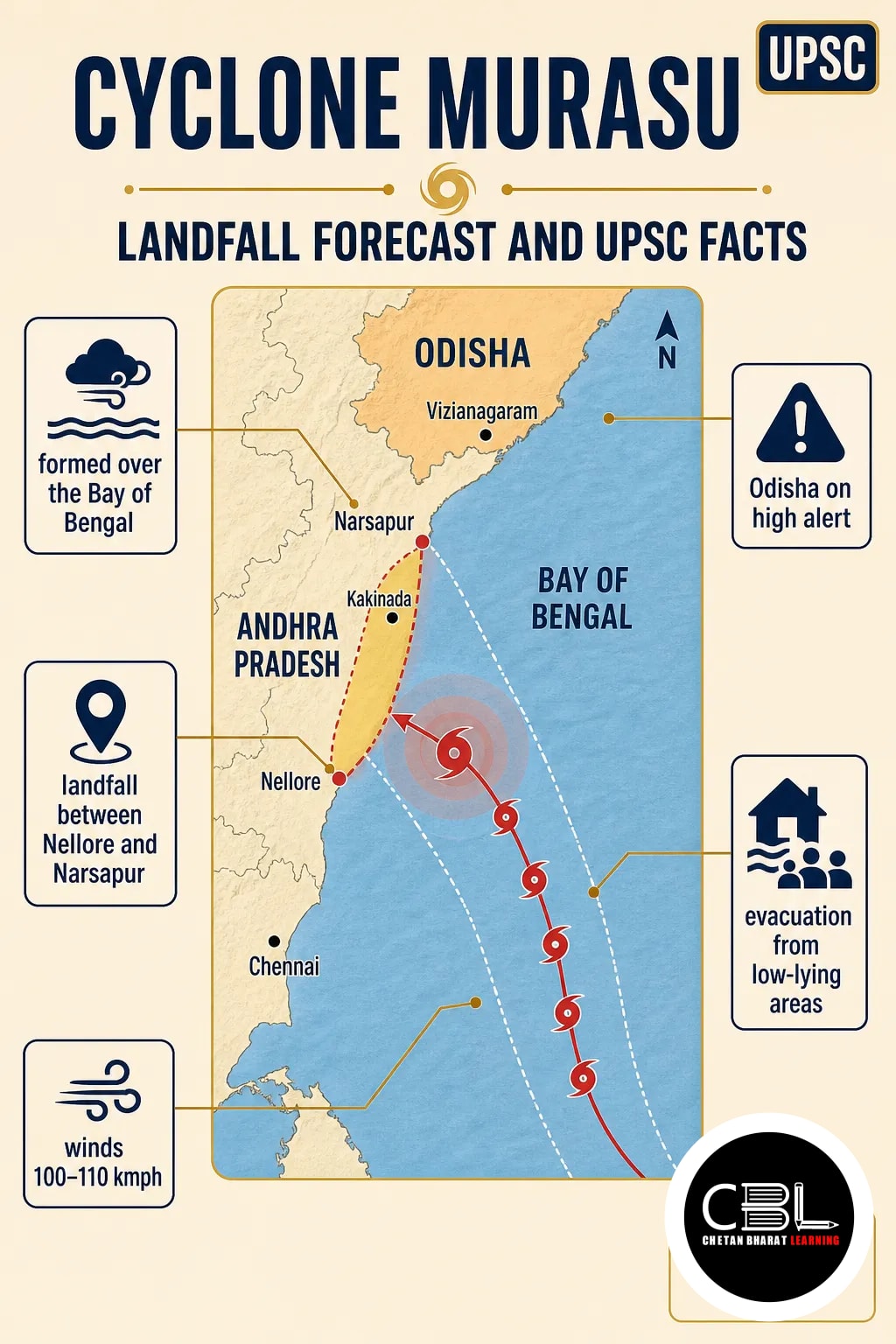
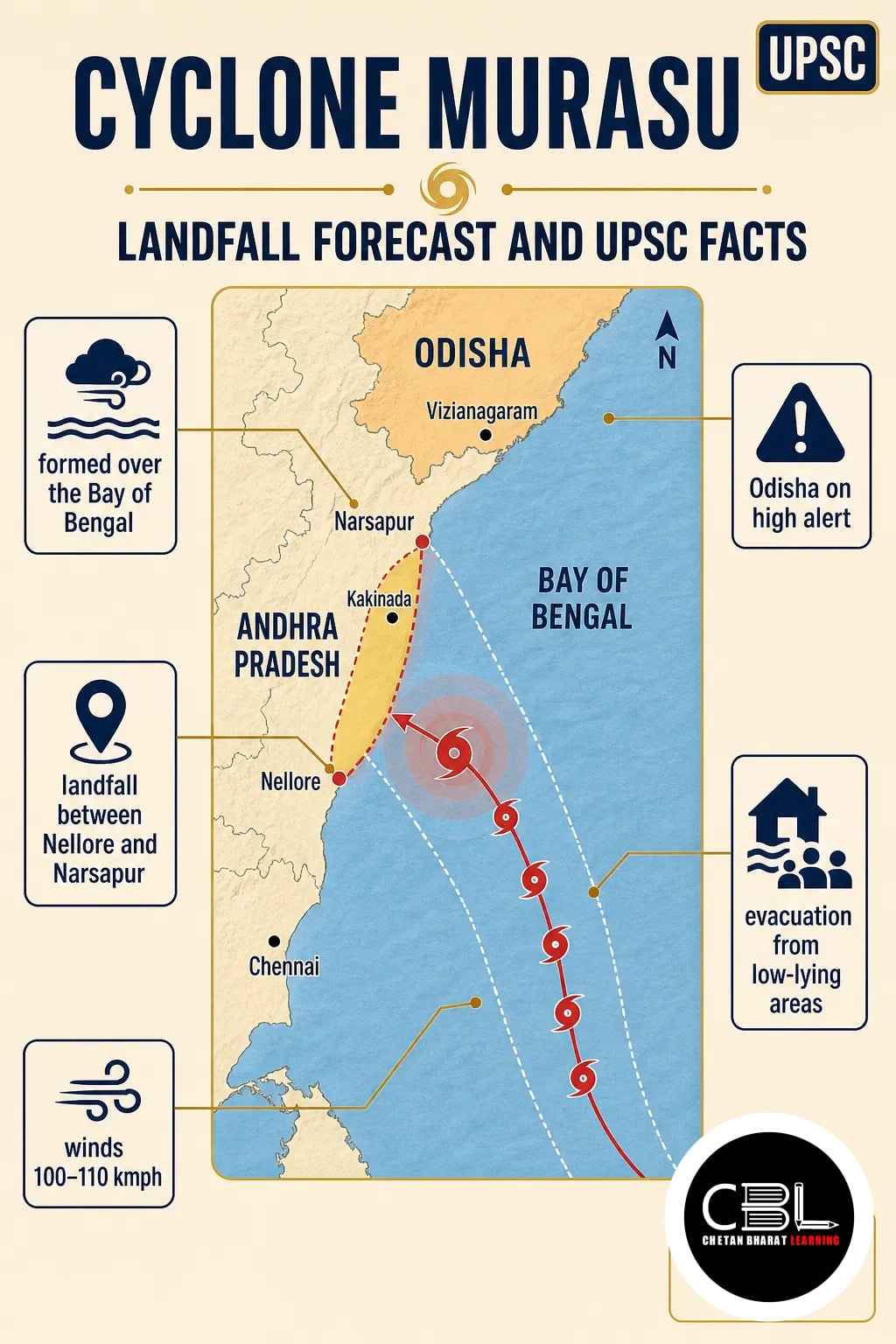
Quick answer: Cyclone Murasu formed over the Bay of Bengal on 1 November 2026. The India Meteorological Department (IMD) forecast landfall between Nellore and Narsapur on the Andhra Pradesh coast by 3 November morning. Meanwhile, southern Odisha is on high alert because the storm is expected to bring rain.
Where did Cyclone Murasu form?
Cyclone Murasu formed over the southwest and adjoining west-central Bay of Bengal. At 11:30 am Indian Standard Time on 1 November, a deep depression intensified into a cyclonic storm. India named it Murasu, meaning war drum.
| Feature | Fact or forecast |
|---|---|
| Sea area | Southwest and adjoining west-central Bay of Bengal |
| Forecast coastal stretch | Between Nellore and Narsapur, Andhra Pradesh |
| Forecast crossing time | By the morning of 3 November 2026 |
| Forecast winds at crossing | 100–110 kmph, gusting to 120 kmph |
| Naming country and meaning | India; war drum |
What is the landfall forecast?
The IMD expects the storm to cross the Andhra Pradesh coast between Nellore and Narsapur. It also expects Cyclone Murasu to intensify into a very severe cyclonic storm.
The forecast winds are 100–110 kilometres per hour (kmph), with gusts up to 120 kmph. These are forecast conditions, not observed landfall figures. For the preceding alert, see the Andhra Pradesh landfall alert.
Why is southern Odisha on alert?
Southern Odisha is on high alert because the cyclone is expected to bring rain to the state. Meteorological Centre, Bhubaneswar director Manorama Mohanty said rainfall would begin on 2 November. Moreover, she expected its intensity to increase on 3 and 4 November.
Odisha Disaster Management Minister Suresh Pujari said the government had announced the alert. It also ordered the evacuation of people from low-lying areas and hilly terrain.
Why does this matter for disaster management?
The forecast illustrates why cyclone preparedness must cover areas beyond the expected landfall coast. Andhra Pradesh faces the forecast crossing, while neighbouring Odisha is preparing for rain. Thus, aspirants should distinguish the landfall location from the wider area of potential impact.
A tropical cyclone draws energy from warm ocean waters and involves a low-pressure centre. Landfall refers to the crossing of the coast by the cyclone’s centre. However, its effects can extend beyond that point and begin before the crossing.
Source: The Hindu, 1 November 2026
- Andhra Cyclone November 2026: UPSC Facts (1 Nov 2026)
- Andhra Pradesh Cyclone: Landfall Alert for UPSC (31 Oct 2026)
Punjab PCS and Haryana HCS can test tropical cyclone formation, coastal geography and the role of weather warnings in General Studies. In addition, revise evacuation as a disaster preparedness measure.
Prelims Practice Corner
Mains Practice Questions
Frequently Asked Questions
Where is Cyclone Murasu expected to make landfall?
Between Nellore and Narsapur on the Andhra Pradesh coast. The IMD forecast the crossing by the morning of 3 November 2026.
Who named Cyclone Murasu and what does it mean?
India named it Murasu, meaning war drum. The storm formed over the Bay of Bengal on 1 November 2026.
Why did Odisha order evacuations?
Odisha ordered evacuations as part of its cyclone preparedness. The state also placed its southern region on high alert as rain was forecast.
Related Current Affairs
Preparing for UPSC, PCS or HCS?
Talk to a mentor at Chetan Bharat Learning, Chandigarh. Free guidance on choosing the right exam and building a study plan.
Chat on WhatsAppCall 97793 53345UPSC / IAS / PCS coaching in Chandigarh · Trusted by aspirants across Punjab & Haryana

 Ananya RanaIAS · AIR 60
 Aditya SharmaIAS · AIR 70
 Ria Kaur SethiIPS · AIR 89
 Aman AloonIRS · AIR 295
 Sumer Singh VirkIRS · AIR 335
 Shivani PanchalIAS

Leave a Reply
You must be logged in to post a comment.