
India’s cotton sector stands at a critical juncture. Once considered a success story of agricultural biotechnology, the sector is now facing declining productivity, stagnant yields, and increasing competition from global producers. Recognising these challenges, the Government of India has launched the Cotton Productivity Mission with the objective of improving cotton yields and strengthening farmer incomes.
However, experts argue that policy decisions over the last decade have weakened the momentum created by scientific innovations. The success of the mission will therefore depend not only on investment and technology but also on creating a supportive policy environment.
For aspirants preparing through UPSC Coaching in Chandigarh and IAS Coaching in Chandigarh, the Cotton Productivity Mission is important from the perspectives of agriculture, biotechnology, rural development, and economic growth.
What is the Cotton Productivity Mission?
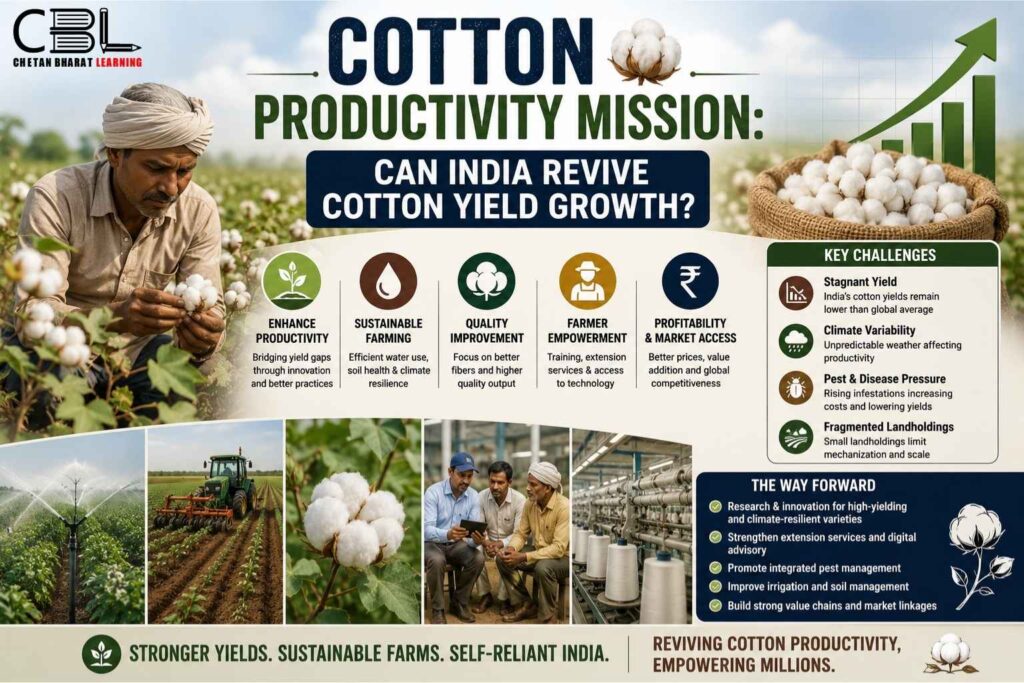
In April 2026, the Union Cabinet approved the Cotton Productivity Mission with an outlay of approximately ₹5,659 crore for the period 2026-27 to 2030-31.
The mission aims to increase cotton productivity from around 441 kg per hectare to 755 kg per hectare by 2031. The broader objective is to improve cotton production, enhance farmer incomes, strengthen India’s textile sector, and reduce dependence on imports.
The initiative seeks to address long-standing concerns regarding declining cotton yields and technological stagnation in the sector.
India’s Cotton Success Story
India’s cotton revolution began in the early 2000s with the adoption of Bt Cotton technology.
In 2002, the approval of Bt cotton marked a major turning point in Indian agriculture. The technology helped farmers tackle bollworm infestations, reduce pesticide use, and improve yields.
As adoption increased, cotton production rose significantly. Between 2002 and 2014, India’s cotton output expanded rapidly, making the country one of the world’s largest cotton producers and exporters.
Cotton yields improved substantially, and millions of farmers benefited from higher productivity and better returns.
Why Did Cotton Productivity Slow Down?
The period after 2014 witnessed a noticeable decline in cotton productivity growth.
One major concern highlighted by experts is the weakening of incentives for innovation. Regulatory uncertainties, prolonged approval processes, and seed price controls reduced private-sector investment in research and development.
As agricultural biotechnology advanced globally, India witnessed slower adoption of next-generation cotton technologies. While countries such as the United States, Brazil, and Australia continued investing in advanced seed technologies, India’s progress became comparatively slower.
This gap has contributed to stagnating productivity levels and declining competitiveness.
The Role of Biotechnology in Cotton Production
Biotechnology played a crucial role in India’s cotton success.
Bt cotton technology helped increase yields, reduce pest-related losses, and improve farm profitability. However, agricultural innovation requires continuous research and development.
New pest threats, changing climatic conditions, and evolving agricultural challenges require the introduction of advanced seed varieties and improved farming practices.
Without sustained innovation, earlier gains may gradually diminish, reducing productivity and affecting farmer incomes.
Policy Challenges Facing the Cotton Sector
Several policy-related issues continue to affect the sector.
Price control mechanisms, regulatory delays, and uncertainty regarding intellectual property rights have discouraged investment in seed innovation. Private companies often require long-term certainty before committing resources to research and product development.
In addition, lengthy approval procedures for genetically modified crops can slow the introduction of new technologies that could potentially improve yields and resilience.
Many experts believe that balancing farmer welfare with innovation incentives is essential for long-term agricultural growth.
Why the Cotton Productivity Mission Matters
The Cotton Productivity Mission is significant for multiple reasons.
First, cotton supports millions of farmers across states such as Maharashtra, Gujarat, Telangana, Andhra Pradesh, Punjab, and Haryana.
Second, cotton is the backbone of India’s textile and apparel industry, which contributes significantly to exports and employment.
Third, higher cotton productivity can improve rural incomes, strengthen agricultural growth, and enhance India’s competitiveness in global markets.
The mission also aligns with broader goals of agricultural modernisation and sustainable development.
Challenges Before the Mission
Despite its ambitious targets, the mission faces several hurdles.
Technology Adoption
Improving productivity requires widespread adoption of modern seed varieties, precision agriculture, and scientific farming practices.
Climate Change
Erratic rainfall, rising temperatures, and extreme weather events continue to affect cotton cultivation.
Pest Resistance
Over time, pest resistance can reduce the effectiveness of existing technologies, requiring constant innovation.
Research Investment
Long-term success depends on strong investment in agricultural research, seed development, and extension services.
Regulatory Reforms
A predictable and transparent regulatory framework is essential to encourage innovation and attract private-sector participation.
The Way Forward
To achieve its productivity targets, India must adopt a comprehensive approach.
The government should strengthen agricultural research institutions, encourage public-private partnerships, improve extension services, and promote technology adoption among farmers.
At the same time, policymakers need to create a balanced regulatory environment that supports innovation while protecting farmer interests.
Investment in climate-resilient agriculture, advanced biotechnology, and sustainable farming practices will be critical for ensuring long-term success.
Significance for UPSC Aspirants
The Cotton Productivity Mission is relevant for:
UPSC Prelims
- Bt Cotton
- Biotechnology in Agriculture
- Agricultural Productivity
- Government Agricultural Missions
UPSC Mains GS Paper III
- Agriculture and Food Security
- Biotechnology
- Science and Technology
- Rural Economy
- Agricultural Reforms
Essay Topics
- Technology and Agricultural Development
- Sustainable Agriculture in India
- Innovation and Farmer Welfare
Students preparing through UPSC Coaching in Chandigarh can use the Cotton Productivity Mission as a contemporary example in answers related to agricultural reforms and biotechnology. Similarly, aspirants enrolled in IAS Coaching in Chandigarh can use it to enrich discussions on innovation, productivity, and rural development.
FAQs
What is the Cotton Productivity Mission?
It is a government initiative launched to increase cotton productivity and improve farmer incomes between 2026 and 2031.
What is Bt Cotton?
Bt Cotton is a genetically modified cotton variety designed to resist specific pest attacks, particularly bollworms.
Why is cotton productivity declining in India?
Factors include regulatory challenges, limited technological innovation, climate-related issues, and pest resistance.
Why is cotton important for India?
Cotton supports millions of farmers and serves as the foundation of India’s textile and apparel industry.
Why is the Cotton Productivity Mission important for UPSC?
The topic covers agriculture, biotechnology, rural development, public policy, and economic growth, making it highly relevant for both Prelims and Mains.
Conclusion
The Cotton Productivity Mission reflects India’s determination to revive growth in one of its most important agricultural sectors. While the mission’s objectives are ambitious, achieving them will require more than financial investment alone. Scientific innovation, supportive policies, regulatory reforms, and farmer-centric implementation will determine its success.
If India can successfully combine technology, research, and policy support, the Cotton Productivity Mission could help restore competitiveness, improve farmer livelihoods, and strengthen the country’s agricultural economy in the years ahead.
Related Current Affairs
Preparing for UPSC, PCS or HCS?
Talk to a mentor at Chetan Bharat Learning, Chandigarh. Free guidance on choosing the right exam and building a study plan.
Chat on WhatsAppCall 97793 53345UPSC / IAS / PCS coaching in Chandigarh · Trusted by aspirants across Punjab & Haryana
Leave a Reply
You must be logged in to post a comment.