
UPSC Mapping
- GS Paper III: Environment & Ecology – Climate Change & Disaster Management
Article
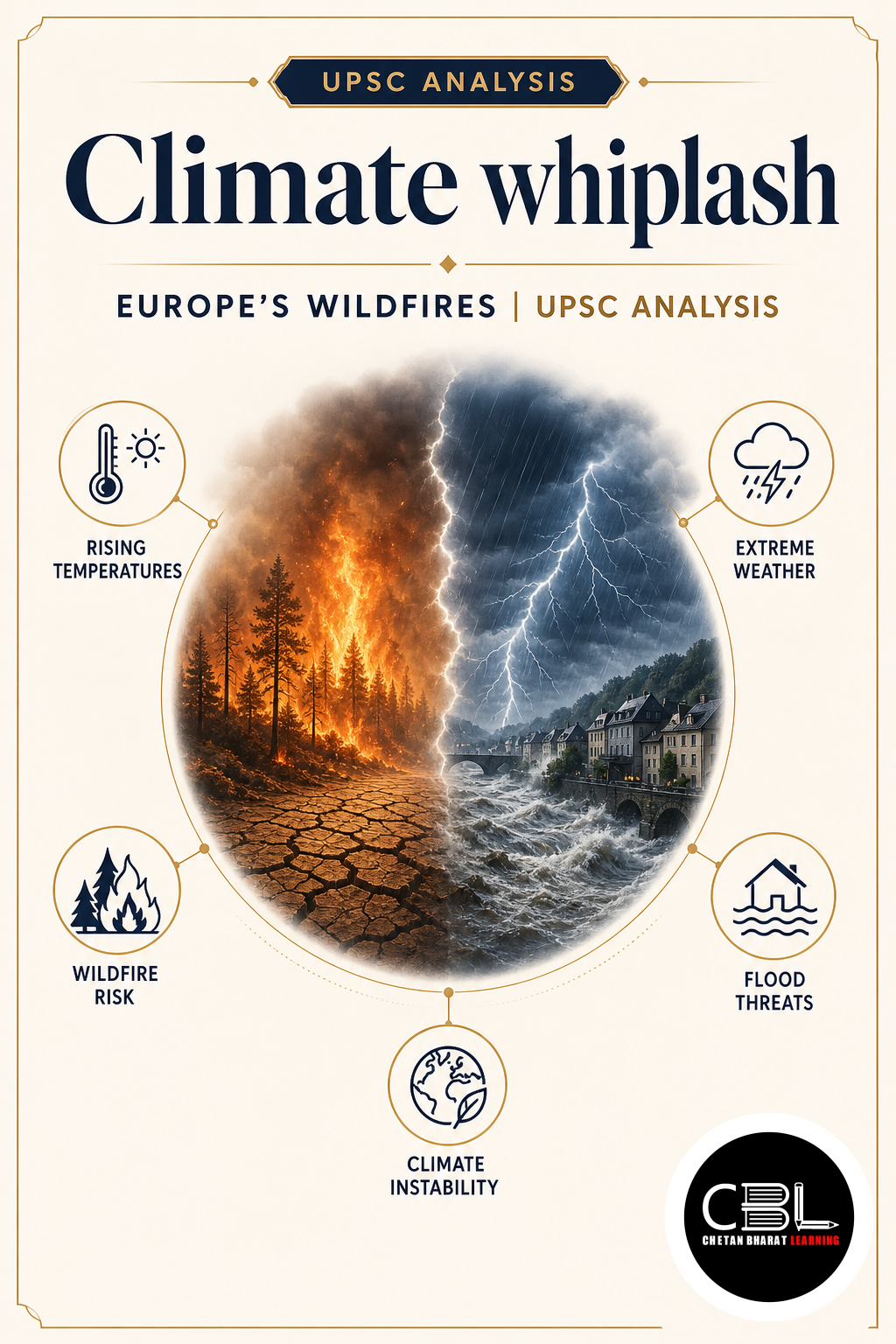
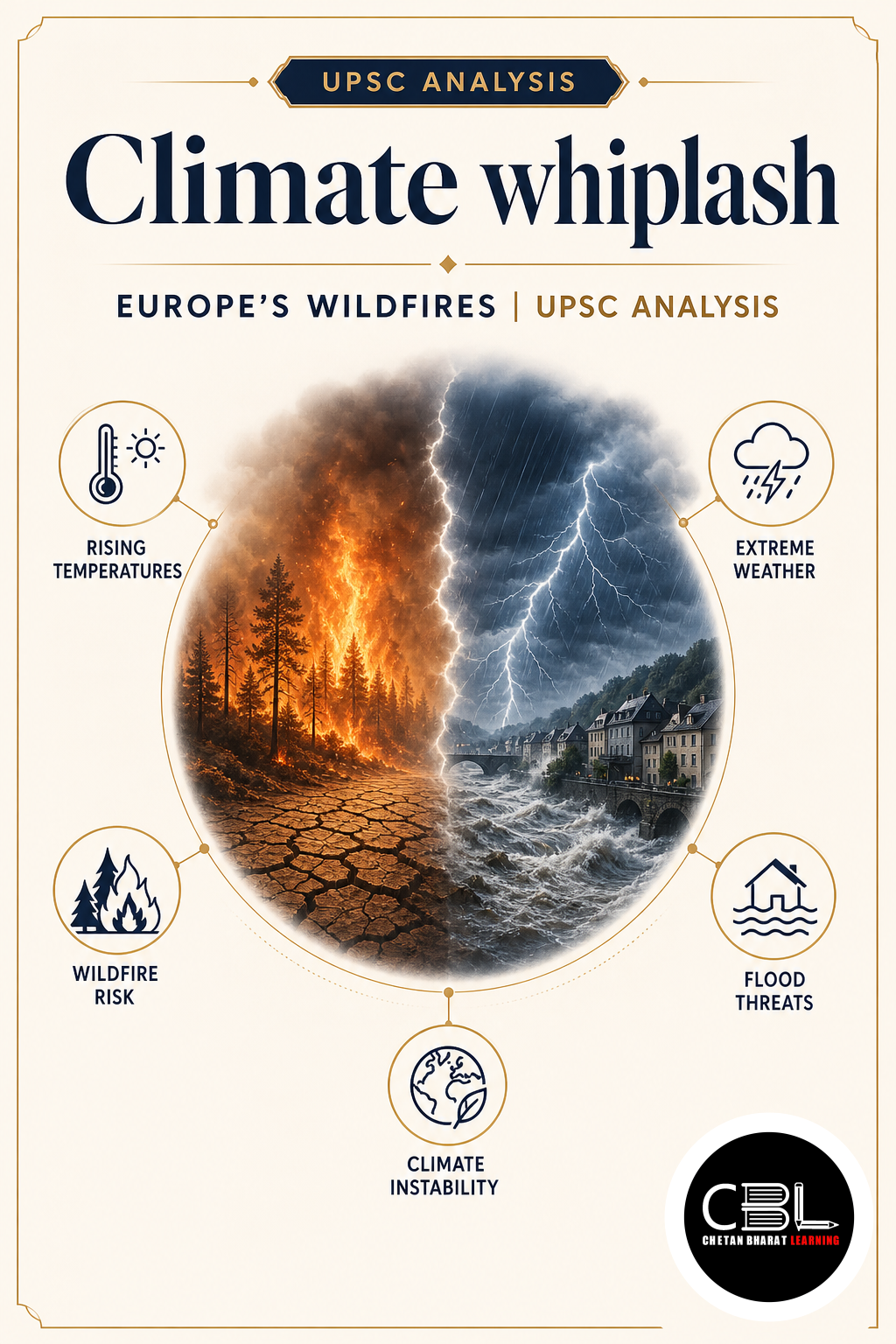
Climate Whiplash is in the news after reports linked Europe’s increasingly severe wildfires to rapid shifts between extreme weather conditions. The passage explains how alternating periods of heavy rainfall and prolonged heat have created ideal conditions for massive wildfires, highlighting the growing interaction between climate change and disaster risk.
Why in News
According to the passage, Europe has witnessed widespread wildfires across countries such as Greece, Spain, Portugal, Italy, Cyprus, Croatia and France. The report attributes the intensity of these fires to climate change, climate whiplash, fire clouds, land-use change and fuel accumulation.
Quick Facts
| Issue | Large-scale wildfires across Europe. |
|---|---|
| Major Drivers | Climate whiplash, heatwaves, fire clouds, land-use change and strong winds. |
| UPSC Themes | Climate change, disaster management, ecology and environmental governance. |
What is Climate Whiplash?
The passage defines Climate Whiplash as the rapid shift between opposite weather extremes. A period of heavy rainfall encourages rapid vegetation growth, which is followed by prolonged dry and hot conditions that dry the vegetation into highly combustible fuel.
This sequence creates a large accumulation of dry biomass, allowing even a small spark to trigger extensive wildfires.
What is a Wildfire?
According to the passage, a wildfire is an uncontrolled fire that spreads rapidly through natural vegetation such as forests, grasslands and shrublands.
The infographic identifies both natural causes, including lightning and volcanic eruptions, and human causes such as accidental fires, agricultural burning and power lines. It also notes that human activities are responsible for most wildfire ignitions.
Why Climate Whiplash Increases Fire Risk
- Heavy Rainfall: Produces abundant vegetation.
- Heatwaves: Dry vegetation rapidly.
- Fuel Build-up: Large quantities of dry biomass accumulate.
- Easy Ignition: A small spark can trigger a massive wildfire.
Fire Clouds (Pyrocumulonimbus)
The passage introduces Pyrocumulonimbus (PyroCb) clouds as giant thunderstorm clouds generated by the intense heat of large wildfires rather than normal atmospheric processes.
Unlike ordinary thunderstorms, these clouds develop because rising hot air from fires rapidly lifts smoke, ash and water vapour high into the atmosphere.
How Fire Clouds Form
- Wildfires release enormous heat.
- Hot air rises rapidly.
- Smoke, ash and water vapour rise together.
- Condensation forms thunderstorm clouds.
- Lightning develops and can ignite new fires.
Why Fire Clouds Are Dangerous
- Dry Lightning: Can ignite fresh wildfires.
- Thunderstorms: Produce unstable weather.
- Strong Winds: Accelerate fire spread.
- Fire Tornadoes: May develop under extreme conditions.
- Self-Sustaining Fires: Large fires can generate their own weather systems.
Why Europe’s Wildfires Are Becoming Worse
- Climate Change: Higher temperatures extend wildfire seasons.
- Climate Whiplash: Alternating wet and dry periods increase fuel availability.
- Heatwaves: Repeated extreme temperatures dry vegetation.
- Land-use Change: Fuel accumulation increases fire intensity.
- Strong Winds: Help fires spread rapidly.
The Wildfire–Climate Feedback Loop
Wildfires release carbon dioxide into the atmosphere. Increased greenhouse gas concentrations contribute to further warming, creating hotter and drier conditions that increase wildfire risk, resulting in a reinforcing feedback cycle.
Impacts of Wildfires
- Environmental: Biodiversity loss, soil degradation, habitat destruction and carbon emissions.
- Economic: Damage to infrastructure, agriculture and tourism.
- Social: Respiratory illnesses, displacement of communities and loss of livelihoods.
Relevance for India
India is also vulnerable to increasing wildfires. Regions highlighted include Uttarakhand, Himachal Pradesh, Jammu & Kashmir, Odisha, Chhattisgarh and the Western Ghats.
Contributing factors include heatwaves, irregular rainfall, dry spells and increasing forest fire frequency.
Managing Wildfires
- Prevention: Satellite monitoring, early warning systems, fire lines, controlled burning and community awareness.
- Response: Rapid firefighting, aerial firefighting and incident command systems.
- Long-term Measures: Climate mitigation, sustainable forestry and landscape restoration.
UPSC Relevance
This topic is important for GS Paper III, covering environment, climate change, disaster management, biodiversity conservation and ecological resilience.
Prelims Practice Questions
- Climate Whiplash refers to: (a) A permanent drought (b) Rapid shifts between opposite weather extremes (c) Ocean warming only (d) Volcanic eruptions. Answer: (b).
- Pyrocumulonimbus clouds are associated with: (a) Cyclones (b) Wildfires (c) Monsoon depressions (d) Tornadoes only. Answer: (b).
- According to the passage, which factor contributes significantly to Europe’s worsening wildfires? (a) Climate Whiplash (b) Fuel accumulation (c) Heatwaves (d) All of the above. Answer: (d).
- Which of the following is a natural cause of wildfire mentioned in the passage? (a) Lightning (b) Agricultural burning (c) Power lines (d) Campfires. Answer: (a).
- Which Indian regions are highlighted in the passage as vulnerable to forest fires? Uttarakhand, Himachal Pradesh, Jammu & Kashmir, Odisha, Chhattisgarh and the Western Ghats.
Mains Practice Questions
- Q1 (10 Marks): Explain the concept of Climate Whiplash and discuss its role in increasing wildfire risks.
- Q2 (15 Marks): Examine how climate change, land-use change and extreme weather events contribute to large-scale wildfires. Suggest measures to strengthen wildfire management in India.
FAQs
What is Climate Whiplash? According to the passage, it is the rapid shift between opposite weather extremes, such as heavy rainfall followed by prolonged heat.
What are Fire Clouds? Fire clouds, or Pyrocumulonimbus clouds, are thunderstorm clouds generated by the intense heat of large wildfires.
Why is this topic important for UPSC? It connects climate change, disaster management, biodiversity, environmental governance and adaptation strategies under GS Paper III.
Related Current Affairs
Preparing for UPSC, PCS or HCS?
Talk to a mentor at Chetan Bharat Learning, Chandigarh. Free guidance on choosing the right exam and building a study plan.
Chat on WhatsAppCall 97793 53345UPSC / IAS / PCS coaching in Chandigarh · Trusted by aspirants across Punjab & Haryana
Leave a Reply
You must be logged in to post a comment.