

UPSC Mapping
| Prelims | Delhi Ridge, Aravallis and Invasive Species |
|---|---|
| Mains | GS Paper III – Environment and Biodiversity |
| Approved Area | About 70 Hectares |
|---|---|
| Trees Identified | About 13,161 |
| Restoration Plan | Delhi Eco-restoration Plan 2026–30 |
| Supervising Body | Delhi Ridge Management Board |
Article
What is Central Ridge Restoration?
Central Ridge Restoration is a planned effort to revive degraded forest ecosystems within Delhi’s Central Ridge. The Ridge represents the northern extension of the ancient Aravalli system and functions as an important urban ecological zone. It moderates local temperatures, supports wildlife and protects soil from wind and water erosion. Its rocky terrain and vegetation also provide habitat continuity within a densely built metropolitan landscape.
Restoration seeks to rebuild the area’s ecological composition rather than create a landscaped public park. It involves controlling dominant invasive vegetation, assisting natural regeneration and planting suitable native trees, shrubs and grasses. Authorities must also protect topsoil, conserve moisture and monitor wildlife responses. Successful restoration should recover ecosystem processes, not merely increase the number of planted saplings.
Why is Central Ridge Restoration in News?
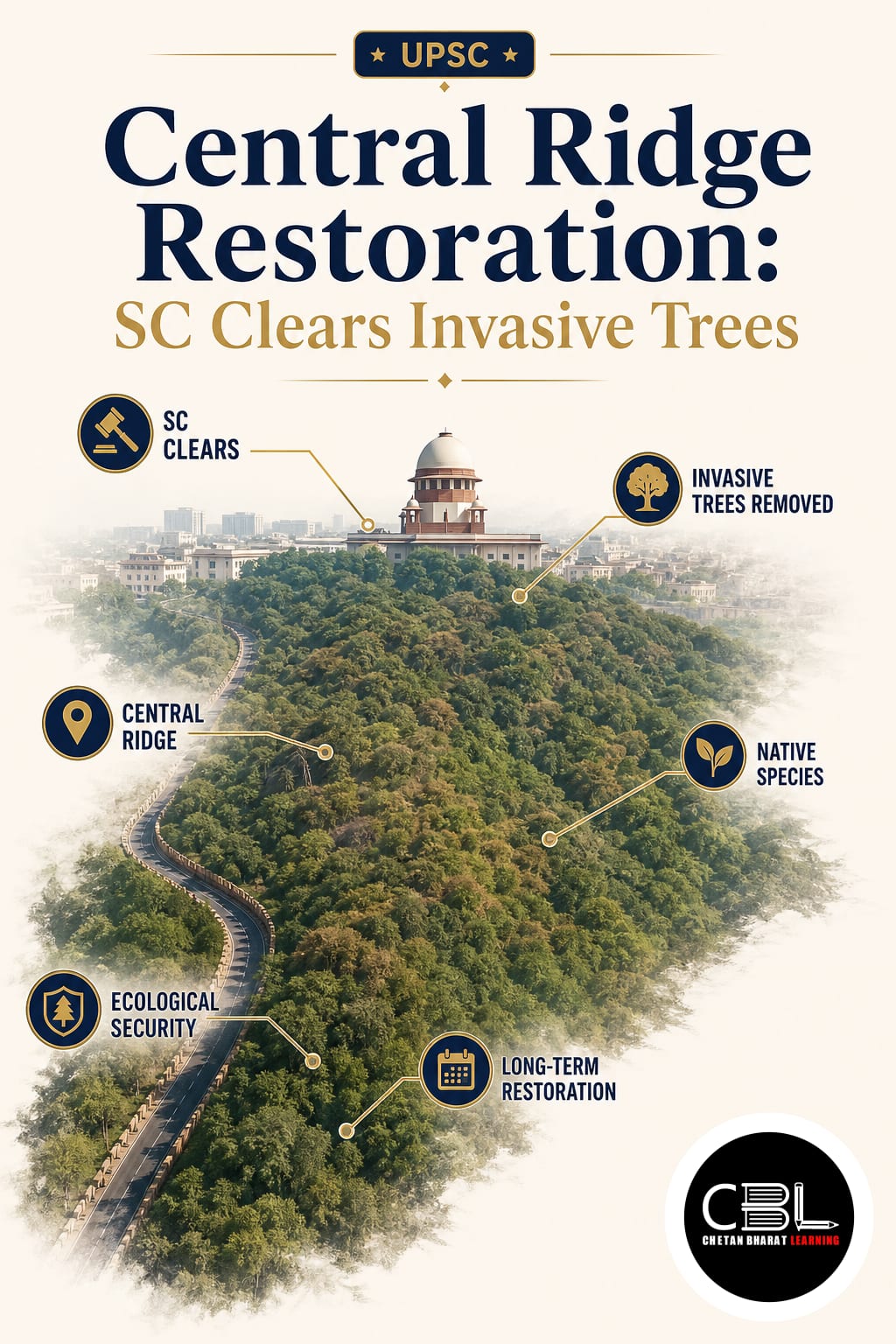
Central Ridge Restoration entered the news after the Supreme Court permitted Delhi authorities to remove identified invasive trees. The approval covers around 13,161 trees remaining across approximately 70 hectares. Authorities must conduct the operation under the Delhi Eco-restoration Plan 2026–30 and replace removed vegetation with indigenous species. The Delhi Ridge Management Board will supervise implementation and compliance.
The Court balanced ecological intervention with concerns about indiscriminate tree felling and topsoil disturbance. It required adherence to the scientific working plan prepared by the Forest Research Institute, Dehradun. An earlier Supreme Court judgment on Ridge protection also emphasised native biodiversity and scientific restoration. The permission therefore does not authorise unrestricted clearing or conversion into ornamental landscapes.
Key Features
- Phased removal: Systematic removal of identified trees rather than large-scale clearing.
- Native replacement: Indigenous trees, shrubs and grasses suited to Delhi’s semi-arid Aravalli ecosystem.
- Scientific framework: Guided by the Forest Research Institute working plan on species selection, removal techniques and regeneration.
- Institutional oversight: Supervised by the Delhi Ridge Management Board to ensure compliance with environmental and judicial directives.
- Compliance reporting: Documentation of implementation, survival rates, ecological impacts and conformity with the approved restoration approach.
Challenges
- Topsoil disturbance: Mechanical uprooting can loosen soil and damage seeds, fungi and microorganisms essential for regeneration.
- Rapid reinvasion: Prosopis juliflora can regenerate from seeds or roots unless follow-up control is conducted.
- Sapling mortality: Native plantations may fail without suitable soil, moisture, protection and maintenance.
- Habitat disruption: Sudden canopy removal can displace birds, insects and small mammals temporarily.
- Governance overlap: Multiple authorities and permissions can delay action or create uncertainty.
Way Forward
Adaptive management based on measurable ecological outcomes is essential. Teams should map invasive density, native regeneration, wildlife use and erosion risk at the patch level. Phased removal must avoid breeding seasons and retain refuges for fauna. Natural regeneration should be prioritised over extensive planting. Authorities must monitor sapling survival, soil stability, groundwater conditions and biodiversity for several years. Public dashboards and independent field verification can enhance transparency. Long-term protection from encroachment and inappropriate construction remains crucial.
Prelims Package
Prelims Practice Corner
Q1. The Delhi Ridge represents an extension of which mountain system?
(a) Vindhyas (b) Aravallis (c) Satpuras (d) Western Ghats
Show answer
Answer: (b) Aravallis
Q2. Vilayati keekar is scientifically known as:
(a) Azadirachta indica (b) Prosopis juliflora (c) Ficus religiosa (d) Shorea robusta
Show answer
Answer: (b) Prosopis juliflora
Q3. Which institution prepared the scientific working plan guiding the restoration exercise?
(a) Botanical Survey of India (b) Forest Research Institute (c) Zoological Survey of India (d) Central Pollution Control Board
Show answer
Answer: (b) Forest Research Institute, Dehradun
Q4. Ecological restoration primarily aims to:
(a) Maximise ornamental plantations (b) Restore ecosystem structure and functions (c) Replace forests with recreational parks (d) Introduce fast-growing exotic species
Show answer
Answer: (b) Restore ecosystem composition, processes and resilience.
Q5. Which body will supervise the approved Ridge exercise?
(a) National Biodiversity Authority (b) Delhi Ridge Management Board (c) National Green Tribunal Registry (d) Central Water Commission
Show answer
Answer: (b) Delhi Ridge Management Board
Mains Package
Mains Practice Questions
Q1. Removal of invasive vegetation can support biodiversity but may also create ecological risks. Discuss with reference to urban forest restoration. (250 words, 15 marks)
Intro: Define invasive-species management as a component of ecosystem restoration.
Body: Cover biodiversity recovery, soil disturbance, habitat transition, reinvasion, native replacement and scientific monitoring.
Conclusion: Recommend phased, site-specific and evidence-based ecological intervention.
Q2. Explain the ecological importance of the Delhi Ridge and suggest measures for its long-term protection. (150 words, 10 marks)
Intro: Identify the Ridge as Delhi’s Aravalli extension and major urban ecological landscape.
Body: Discuss climate regulation, habitat, soil stability, invasive control, encroachment prevention and transparent governance.
Conclusion: Link scientific restoration with permanent legal and community-based protection.
FAQs on Central Ridge Restoration
Why is vilayati keekar being removed from the Ridge?
It spreads aggressively and suppresses native vegetation through dense growth and resource competition, reducing habitat diversity.
Did the Supreme Court permit unrestricted tree felling?
No. Permission applies only to identified trees under the approved plan, with scientific methods, supervision and compliance reporting.
How should restoration success be measured?
By monitoring native regeneration, sapling survival, soil stability and biodiversity recovery rather than counting planted saplings alone.
Related Current Affairs
Preparing for UPSC, PCS or HCS?
Talk to a mentor at Chetan Bharat Learning, Chandigarh. Free guidance on choosing the right exam and building a study plan.
Chat on WhatsAppCall 97793 53345UPSC / IAS / PCS coaching in Chandigarh · Trusted by aspirants across Punjab & Haryana
Leave a Reply
You must be logged in to post a comment.