

UPSC Mapping
| Exam | Syllabus |
|---|---|
| Prelims | International Relations & Environment |
| Mains | GS Paper 2 (International Relations) & GS Paper 3 (Environment) |
Article
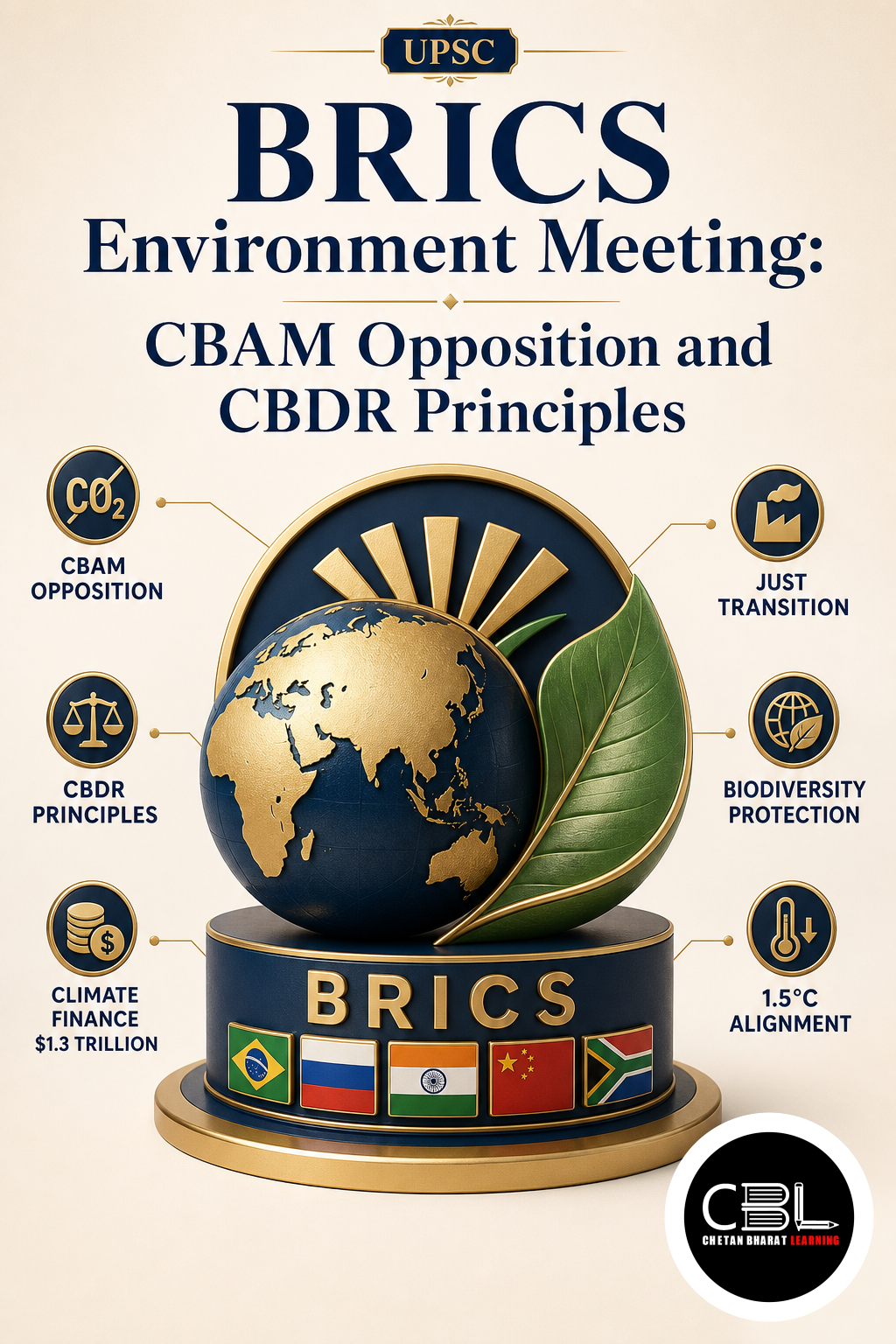
BRICS Environment Meeting in New Delhi, chaired by India, saw environment ministers from Brazil, Russia, India, China, South Africa, UAE, Indonesia, Iran, Saudi Arabia, Egypt, and Ethiopia oppose the EU’s Carbon Border Adjustment Mechanism (CBAM), calling it unilateral, punitive, and discriminatory. The bloc reaffirmed the principle of Common but Differentiated Responsibilities and Respective Capabilities (CBDR-RC). For more such international relations updates, explore the international relations archive.
Quick Facts
| Meeting | 12th BRICS Environment Ministers’ Meeting |
|---|---|
| Key Opposition | EU CBAM |
What is the BRICS Environment Meeting?
The BRICS Environment Meeting is the 12th edition of the BRICS Environment Ministers’ meeting, hosted by India in New Delhi. The meeting brought together environment and climate ministers from 12 countries (BRICS plus UAE, Indonesia, Iran, Saudi Arabia, Egypt, and Ethiopia). The bloc issued a joint statement opposing the EU’s Carbon Border Adjustment Mechanism (CBAM), calling it a unilateral, punitive, and protectionist measure inconsistent with international law.
The meeting also reiterated the principle of Common but Differentiated Responsibilities and Respective Capabilities (CBDR-RC), urging developed nations to scale up climate finance, especially for adaptation. India formally handed over hosting duties to China for the 2027 meeting.
Why is BRICS Environment Meeting in News?
The BRICS Environment Meeting is in the news because of the strong opposition to the EU’s CBAM, which was fully implemented from January 2026. BRICS countries, as major developing economies, view CBAM as a trade barrier that undermines their development and climate efforts.
The joint statement also stressed the need for the New Collective Quantified Goal (NCQG) on climate finance to triple adaptation finance to developing countries by 2035. The bloc emphasised voluntary cooperation, based on national circumstances, rather than imposed standards. For more details, refer to this PIB release.
Key Features of BRICS Environment Meeting
- Opposition to CBAM: BRICS countries opposed the EU’s carbon border tax as discriminatory and protectionist.
- CBDR-RC: Reaffirmed the principle that developed countries have historical responsibility and must lead climate action.
- Climate Finance: Urged developed nations to deliver on NCQG and triple adaptation finance by 2035.
- Voluntary Cooperation: Emphasised that cooperation commitments remain voluntary, based on national circumstances.
- Leadership Handover: India handed over the 2027 meeting hosting to China.
Challenges in BRICS Environment Meeting
- CBAM Implementation: The EU’s CBAM is already in effect, creating trade barriers for developing countries.
- Climate Finance Gap: Developed nations have not met the $100 billion annual goal, and the NCQG may fall short.
- Divergent National Interests: BRICS members have different economic structures and priorities, making consensus difficult.
- Geopolitical Tensions: Conflicts in West Asia and elsewhere may overshadow environmental cooperation.
- Enforcement: Ensuring that the joint statement translates into concrete action. For more on climate governance, visit the environment section.
Way Forward for BRICS Environment Meeting
To advance the BRICS Environment Meeting outcomes, BRICS countries should collectively engage with the EU to negotiate more equitable climate measures. Strengthening domestic climate action and green technologies can reduce reliance on carbon-intensive exports.
BRICS should also push for a reformed global climate finance architecture that meets the needs of developing countries. Technical cooperation on circular economy, renewable energy, and biodiversity can build resilience. For international best practices, refer to the UNEP.
Prelims Practice Corner
- Q1. What is CBAM?
Options: (a) Carbon Border Adjustment Mechanism; (b) Climate Bond Allocation Mechanism; (c) Clean Energy Agreement; (d) Carbon Budget Assessment Model
Answer: (a) Carbon Border Adjustment Mechanism. - Q2. What is the CBDR-RC principle?
Options: (a) Common but Differentiated Responsibilities and Respective Capabilities; (b) Clean and Green Development; (c) Climate Action and Adaptation; (d) Carbon Trading
Answer: (a) It is the principle that developed countries have historical responsibility for climate change. - Q3. Which country hosted the 12th BRICS Environment Ministers’ Meeting?
Options: (a) Brazil; (b) Russia; (c) India; (d) China
Answer: (c) India hosted the meeting in New Delhi. - Q4. What is the New Collective Quantified Goal (NCQG)?
Options: (a) A new climate finance goal for developing countries; (b) A carbon trading scheme; (c) A technology transfer mechanism; (d) A forest conservation target
Answer: (a) NCQG is the post-2025 climate finance goal. - Q5. When was CBAM fully implemented?
Options: (a) 1 January 2025; (b) 1 October 2023; (c) 1 January 2026; (d) 1 July 2026
Answer: (c) CBAM became fully effective from 1 January 2026.
Mains Practice Questions
-
Q1. Discuss the implications of the EU’s Carbon Border Adjustment Mechanism for developing countries and the response of BRICS nations. (250 words, 15 marks)
Answer Structure:
- Intro: Introduce CBAM and its implementation.
- Body: Explain CBAM’s objective (carbon leakage prevention) and its impact on developing countries (trade barriers, compliance costs). Discuss BRICS’ opposition and CBDR principle. Analyse potential ways forward.
- Conclusion: Emphasise the need for a fair, multilateral approach to carbon pricing.
-
Q2. What is the principle of Common but Differentiated Responsibilities (CBDR), and why is it important for climate negotiations? (150 words, 10 marks)
Answer Structure:
- Intro: Define CBDR as a principle in the UNFCCC.
- Body: Explain that it acknowledges developed countries’ historical responsibility and greater capacity, thus they should lead emission reductions and provide finance. It is important for ensuring equity in climate action.
- Conclusion: Conclude that CBDR is essential for developing countries’ trust in the climate regime.
FAQs on BRICS Environment Meeting
- What was the main outcome of the BRICS Environment Meeting?
- The meeting opposed the EU’s CBAM and reaffirmed the CBDR-RC principle, urging developed nations to scale up climate finance.
- Why is CBAM controversial?
- Developing countries view it as a protectionist trade barrier that imposes their carbon costs on exports, violating equity principles.
- What is the NCQG?
- The New Collective Quantified Goal is the post-2025 climate finance target for developed countries to support developing nations.
Related Current Affairs
Preparing for UPSC, PCS or HCS?
Talk to a mentor at Chetan Bharat Learning, Chandigarh. Free guidance on choosing the right exam and building a study plan.
Chat on WhatsAppCall 97793 53345UPSC / IAS / PCS coaching in Chandigarh · Trusted by aspirants across Punjab & Haryana
Leave a Reply
You must be logged in to post a comment.