
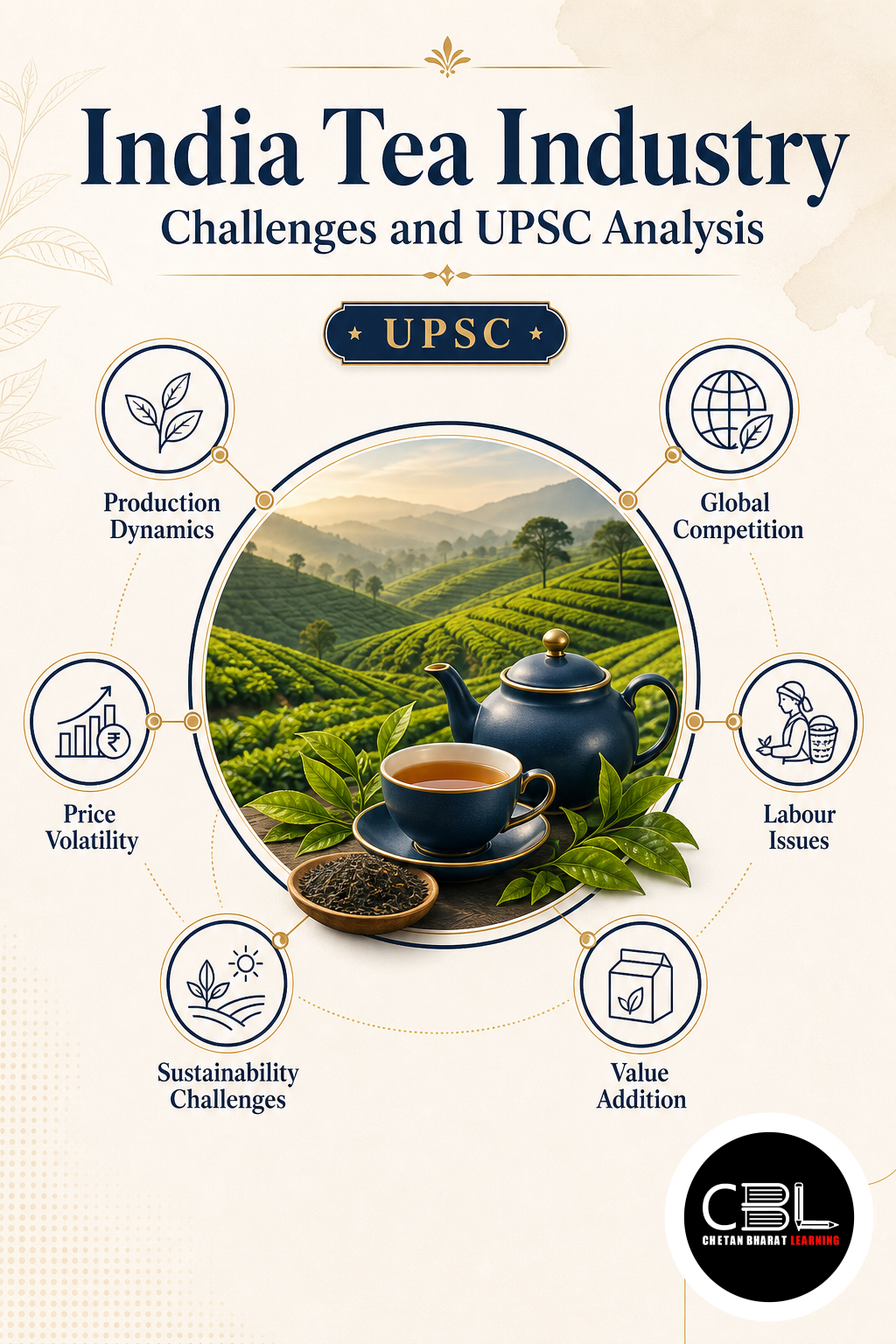

UPSC Mapping
Prelims
- Plantation Crops, Tea Board, Agricultural Exports
Mains
- GS Paper III – Agriculture, Economy, Climate Change and External Trade
Article
India Tea Industry is facing a challenging phase marked by declining prices, climate-related disruptions, rising competition from cheaper imports and changing consumer preferences. Aspirants can also refer to the daily current affairs archive for similar economy and agriculture topics. The issue is relevant for UPSC because it links agriculture, exports, climate change, rural livelihoods and trade policy under GS Paper III.
| Production (2025) | Major Producers | Global Production Share | Global Export Share |
|---|---|---|---|
| 1,369.98 million kg | Assam & West Bengal | 18.43% (2024) | 13.13% (2024) |
What is the India Tea Industry issue?
India Tea Industry refers to the current challenges affecting India’s tea sector, where listed tea companies are witnessing declining revenues because of falling tea prices, adverse weather conditions, cheaper imports and a growing consumer preference for lower-priced products. According to the source, the domestic tea market has remained in a deflationary phase for the past four to five quarters.
Tea remains one of India’s most important plantation crops and export commodities. The source notes that production recovered to 1,369.98 million kg in 2025 after fluctuations caused by the pandemic, weather shocks, pest attacks and labour constraints.
Why is the India Tea Industry in News?
The tea industry is under pressure because climate variability, cheaper imports and price-sensitive consumer behaviour have reduced earnings for organised tea companies. Major firms are responding by promoting premium tea brands and diversifying into other businesses.
The source also highlights that imports from countries such as Nepal and Kenya have increased price competition, while erratic weather in major tea-producing states has affected crop quality and auction prices. Official sector updates may be accessed through the Tea Board of India.
Key Features
- Regional concentration: Assam and West Bengal together account for more than 80% of India’s tea production, making national output highly sensitive to climatic disruptions in these states.
- Export performance: India exported 262.98 million kg of tea worth ₹7,817.58 crore in 2024-25, with the UAE, Iraq, Russia, China, the US and Iran among the leading destinations.
- Limited imports: Tea imports generally account for only 2–3% of domestic production but increased sharply during 2024-25, making import management important for market balance.
- Premiumisation strategy: Companies are promoting higher-value tea products to improve profitability amid weak demand for regular tea.
- Diversification: Large firms are expanding into packaged foods, beverages and other businesses to reduce dependence on tea revenues.
Challenges
- Climate variability: Heatwaves, prolonged dry spells, erratic monsoons and landslides have reduced yields and affected tea quality.
- Cheaper imports: Low-priced imports from Nepal and Kenya have exerted downward pressure on domestic prices.
- Commodity nature: Tea has relatively low brand loyalty, making consumers more likely to switch to cheaper alternatives than premium products.
- Consumer demand: The source notes that an LPG shortage linked to the West Asia conflict temporarily reduced household tea consumption.
- Future climate risks: Weather shocks, including potential El Niño events, may continue to affect production and price stability. Related agriculture and economy topics are available in the Economy current affairs section.
Way Forward
According to the source, premiumisation and business diversification may improve long-term resilience, although gains are likely to emerge gradually because tea consumers have established purchasing preferences. Strengthening export competitiveness, improving quality and managing climate risks remain important priorities.
Enhancing climate-resilient cultivation, modernising plantations, supporting value addition and expanding export markets can strengthen India’s position in the global tea trade. Aspirants should also refer to the Ministry of Commerce and Industry for official trade-related developments.
Prelims Practice Corner
Q1. Which two states together account for over 80% of India’s tea production according to the source?
- (a) Kerala and Tamil Nadu
- (b) Assam and West Bengal
- (c) Karnataka and Kerala
- (d) Odisha and Assam
Answer: (b) Assam and West Bengal
Q2. According to the source, cheaper tea imports mainly come from:
- (a) Sri Lanka and Bangladesh
- (b) Nepal and Kenya
- (c) China and Japan
- (d) Vietnam and Indonesia
Answer: (b)
Q3. The organised tea industry is responding by:
- (a) Reducing exports completely
- (b) Premiumisation and diversification
- (c) Stopping production
- (d) Closing plantations
Answer: (b)
Q4. India’s tea exports in 2024-25 were valued at:
- (a) ₹4,500 crore
- (b) ₹5,900 crore
- (c) ₹7,817.58 crore
- (d) ₹10,250 crore
Answer: (c)
Q5. Tea is classified primarily as a:
- (a) Plantation crop
- (b) Pulse crop
- (c) Oilseed crop
- (d) Fibre crop
Answer: (a)
Mains Practice Questions
Q1. Examine the factors responsible for the current challenges facing India’s tea industry. Suggest suitable policy measures. (10 Marks)
Answer Structure:
- Intro: Briefly explain the importance of tea in India’s agricultural economy.
- Body: Climate change, imports, consumer behaviour, export competitiveness, diversification and value addition.
- Conclusion: Highlight sustainable and resilient growth for the tea sector.
Q2. Discuss how climate change and international trade are reshaping plantation agriculture in India with reference to the tea industry. (15 Marks)
Answer Structure:
- Intro: Explain the importance of plantation crops.
- Body: Climate impacts, trade dynamics, competitiveness, adaptation strategies and government support.
- Conclusion: Emphasise resilient agriculture and export-oriented reforms.
FAQs on India Tea Industry
- Why is India’s tea industry under pressure?
- According to the source, climate variability, cheaper imports, adverse weather and consumer preference for lower-priced alternatives have reduced earnings for organised tea companies.
- Why are Assam and West Bengal important for tea production?
- The source states that these two states account for over 80% of India’s tea production, making national output highly dependent on climatic conditions in these regions.
- Why is this topic important for UPSC?
- It connects plantation agriculture, climate change, exports, imports, consumer markets and rural livelihoods, making it relevant for both Prelims and GS Paper III.
Related Current Affairs
Preparing for UPSC, PCS or HCS?
Talk to a mentor at Chetan Bharat Learning, Chandigarh. Free guidance on choosing the right exam and building a study plan.
Chat on WhatsAppCall 97793 53345UPSC / IAS / PCS coaching in Chandigarh · Trusted by aspirants across Punjab & Haryana
Leave a Reply
You must be logged in to post a comment.