

UPSC Mapping
- GS Paper III: Indian Economy, Energy Security, Public Sector Enterprises, Infrastructure.
- GS Paper II: Government Policies relating to strategic sectors.
Article
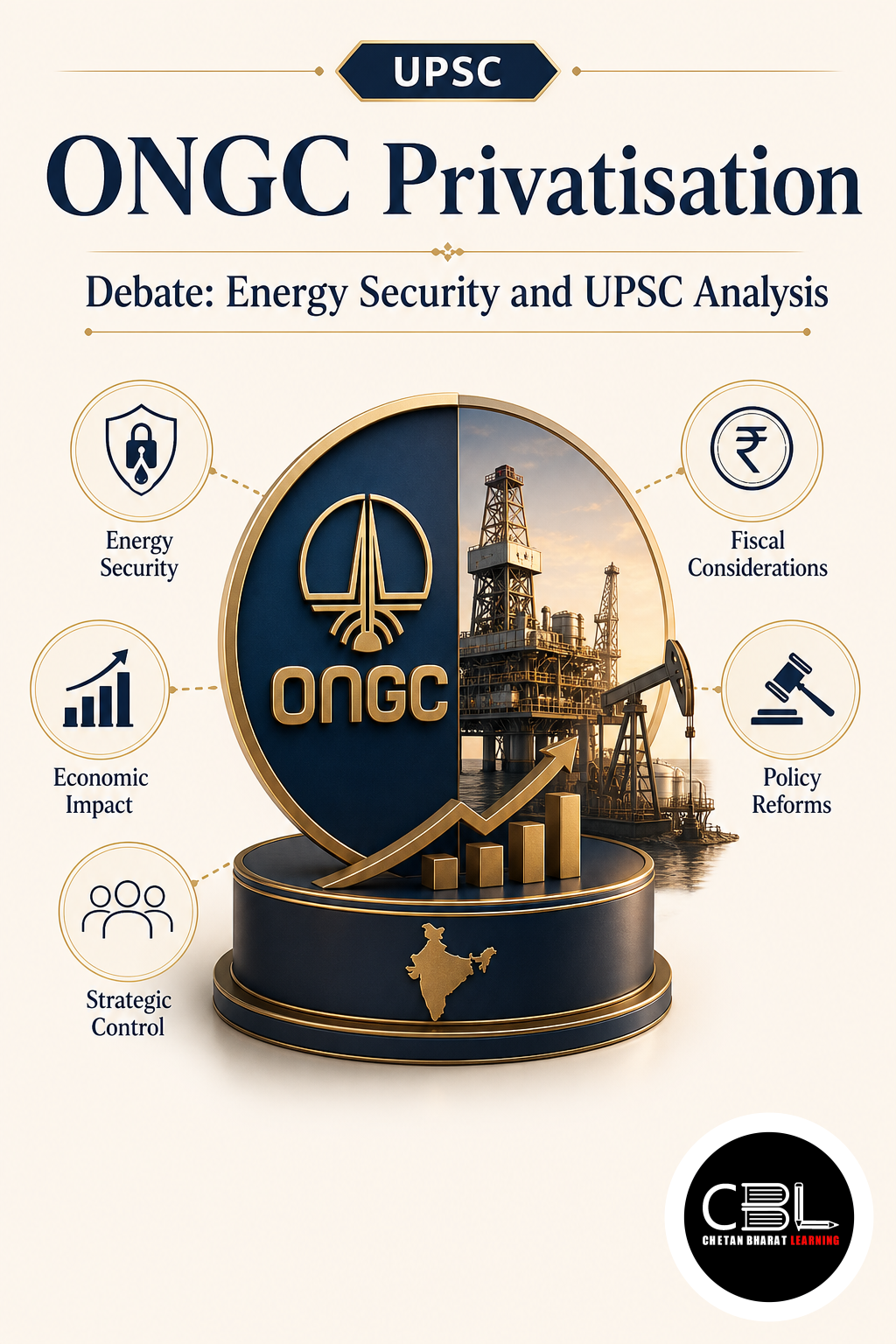
ONGC Privatisation has returned to public debate after the passage discussed whether India should privatise upstream petroleum public sector undertakings (PSUs), particularly Oil and Natural Gas Corporation (ONGC) and Oil India Limited (OIL). The article links this debate to India’s growing energy needs, geopolitical uncertainty and long-term energy security.
Why in News
According to the passage, renewed discussion has emerged over the future ownership of upstream oil PSUs. The article argues that changing geopolitical conditions, declining domestic oil production and increasing import dependence require a careful reassessment of privatisation policy.
Why is the Issue Important?
- Public Sector Enterprises: ONGC and OIL are strategic public sector companies.
- Energy Security: Domestic production reduces excessive dependence on imports.
- Oil & Gas Sector: Upstream exploration is critical for future supplies.
- Strategic Petroleum Interests: Energy assets influence long-term national resilience.
- Geopolitical Considerations: Global conflicts increasingly affect energy markets.
What is Privatisation?
The passage defines privatisation as the transfer of ownership and management of a government-owned enterprise to the private sector. Its stated objectives include improving efficiency, reducing fiscal pressure, increasing competition, encouraging innovation and reducing direct government involvement in business activities.
Disinvestment vs Privatisation
| Aspect | Disinvestment | Privatisation |
|---|---|---|
| Ownership | Government sells part of its shares | Government transfers management or control |
| Control | May remain with government | Private sector gains control |
| Observation | Every privatisation involves disinvestment | Not every disinvestment results in privatisation |
Structure of the Petroleum Industry
- Upstream: Exploration and production of crude oil and natural gas.
- Midstream: Transportation and storage.
- Downstream: Refining, marketing and retail distribution.
Why is ONGC Important?
The passage highlights ONGC as India’s largest oil and gas exploration company. It produces a significant share of India’s crude oil, contributes substantially to domestic natural gas production and has investments in overseas energy assets through ONGC Videsh Ltd. According to the uploaded source, ONGC remains central to India’s energy security.
Understanding Energy Security
The passage defines energy security as the reliable, affordable and uninterrupted availability of energy to meet present and future needs. It identifies four dimensions:
- Availability: Adequate energy supply.
- Accessibility: Reliable access to energy.
- Affordability: Reasonable prices.
- Sustainability: Environmentally responsible energy use.
India’s Energy Challenge
India imports around 85% of its crude oil requirements. It identifies large import bills, exposure to global price shocks, current account pressures and strategic vulnerability as key concerns associated with high import dependence.
Why Was Privatisation Favoured Earlier?
Earlier economic thinking emphasised global competition, private investment, operational efficiency and reduced fiscal burdens. It was believed that private ownership could improve efficiency and encourage innovation.
What Has Changed?
The article argues that the global environment has become significantly more uncertain. It cites geopolitical developments including the Russia–Ukraine conflict, tensions in West Asia, rivalry among major powers and volatile energy markets as reasons for reconsidering strategic energy assets.
Declining Domestic Production
The passage attributes declining domestic production to ageing oil fields, depletion of reserves, high exploration costs and geological uncertainty. These factors increase the importance of maintaining long-term investment in exploration.
Prelims Practice
- Which sector of the petroleum industry includes exploration and production? Answer: Upstream.
- Every privatisation involves disinvestment, but every disinvestment does not amount to privatisation. Answer: Correct.
- Which PSU is identified in the passage as India’s largest oil and gas exploration company? Answer: ONGC.
- Energy security includes which four dimensions? Answer: Availability, Accessibility, Affordability and Sustainability.
- India imports approximately what share of its crude oil requirement according to the passage? Answer: Around 85%.
Mains Practice
- Discuss the strategic importance of upstream petroleum public sector enterprises for India’s energy security. (10 Marks)
- Evaluate the arguments for and against privatisation of strategic public sector enterprises in the energy sector. (15 Marks)
FAQs
What is ONGC? According to the passage, ONGC is India’s largest oil and gas exploration company and plays a central role in domestic energy production.
What is the difference between disinvestment and privatisation? Disinvestment refers to the sale of government shares, while privatisation involves transfer of ownership or management control to the private sector.
Why is this topic important for UPSC? It integrates economic reforms, public sector enterprises, strategic resources, energy security and geopolitics, making it highly relevant for GS Paper III.
Related Current Affairs
Preparing for UPSC, PCS or HCS?
Talk to a mentor at Chetan Bharat Learning, Chandigarh. Free guidance on choosing the right exam and building a study plan.
Chat on WhatsAppCall 97793 53345UPSC / IAS / PCS coaching in Chandigarh · Trusted by aspirants across Punjab & Haryana
Leave a Reply
You must be logged in to post a comment.