

UPSC Mapping
| Prelims | Artificial Intelligence, Robotics, Computer Vision, Industrial Automation |
|---|---|
| Mains | GS Paper III – Science & Technology, AI, Manufacturing and Industry 4.0 |
Article
Introduction
AI Palletising is emerging as a transformative industrial automation technology as the global market for AI-based palletising and depalletising systems is projected to expand rapidly over the next decade. By combining artificial intelligence, robotics and computer vision, these systems improve efficiency, accuracy and flexibility in modern manufacturing and logistics.
For more science and technology updates, visit the daily current affairs archive.
Quick Facts
| Technology | AI-enabled Robotics |
|---|---|
| Core Components | Computer Vision, Machine Learning & Robotic Arms |
| Market Outlook | Projected growth from $1.8 billion (2026) to $9 billion (2036) |
What is AI Palletising?
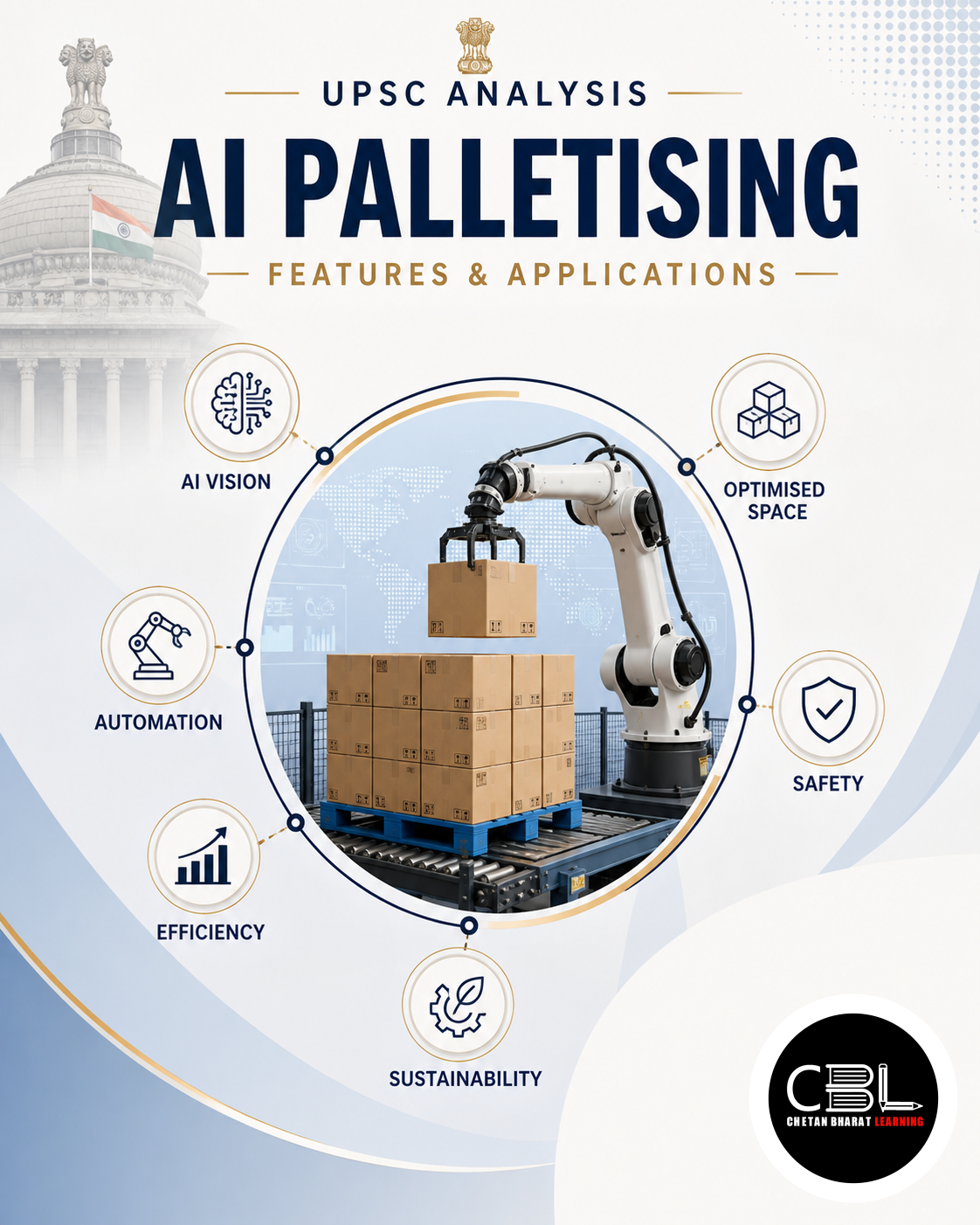
AI Palletising is an advanced industrial automation technology that uses artificial intelligence, computer vision, machine learning and robotic arms to automatically stack products onto pallets (palletising) or remove products from pallets (depalletising). Unlike conventional industrial robots that require fixed programming, AI-enabled systems can adapt to mixed product sizes, irregular packaging and damaged cartons without manual reprogramming.
The technology forms a key component of Industry 4.0, enabling intelligent warehouses and automated production facilities to improve operational efficiency, safety and supply chain management.
Why is AI Palletising in News?
According to Future Market Insights (FMI), the global AI palletising and depalletising market is expected to grow from approximately $1.8 billion in 2026 to nearly $9 billion by 2036, reflecting the rapid adoption of AI-driven automation across logistics, manufacturing and e-commerce industries.
The growing demand is driven by increasing warehouse automation, labour shortages and the need for faster, more accurate supply chains. More information on AI developments can be accessed through the Ministry of Electronics and Information Technology.
Key Features of AI Palletising
- 3D computer vision: High-resolution cameras identify package dimensions, orientation and structural integrity in real time.
- Machine learning algorithms: AI determines optimal gripping points and generates stable stacking patterns that maximise pallet utilisation.
- Adaptive robotic execution: Multi-axis robotic arms continuously adjust movement, speed and gripping force based on sensor feedback.
- Mixed-case handling: The system efficiently handles packages of different sizes, weights and shapes on a single pallet without manual programming.
- Continuous learning: Machine learning models improve operational efficiency by learning from previous handling tasks and error recovery.
Applications of AI Palletising
- E-commerce and logistics: Automates warehouse operations, mixed-SKU order fulfillment and container unloading.
- Food and beverage industry: Handles bottles, cartons, crates and packaged food with high accuracy.
- FMCG sector: Supports high-volume distribution centers managing diverse product portfolios.
- Pharmaceuticals: Enables careful handling of medicines and sensitive healthcare products.
- Chemical industry: Improves safety while handling hazardous or heavy industrial materials.
Challenges
- High initial investment: Advanced robotic systems, sensors and AI software require substantial capital expenditure.
- Legacy system integration: Integrating AI with older warehouse management systems and conveyor infrastructure remains technically complex.
- Maintenance requirements: Regular calibration and specialised technical expertise are necessary for reliable operation.
- Cybersecurity concerns: Increasing digital connectivity exposes industrial systems to cyber threats.
- Skilled workforce: Industries require trained professionals capable of operating and maintaining AI-enabled robotic systems.
Way Forward
India’s manufacturing sector can benefit from AI palletising by promoting automation, improving productivity and reducing operational costs. Investments in digital infrastructure, AI research and workforce reskilling will accelerate adoption across industries.
Encouraging innovation under Industry 4.0, along with stronger cybersecurity standards and greater interoperability between legacy and modern systems, will enable sustainable deployment of AI-driven industrial automation. Additional information on AI initiatives is available through the Digital India programme.
Prelims Practice Corner
Q1. AI palletising primarily combines which technologies?
- (a) Blockchain and IoT only
- (b) Artificial Intelligence, Computer Vision and Robotics
- (c) Quantum Computing
- (d) Satellite Navigation
Answer: (b) AI palletising integrates artificial intelligence, computer vision and robotic systems.
Q2. The primary function of computer vision in AI palletising is to:
- (a) Generate electricity
- (b) Identify package dimensions and orientation
- (c) Manage payroll
- (d) Store inventory records
Answer: (b) Computer vision scans packages to determine size, position and condition.
Q3. AI palletising is an important component of:
- (a) Green Revolution
- (b) Industry 4.0
- (c) Blue Economy
- (d) White Revolution
Answer: (b) It supports intelligent automation under Industry 4.0.
Q4. Which sector extensively uses AI palletising for mixed-SKU order fulfillment?
- (a) Banking
- (b) E-commerce and logistics
- (c) Tourism
- (d) Fisheries
Answer: (b) AI palletising is widely adopted in e-commerce warehouses and logistics centres.
Q5. One major challenge associated with AI palletising is:
- (a) Lack of electricity generation
- (b) High capital investment
- (c) Water scarcity
- (d) Poor internet browsing
Answer: (b) Advanced robotic systems require substantial initial investment.
Mains Practice Questions
Q1. Discuss the role of AI palletising in advancing Industry 4.0 and supply chain automation. (10 marks)
Answer Structure
- Intro: Define AI palletising.
- Body: Explain technology, industrial applications, benefits and implementation challenges.
- Conclusion: Highlight AI-driven manufacturing transformation.
Q2. Evaluate the opportunities and challenges of artificial intelligence in industrial automation in India. (15 marks)
Answer Structure
- Intro: Introduce AI in manufacturing.
- Body: Cover productivity, employment, infrastructure, cybersecurity and policy support.
- Conclusion: Emphasise responsible adoption of AI technologies.
FAQs
What is AI palletising?
AI palletising uses artificial intelligence, robotic arms and computer vision to automatically stack or unstack products with minimal human intervention.
Which industries benefit from AI palletising?
It is widely used in e-commerce, logistics, food and beverage, FMCG, pharmaceuticals and chemical industries.
Why is AI palletising important for UPSC?
The topic is relevant for GS Paper III because it covers artificial intelligence, robotics, Industry 4.0, manufacturing technology and industrial innovation.
Related Current Affairs
Preparing for UPSC, PCS or HCS?
Talk to a mentor at Chetan Bharat Learning, Chandigarh. Free guidance on choosing the right exam and building a study plan.
Chat on WhatsAppCall 97793 53345UPSC / IAS / PCS coaching in Chandigarh · Trusted by aspirants across Punjab & Haryana
Leave a Reply
You must be logged in to post a comment.