

UPSC Mapping
What is the Inter-Parliamentary Union?
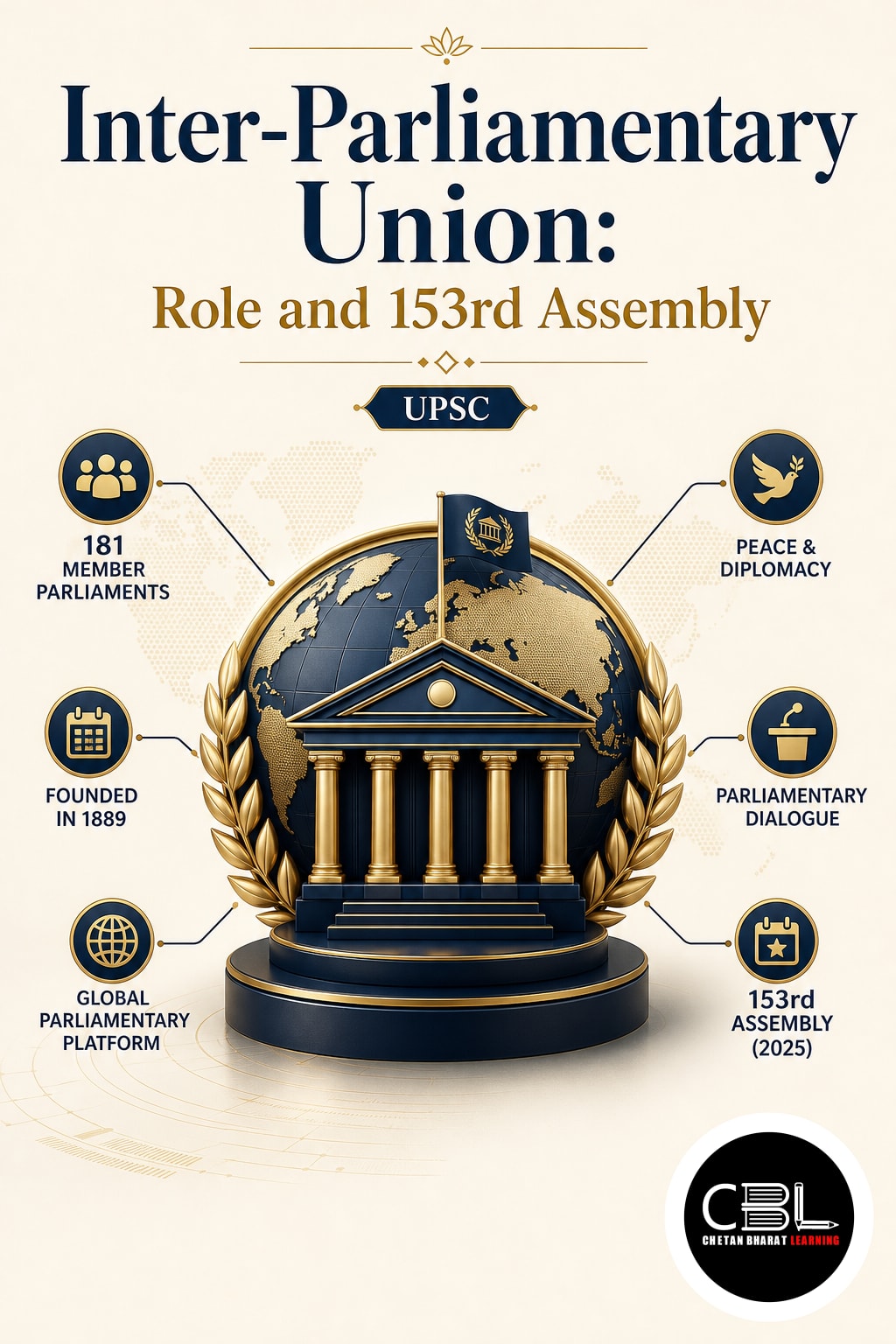
The Inter-Parliamentary Union is the global organisation of national parliaments and the oldest permanent international political organisation. British parliamentarian William Randal Cremer and French parliamentarian Frédéric Passy initiated the body in Paris in 1889. Their early work promoted arbitration and dialogue as alternatives to interstate conflict.
The organisation now facilitates cooperation among legislatures on peace and security, democratic governance, human rights, gender equality, youth participation, climate action and development. Member parliaments finance most of its work, while its secretariat operates from the House of Parliaments in Geneva. The body is distinct from the United Nations, although its Permanent Observer status supports structured cooperation with the UN system.
Why is the Inter-Parliamentary Union in News?
The 153rd IPU Assembly is meeting in Arusha, Tanzania, from 5 to 9 October 2026. Rajya Sabha Deputy Chairman Harivansh leads the Indian Parliamentary Delegation, which is participating in committee sessions, geopolitical consultations and thematic discussions. The official PIB announcement confirms India’s participation and the Assembly’s inclusive governance focus.
The General Debate examines good governance and community empowerment through inclusivity, trust and opportunities for all. Delegates will also consider parliamentary strategies supporting persons with disabilities and may adopt one emergency item on an urgent international concern. The Governing Council is scheduled to elect the organisation’s 32nd President on 9 October for a three-year term.
Key Features
- Global membership: National parliaments join as members, while regional parliamentary bodies may participate as Associate Members within the organisation’s wider network.
- Biannual Assemblies: Delegations meet twice yearly to debate global concerns, negotiate resolutions and translate international commitments into possible parliamentary action.
- Governing bodies: The Assembly, Governing Council, Executive Committee and Secretariat divide deliberative, supervisory, administrative and implementation responsibilities.
- Specialised forums: Standing Committees and forums for women and young parliamentarians develop recommendations on peace, development, democracy and representation.
- Knowledge resources: The Parline database and thematic reports provide comparable information on legislatures, elections, representation and institutional practice.
The Assembly serves as the principal arena for parliamentary debate, but it does not function as a world legislature. Its resolutions express negotiated political positions rather than directly binding national laws. Participating legislators must pursue implementation through domestic law-making, budgets, oversight and constituency engagement.
The Governing Council determines membership and guides policy, while the Executive Committee supervises administration and offers recommendations. The President acts as the political head, chairs statutory meetings and represents the organisation globally. The Secretary General directs the secretariat and supports continuity between assemblies.
The Inter-Parliamentary Union also protects legislators through its Committee on the Human Rights of Parliamentarians. The committee examines complaints involving serving or former lawmakers and seeks dialogue-based remedies with national authorities. This mandate links institutional democracy with the safety and independence of elected representatives.
Parliamentary diplomacy differs from executive diplomacy because elected legislators bring constituency concerns and diverse party positions into international discussion. Their participation can widen public scrutiny of foreign policy and expose domestic institutions to comparative legislative practices. It also creates informal channels for communication when official relations become tense.
The organisation’s partnership with the United Nations adds a legislative dimension to global governance. Governments negotiate international commitments, but parliaments often approve laws, authorise spending and monitor implementation. Regular interaction can therefore narrow the gap between diplomatic promises and results experienced by citizens.
Delegations can strengthen legitimacy by publishing positions before assemblies and reporting outcomes afterwards. Open committee review allows citizens to assess whether international engagement influences legislation or oversight.
Challenges
- Non-binding outcomes: Resolutions depend on member legislatures for translation into national laws, oversight priorities and budgetary decisions.
- Political differences: Conflicting national positions can weaken consensus on wars, sanctions, territorial disputes and urgent humanitarian questions.
- Unequal representation: Low participation by women, young legislators and marginalised groups can limit the inclusiveness of parliamentary diplomacy.
- Domestic follow-through: Delegations may engage actively abroad without establishing clear reporting and accountability mechanisms inside their national parliaments.
- Institutional capacity: Legislatures with limited research, technology or staffing resources may struggle to implement complex international commitments effectively.
The organisation must maintain dialogue without appearing indifferent to serious violations of democratic rights or international law. Excessively general consensus can produce weak outcomes, while polarised voting may reduce space for mediation. Credibility therefore depends on transparent procedures, factual evidence and sustained engagement after formal meetings conclude.
National delegations also vary in political diversity and authority. A delegation may represent its parliament formally without reflecting every party, region or social group within that legislature. Our polity and governance archive helps connect such representation questions with legislative accountability.
Digital transformation creates additional opportunities and risks for parliaments. Artificial intelligence can support legislative research and public communication, but it may introduce bias, privacy concerns and unreliable summaries. International exchanges should therefore emphasise democratic control, transparency and institutional safeguards alongside technological efficiency.
Resources and political attention also differ sharply across national legislatures. Wealthier parliaments can maintain specialist delegations and research support, while smaller legislatures may face travel, staffing and language constraints. Fair participation requires accessible documentation, interpretation and capacity-building that responds to each parliament’s institutional needs.
Way Forward
Member parliaments should establish systematic procedures for reporting Assembly outcomes, referring commitments to committees and tracking domestic implementation. Stronger legislative research services can convert broad resolutions into country-specific policy options and measurable oversight questions. Greater participation by women, youth and opposition members would also improve representative legitimacy.
The organisation should retain dialogue across geopolitical divides while improving transparency around voting, implementation and results. Its official 153rd Assembly portal provides agendas, draft resolutions and governing documents for public scrutiny. Connecting these records with national parliamentary debates can make the Inter-Parliamentary Union a stronger bridge between global commitments and democratic accountability.
Prelims Practice Corner
Mains Practice Questions
FAQs on Inter-Parliamentary Union
Is the IPU part of the United Nations?
No. It is an independent global parliamentary organisation, not a UN specialised agency. It has held Permanent Observer status at the United Nations since 2002.
Are IPU resolutions legally binding?
Its resolutions generally express collective parliamentary positions rather than creating binding international law. National parliaments must use legislation, budgets and oversight to convert commitments into domestic action.
What is the theme of the 153rd IPU Assembly?
The theme focuses on good governance and empowering communities through inclusivity, trust and opportunities for all. It links representative institutions with social inclusion and public confidence.
Related Current Affairs
Preparing for UPSC, PCS or HCS?
Talk to a mentor at Chetan Bharat Learning, Chandigarh. Free guidance on choosing the right exam and building a study plan.
Chat on WhatsAppCall 97793 53345UPSC / IAS / PCS coaching in Chandigarh · Trusted by aspirants across Punjab & Haryana
Leave a Reply
You must be logged in to post a comment.