
UPSC Mapping
| Exam | Topic |
|---|---|
| Prelims | Modern Indian History |
| Mains | GS Paper I: Freedom Struggle |
Quick Facts
| Born | 4 October 1857 |
| Birthplace | Mandvi, Kachchh |
| Key Organisation | Indian Home Rule Society |
| Journal | The Indian Sociologist |
What is Shyamji Krishna Varma?
Shyamji Krishna Varma was a Sanskrit scholar, lawyer, journalist and revolutionary nationalist from Mandvi in present-day Gujarat. Born on 4 October 1857, he gained recognition for scholarship before turning increasingly towards political organisation against colonial rule. His intellectual formation combined Indian reformist thought, European political debate and a firm belief in national self-government.
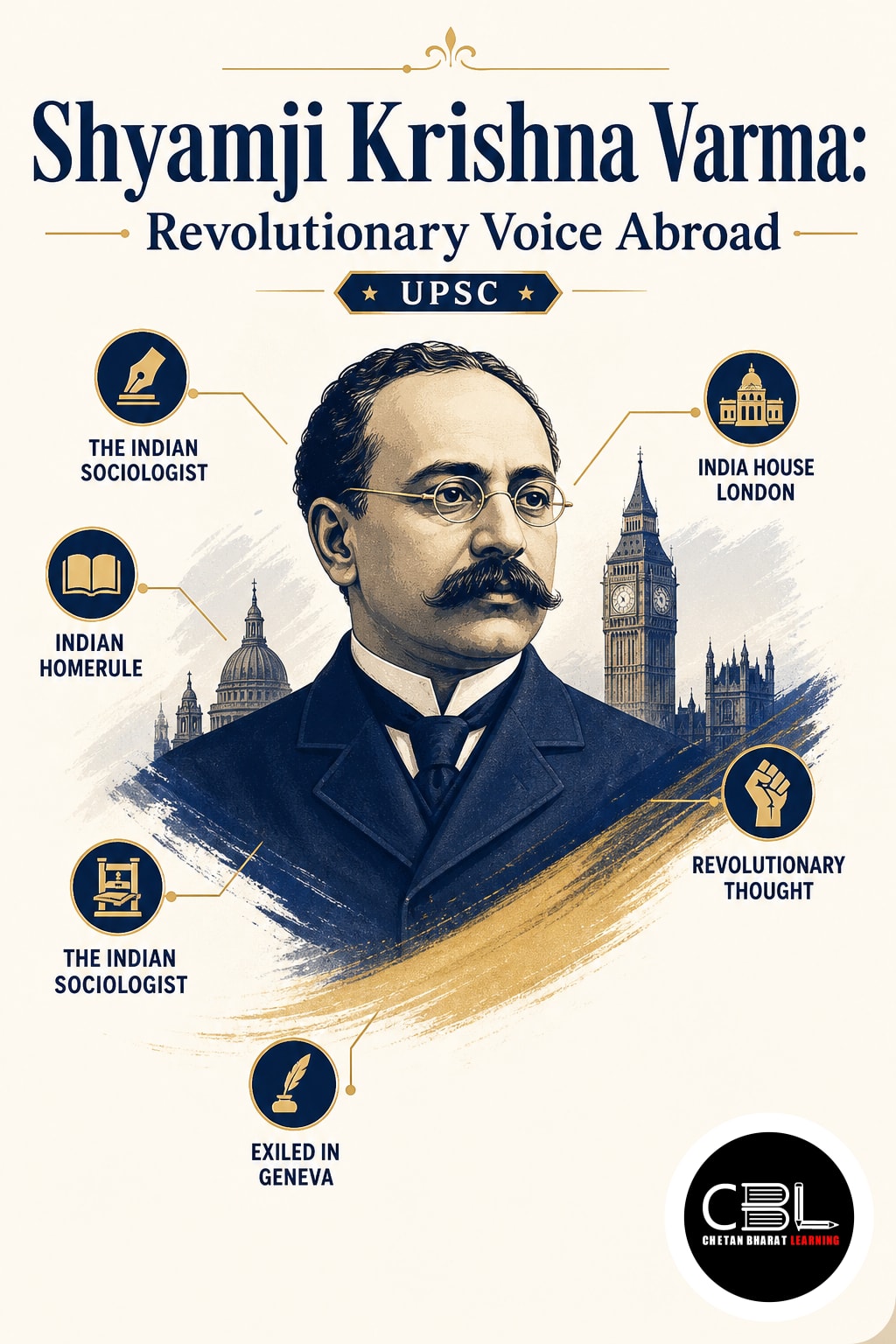
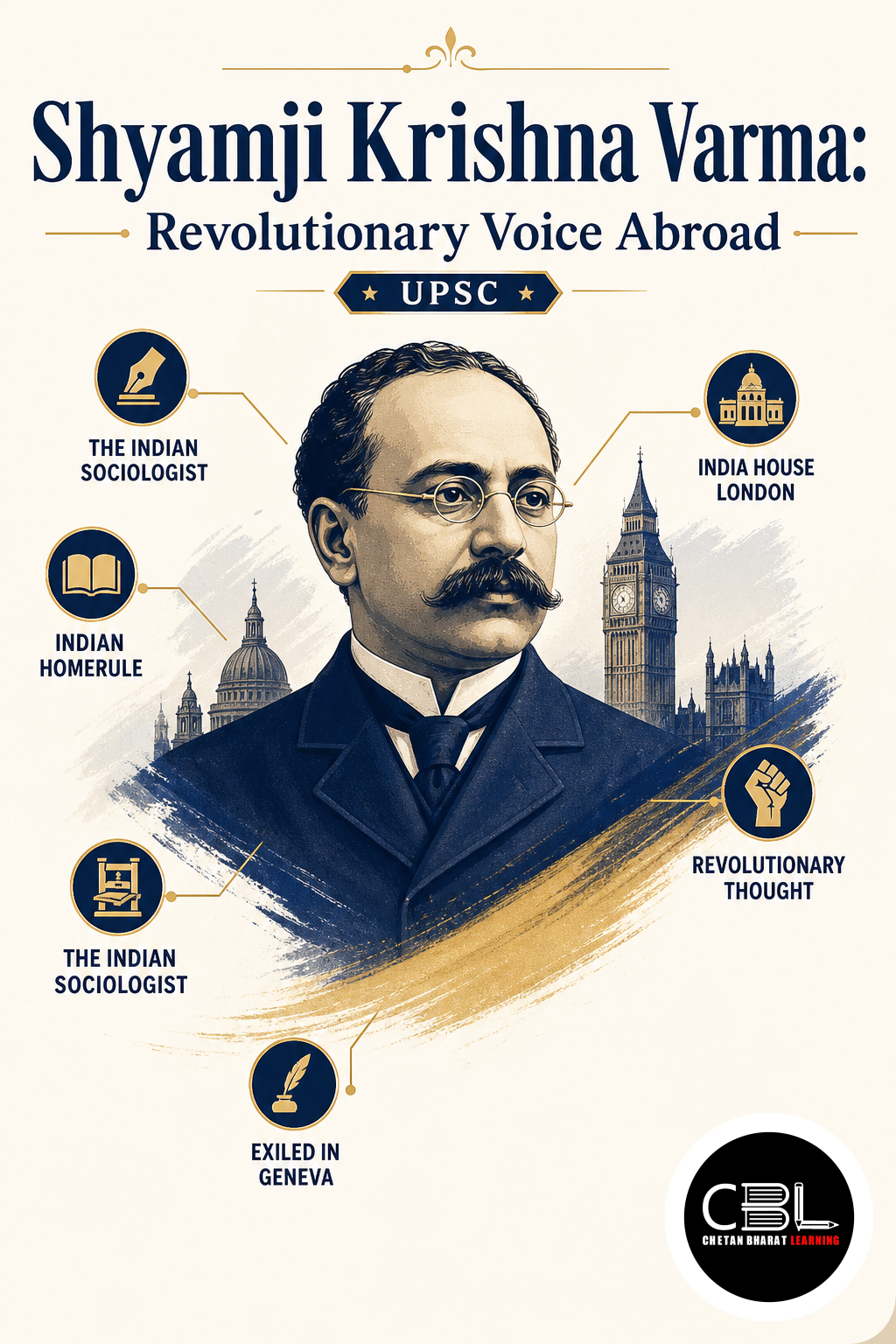
He made London a strategic centre for advocating Indian freedom, where imperial institutions and international opinion could be directly addressed. In 1905, he launched The Indian Sociologist, founded the Indian Home Rule Society and developed India House as a residence and political meeting space. These initiatives connected students, writers and activists who sought stronger methods than constitutional petitions alone.
Why is Shyamji Krishna Varma in News?
The Prime Minister paid homage on his birth anniversary on 4 October 2026, recalling his courage and lifelong dedication to ending colonial subjugation. The official PIB tribute renewed attention to the international dimension of India’s freedom struggle. The commemoration also highlights how expatriate networks challenged empire through print, association and political education.
The anniversary matters for historical understanding because the national movement operated both within India and across global cities. London offered access to Indian students, British political circles and publishing channels, while Paris and Geneva later provided spaces for continued advocacy. His career therefore helps learners connect diaspora politics, revolutionary networks and colonial surveillance within one analytical framework.
Key Features
His work combined political communication, institution building and material assistance for Indians abroad.
- The Indian Sociologist: The English monthly presented arguments for self-rule, criticised colonial governance and circulated nationalist ideas beyond India’s borders.
- Indian Home Rule Society: Established in February 1905, the organisation promoted home rule, national unity and sustained propaganda against British domination.
- India House: Opened in London in 1905, this student residence became a meeting point for politically active Indians and sympathetic international voices.
- Student support: Scholarships and affordable accommodation reduced practical barriers, allowing talented Indians to study while encountering wider nationalist debates.
- European network: His later activity in Paris and Geneva kept the independence question visible after official pressure narrowed his room in Britain.
These initiatives formed an ecosystem rather than isolated ventures. Print created arguments, associations recruited supporters, residential space encouraged discussion and scholarships cultivated future political actors. Shyamji Krishna Varma thus demonstrated how organisational infrastructure could amplify ideas across borders despite the absence of mass communication technologies.
India House also revealed the diversity within early twentieth-century nationalism. Its circles included people with different methods, ideological influences and assessments of political violence. The shared objective was Indian freedom, but approaches ranged from intellectual persuasion and non-cooperation to more militant revolutionary activity.
The movement’s institutional design turned personal conviction into collective capacity. A journal could define political objectives, while a society converted readers into participants and maintained regular discussion. Residential support helped students develop durable relationships beyond occasional meetings or public lectures.
This combination made overseas activism more resilient than a single campaign. It connected intellectual criticism with practical resources and gave younger nationalists access to mentors, texts and international contacts. The model shows why organisations often matter as much as celebrated individuals within political history.
These activities also internationalised an issue that colonial authorities often presented as domestic administration. Public argument in Britain exposed imperial claims to scrutiny and created opportunities for solidarity with other political movements. International attention could not replace mobilisation within India, but it widened the arena in which colonial legitimacy faced sustained challenge.
Challenges
Overseas nationalism faced imperial surveillance, restricted communication and continuing disagreements about strategy.
- State monitoring: British authorities watched publications, organisations and personal networks that questioned imperial legitimacy or encouraged organised resistance.
- Press restrictions: Colonial controls complicated the printing, circulation and receipt of nationalist material across Britain, Europe and India.
- Political exile: Movement between London, Paris and Geneva disrupted stable organisation and separated leaders from developments inside India.
- Strategic divisions: Nationalists differed over petitions, non-cooperation, revolutionary action and the acceptable limits of political resistance.
- Uneven remembrance: Textbook narratives often privilege domestic mass movements, leaving transnational organisers and supporting institutions less visible.
Assessing such networks also requires care with historical evidence. Colonial intelligence records may reflect official anxieties, while commemorative accounts can compress complex ideological differences into heroic summaries. Students should compare organisational records, journals, correspondence and later scholarship before drawing conclusions about influence or intent.
A balanced account should neither isolate overseas activists nor treat every nationalist as part of one uniform strategy. Their significance lies in widening the political arena, creating international publicity and supporting people who later influenced anti-colonial action. Our freedom struggle analyses place these networks alongside social reform, constitutional politics and mass mobilisation.
Physical distance created another structural limitation. Overseas organisers could shape debate and assist individuals, yet they lacked direct access to many rural and working-class communities. Their political reach therefore depended on circulation networks, returning students and connections with organisations operating inside India.
Later historical narratives also risk judging early activists through categories developed during subsequent mass movements. Contextual analysis must distinguish home rule, complete independence, passive resistance and revolutionary action as changing concepts. This approach clarifies both the contribution and the limits of expatriate political work.
Way Forward
Historical education should integrate overseas centres into the broader story of India’s freedom movement. Digitising archival journals, letters and institutional records can help students examine claims through primary material rather than isolated anecdotes. Universities and museums can jointly map connections among India House, expatriate publications, student networks and political groups operating within India.
Public commemoration should explain ideas, methods and historical context alongside personal courage. The official Kachchh memorial profile records his Mandvi origins, London activities and educational legacy. Linking such institutions with curated digital material can strengthen evidence-based remembrance and illuminate how Shyamji Krishna Varma built political agency across borders.
Prelims Practice Corner
Q1. Which publication was founded to circulate nationalist and reformist ideas from London?
(a) Bande Mataram (b) The Indian Sociologist (c) Kesari (d) Young India
Answer: (b) The Indian Sociologist was launched in London in 1905.
Q2. India House was established in which city?
(a) Paris (b) Geneva (c) London (d) Berlin
Answer: (c) India House operated at Highgate in London.
Q3. The Indian Home Rule Society was founded in:
(a) 1885 (b) 1905 (c) 1916 (d) 1920
Answer: (b) The society was established in London in February 1905.
Q4. Mandvi, his birthplace, lies in which present-day state?
(a) Rajasthan (b) Maharashtra (c) Gujarat (d) Madhya Pradesh
Answer: (c) Mandvi lies in the Kachchh district of Gujarat.
Q5. Consider the following pairs: 1. India House—Student residence and nationalist centre; 2. The Indian Sociologist—Monthly journal; 3. Indian Home Rule Society—Promotion of self-government. How many pairs are correctly matched?
(a) Only one (b) Only two (c) All three (d) None
Answer: (c) All three descriptions correctly match their respective institutions.
Mains Practice Questions
Q1. Examine the role of overseas organisations and publications in India’s freedom struggle. (250 words, 15 marks)
Answer Structure
- Intro: Frame the international reach of Indian anti-colonial nationalism.
- Body: Cover India House, print networks, student support, global advocacy and colonial surveillance.
- Conclusion: Link overseas mobilisation with the wider, diverse freedom movement.
Q2. Evaluate the contribution of expatriate revolutionary networks to nationalist political consciousness. (150 words, 10 marks)
Answer Structure
- Intro: Define expatriate networks within the freedom struggle.
- Body: Discuss publications, associations, scholarships, international opinion and strategic limitations.
- Conclusion: Assess their catalytic role without overstating direct mass influence.
FAQs on Shyamji Krishna Varma
Why was India House historically important?
It provided residential support and a forum for political discussion among Indian students in London. The institution became closely associated with revolutionary nationalism and overseas anti-colonial networking.
What was the purpose of The Indian Sociologist?
The monthly journal argued for Indian self-government and criticised colonial policies. It carried nationalist discussion to audiences in Britain, Europe and India through political journalism.
Where is his memorial located?
The Kranti Teerth memorial stands near Mandvi in Gujarat’s Kachchh district. It preserves his association with India House and introduces visitors to overseas resistance.
Related Current Affairs
Preparing for UPSC, PCS or HCS?
Talk to a mentor at Chetan Bharat Learning, Chandigarh. Free guidance on choosing the right exam and building a study plan.
Chat on WhatsAppCall 97793 53345UPSC / IAS / PCS coaching in Chandigarh · Trusted by aspirants across Punjab & Haryana
Leave a Reply
You must be logged in to post a comment.