
UPSC Mapping
| Exam | Topic |
|---|---|
| Prelims | BRICS and International Institutions |
| Mains | GS Paper II — International Relations |
Quick Facts
| Established | Headquarters | Founding Members | Authorised Capital |
|---|---|---|---|
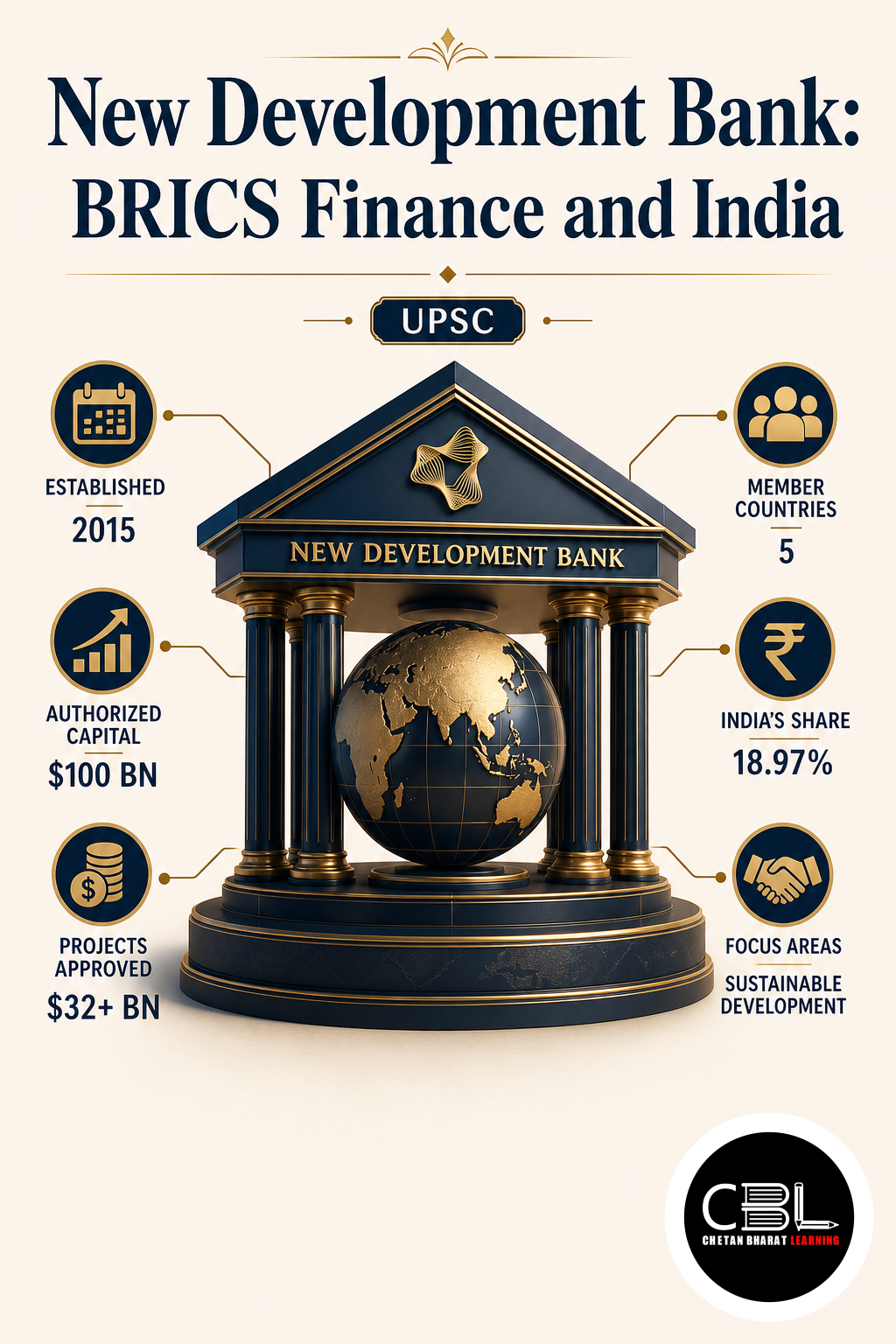
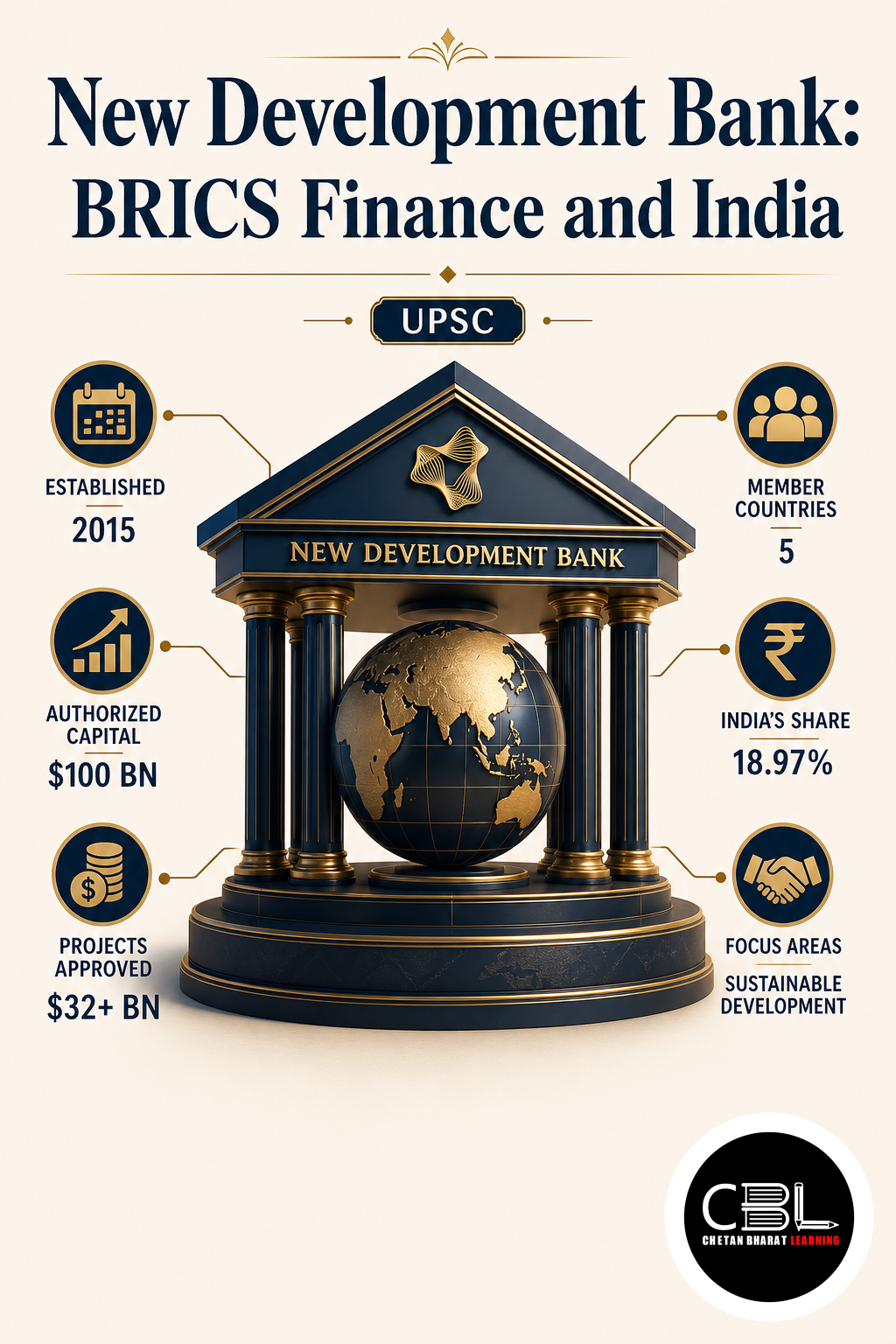
| 2015 | Shanghai, China | Brazil, Russia, India, China and South Africa | US$100 billion |
What is New Development Bank?
The New Development Bank is a multilateral development bank established by Brazil, Russia, India, China and South Africa. Its central purpose is to mobilise resources for infrastructure and sustainable development projects in BRICS members and other emerging economies. The institution supports areas such as clean energy, transport, water and sanitation, urban development, environmental protection and social infrastructure.
BRICS leaders first considered the proposal at their New Delhi summit in 2012. They signed the establishing agreement during the sixth BRICS Summit at Fortaleza, Brazil, in 2014. The bank formally launched in 2015 and later became fully operational. It began with an authorised capital of US$100 billion and an initial subscribed capital of US$50 billion, distributed equally among the five founders.
Why is New Development Bank in News?
The New Development Bank remains significant as BRICS members debate reforms in the global financial system and greater development financing for emerging economies. India holds the BRICS chairship in 2026, bringing questions of resilience, innovation, cooperation and sustainability into sharper focus. The institution also represents an effort to give developing countries a stronger role in designing and financing projects that reflect their priorities.
Its expanding membership has strengthened this relevance. Alongside the five founders, the bank lists Bangladesh, the United Arab Emirates, Egypt, Algeria and Uzbekistan as members. Membership remains open to United Nations members under the bank’s founding agreement. The official NDB membership portal distinguishes full members from prospective members that must complete accession procedures.
Key Features
- Equal founding shareholding: Each founding member initially subscribed an equal share, giving the five countries equal voting strength and preventing a single founder from holding a veto.
- Development mandate: The bank finances infrastructure and sustainable development projects aligned with members’ priorities, the Sustainable Development Goals and climate commitments.
- Local-currency finance: Lending and borrowing in members’ currencies can reduce exchange-rate exposure and support the development of domestic capital markets.
- Open membership: United Nations members may join as borrowing or non-borrowing members, allowing the institution to extend its geographical reach.
- Regional presence: Offices outside Shanghai strengthen project preparation, local engagement, monitoring and institutional partnerships across member regions.
The General Strategy for 2022–2026 set measurable operational goals. It targeted US$30 billion in approved financing from the bank’s balance sheet, with 30% of financing in local currencies and 30% directed towards non-sovereign operations. The strategy also envisaged co-financing 20% of projects with partner multilateral banks and directing 40% of approvals towards climate mitigation and adaptation. These targets show an effort to combine scale, sustainability and financial innovation.
Challenges
- Resource mobilisation: Large infrastructure gaps require the institution to expand lending without weakening capital adequacy, creditworthiness or prudent risk management.
- Currency risks: Local-currency lending can protect borrowers, but the bank must obtain stable funding and manage mismatches across several currencies.
- Geopolitical pressures: Strategic differences among members and tensions in the international system can complicate financing, settlements and external partnerships.
- Project quality: Rapid approval must not dilute environmental safeguards, social protection, transparency, procurement standards or long-term financial viability.
- Balanced representation: Expansion requires fair participation for newer members while preserving the founding principle of equality among the original shareholders.
The bank must also demonstrate that it complements rather than merely duplicates established development institutions. Its comparative advantage may lie in faster project preparation, greater use of national systems and closer attention to borrower priorities. Yet country ownership must operate alongside credible safeguards and public accountability.
Way Forward
The New Development Bank should deepen local-currency finance through domestic bond markets, currency-risk instruments and cooperation with national development institutions. It can mobilise more private investment through guarantees, blended finance and carefully designed public-private partnerships. Strong project pipelines, transparent selection standards and measurable development outcomes would help protect institutional credibility while increasing lending capacity.
For India, the bank offers a platform to advance sustainable infrastructure, climate resilience and more representative global governance. India can support projects involving renewable energy, resilient cities, transport connectivity, water security and digital public infrastructure. Coordination with other multilateral banks can expand financial reach and avoid duplication.
Prelims Practice Corner
Q1. Which countries were the founding members of the NDB?
- (a) BRICS countries including all present members
- (b) Original five BRICS countries
- (c) G7 countries
- (d) SAARC countries
Answer: (b) Brazil, Russia, India, China and South Africa established the institution.
Q2. Where is the headquarters of the NDB located?
- (a) New Delhi
- (b) Johannesburg
- (c) Shanghai
- (d) Brasília
Answer: (c) Its headquarters is located in Shanghai, China.
Q3. Consider the following statements: 1. Membership is open to United Nations members. 2. One founding member possesses a permanent veto. Which is correct?
- (a) 1 only
- (b) 2 only
- (c) Both 1 and 2
- (d) Neither 1 nor 2
Answer: (a) UN members may join, while no single founding member holds veto power.
Q4. The institution primarily mobilises resources for:
- (a) military alliances
- (b) infrastructure and sustainable development
- (c) humanitarian intervention
- (d) regulating international trade
Answer: (b) Its mandate focuses on infrastructure and sustainable development in emerging economies.
Q5. Under the 2022–2026 strategy, what proportion of approvals was targeted for climate-related projects?
- (a) 20%
- (b) 30%
- (c) 40%
- (d) 50%
Answer: (c) The strategy targeted 40% for climate mitigation and adaptation, including energy transition.
Mains Practice Questions
Q1. Examine the role of the NDB in reforming the global development-finance architecture. (250 words, 15 marks)
Answer Structure
- Intro: Present the institution as a BRICS-created multilateral development bank.
- Body: Discuss equal founding votes, infrastructure finance, local currencies, climate funding, membership expansion, safeguards and geopolitical constraints.
- Conclusion: Link its future relevance with credible governance, wider resources and measurable development outcomes.
Q2. Local-currency financing can strengthen development cooperation but also creates financial risks. Discuss with reference to BRICS. (150 words, 10 marks)
Answer Structure
- Intro: Define local-currency financing and its development purpose.
- Body: Cover exchange-rate protection, domestic capital markets, funding availability, currency mismatches, liquidity and risk-management requirements.
- Conclusion: Recommend gradual expansion supported by hedging tools and sound financial governance.
FAQs on New Development Bank
Why did the BRICS countries establish the NDB?
They created it to mobilise additional resources for infrastructure and sustainable development in emerging economies. It also gives developing countries a greater institutional role in development finance.
How is the NDB different from traditional multilateral banks?
Its five founders began with equal subscribed shares and equal voting strength, without a unilateral veto. It also emphasises borrower priorities, national systems and local-currency financing.
Why is the institution important for India?
It can finance Indian infrastructure, renewable energy and climate-resilience projects while supporting India’s Global South diplomacy. India also gains a platform for advocating more representative international financial governance.
Related Current Affairs
Preparing for UPSC, PCS or HCS?
Talk to a mentor at Chetan Bharat Learning, Chandigarh. Free guidance on choosing the right exam and building a study plan.
Chat on WhatsAppCall 97793 53345UPSC / IAS / PCS coaching in Chandigarh · Trusted by aspirants across Punjab & Haryana
Leave a Reply
You must be logged in to post a comment.