
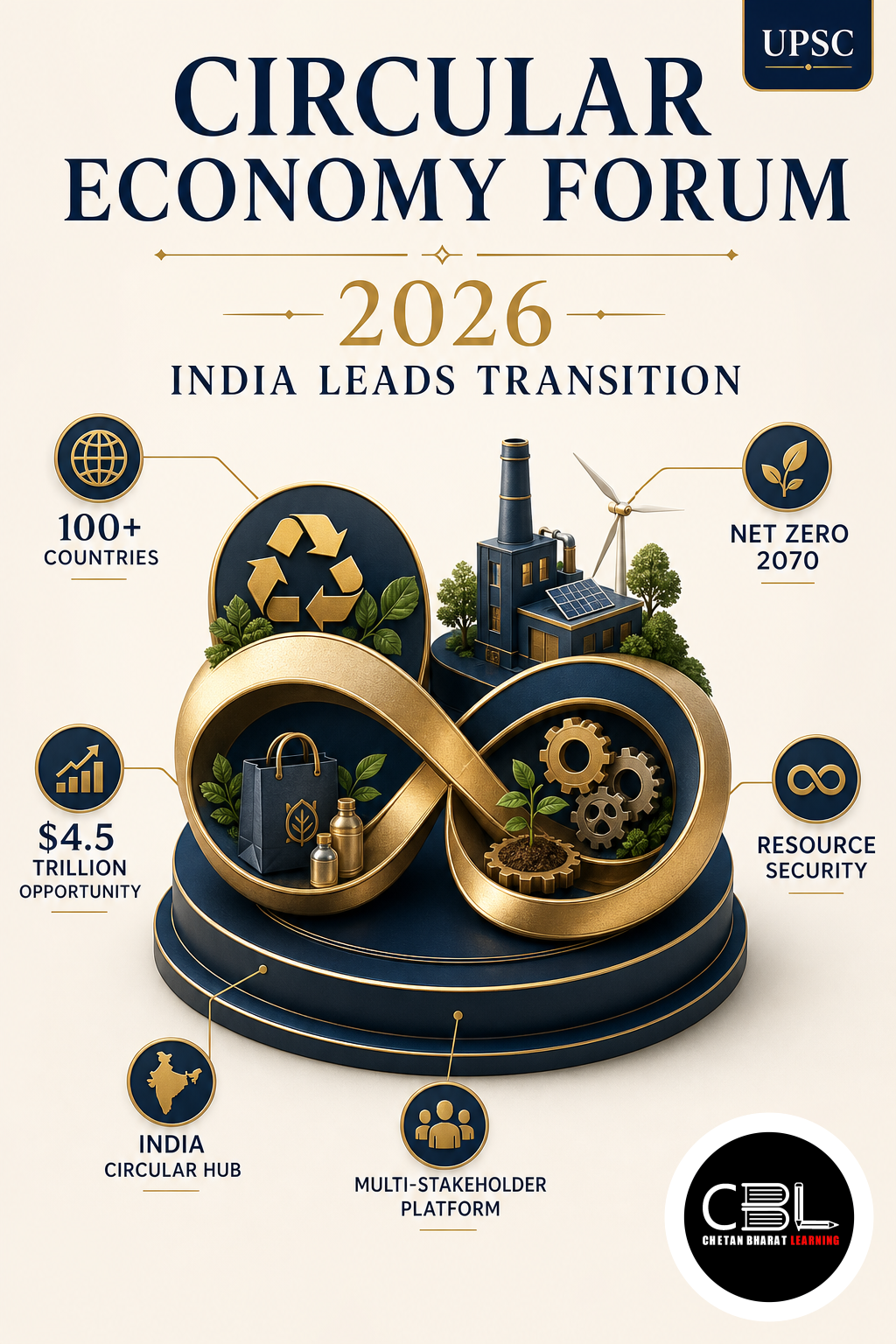

UPSC Mapping
| Prelims | Environment, Economy and Institutions |
|---|---|
| Mains | GS Paper III: Environment and Economy |
Quick Facts
| Dates | 15–18 September 2026 |
|---|---|
| Venue | Mahatma Mandir, Gandhinagar |
| Edition | Tenth |
| Theme | Transition for People and Prosperity |
Article
What is Circular Economy Forum?
The Circular Economy Forum is a global platform where governments, businesses, researchers and innovators present scalable circular solutions. The Finnish Innovation Fund Sitra initiated the annual event in 2017 with international partners. It promotes an economic system that keeps materials in use and supports natural regeneration.
A circular economy replaces the take-make-dispose model with reduction, repair, reuse, remanufacturing and recycling. Producers consider a product’s entire life cycle, including design, maintenance and safe recovery. This approach seeks to decouple economic value from rising extraction while reducing waste and pollution.
Why is Circular Economy Forum in News?
The Circular Economy Forum opened in Gandhinagar on 15 September 2026 and runs until 18 September. India is hosting the event for the first time, while South Asia is hosting it for the first time. The tenth edition carries the theme Circular Economy: Transition for People and Prosperity.
Sitra and the Central Pollution Control Board jointly organise WCEF 2026 with support from MoEFCC and Gujarat. The main programme includes plenaries, parallel sessions and an expo, followed by accelerator sessions. The official government release links the event with international cooperation, finance, innovation and the Global South.
Key Features
- Global participation: Policymakers, businesses, international organisations, researchers, entrepreneurs and civil society exchange solutions across developed and developing economies.
- Scalable solutions: Sessions examine approaches that can reshape value chains, improve competitiveness and reduce dependence on virgin materials.
- People-centred transition: The theme connects environmental goals with livelihoods, affordability, inclusion, skills and equitable access to economic opportunities.
- Finance and innovation: Participants discuss private investment, digital tools, start-ups and policies that can make circular business models commercially viable.
- Global South focus: The forum highlights local value addition, resilient supply chains and development pathways suited to resource-constrained economies.
The main forum on 15 and 16 September features plenaries, thematic sessions and an exhibition. Collaborators conduct accelerator sessions on 17 and 18 September in Gandhinagar and online. This structure moves discussion from broad commitments towards partnerships, financing and implementation.
India brings substantial regulatory experience to the event through extended producer responsibility frameworks. These systems require producers to support collection and environmentally sound management after consumer use. National rules cover notified sectors including plastics, e-waste, batteries, tyres, used oil and end-of-life vehicles.
The event also complements Mission LiFE and the principles of reduce, reuse and recycle. Mission LiFE encourages individuals and communities to adopt environmentally responsible behaviour. Industrial circularity adds product design, material tracking and reverse logistics to this behavioural approach.
Circular practices can improve economic resilience when conflicts or trade restrictions disrupt raw-material supplies. Repair, remanufacturing and secondary materials create domestic sources of usable inputs. They can also support local enterprises and skilled employment in collection, maintenance and resource recovery.
Measurement is essential because circularity involves more than counting recycled tonnes. Indicators should track material productivity, product lifespan, repair rates, recycled content and avoided disposal. Comparable metrics help governments identify whether policies reduce virgin-resource demand or merely shift waste between locations.
Businesses gain when circular models reduce exposure to volatile commodity markets. Leasing, product-service systems and remanufacturing can preserve ownership of valuable materials across repeated use cycles. Such models require consumer trust, fair worker protections, affordable finance, predictable standards and efficient systems for returning used products.
Challenges
India must bridge implementation gaps before circularity becomes normal across production and consumption systems.
- Linear product design: Many goods remain difficult to repair, disassemble or recycle because manufacturers prioritise short-term cost and convenience.
- Informal-sector risks: Waste workers provide essential recovery services but often lack safe equipment, stable earnings, recognition and social protection.
- Weak material data: Limited information on resource flows, recycled content and product life cycles complicates targets, enforcement and investment.
- Financing barriers: New recovery technologies and reverse-logistics systems can face uncertain revenue, high initial costs and limited affordable credit.
- Quality concerns: Buyers may avoid secondary materials when standards, certification, traceability and dependable supplies remain inadequate.
Collection alone cannot ensure circularity. Mixed waste, contamination and unsafe processing can destroy material value or transfer pollution elsewhere. Cities need source segregation, reliable transport, scientific facilities and enforcement against dumping and open burning.
Policies must prevent greenwashing and misleading recycling claims. Clear definitions should distinguish reuse, high-quality recycling, downcycling and disposal. Readers can connect these questions with the environment analysis section.
The transition can distribute costs and benefits unevenly. Repair mandates may raise initial prices, while factory changes can affect existing jobs and small suppliers. Governments need skill programmes, phased standards and targeted assistance for vulnerable workers and enterprises.
Trade creates another policy challenge because products and waste move across borders. Different standards for recycled content or hazardous materials can fragment markets and encourage regulatory arbitrage. International cooperation should improve traceability without creating disguised barriers against developing-country exports.
Institutional coordination remains difficult because responsibility spans environment, industry, urban development, consumer affairs and state governments. Conflicting incentives can encourage production while leaving recovery systems underfunded. Shared targets and interoperable data platforms can connect national rules with municipal implementation.
Way Forward
India should adopt sector-specific road maps with measurable goals for durability, repairability, recycled content and recovery. Public procurement can create dependable demand for certified secondary materials, while digital product records can improve traceability. Policymakers must integrate informal workers through registration, training, fair contracts and occupational safeguards.
Regulators should align extended producer responsibility with credible audits and transparent material-flow data. The official WCEF platform can support partnerships, shared standards and replication of proven solutions. A successful Circular Economy Forum should ultimately convert dialogue into investable projects, stronger markets and resource-secure development.
Prelims Practice Corner
Q1. What best describes a circular economy?
(a) Maximum extraction and disposal (b) Keeping materials in use and regenerating nature (c) Banning all manufacturing (d) Replacing trade with barter
Answer: (b) Circular systems preserve material value and support natural regeneration.
Q2. Which city hosted WCEF 2026?
(a) Jaipur (b) Gandhinagar (c) Kochi (d) Shillong
Answer: (b) Mahatma Mandir in Gandhinagar hosted the 2026 event.
Q3. Which Indian body jointly organised WCEF 2026 with Sitra?
(a) Central Pollution Control Board (b) Finance Commission (c) Election Commission (d) Competition Commission
Answer: (a) CPCB jointly organised the event with the Finnish Innovation Fund Sitra.
Q4. Extended producer responsibility primarily places post-use obligations on whom?
(a) Producers (b) Election observers (c) Central banks (d) Weather agencies
Answer: (a) Producers support collection and environmentally sound post-use management.
Q5. Which practice most directly preserves a product’s value before recycling?
(a) Open burning (b) Repair and reuse (c) Landfilling (d) Mixed disposal
Answer: (b) Repair and reuse extend product life before material recovery becomes necessary.
Mains Practice Questions
Q1. Examine how a circular economy can strengthen India’s resource security and industrial competitiveness. (250 words, 15 marks)
Answer Structure:
- Intro: Contrast circular resource use with the linear take-make-dispose model.
- Body: Cover import dependence, innovation, waste reduction, secondary materials, jobs and implementation barriers.
- Conclusion: Link resource efficiency with resilient and inclusive development.
Q2. Discuss the reforms needed to make extended producer responsibility effective in India. (150 words, 10 marks)
Answer Structure:
- Intro: Explain producer responsibility across the product life cycle.
- Body: Address audits, traceability, eco-design, formalisation, standards, enforcement and consumer participation.
- Conclusion: Recommend transparent systems that reward genuine material recovery.
FAQs
Why was WCEF 2026 significant for India?
India hosted the event for the first time, marking its first edition in South Asia. It highlighted India’s resource-efficiency initiatives and the priorities of developing economies.
How does a circular economy differ from recycling?
Recycling recovers materials after use, while circularity begins with durable product design. It prioritises reduction, maintenance, repair and reuse before recycling.
What role can the informal sector play?
Informal workers already collect, sort, repair and recover valuable materials. Formal recognition, fair payment and safe working conditions can improve both livelihoods and recovery outcomes.
Related Current Affairs
Preparing for UPSC, PCS or HCS?
Talk to a mentor at Chetan Bharat Learning, Chandigarh. Free guidance on choosing the right exam and building a study plan.
Chat on WhatsAppCall 97793 53345UPSC / IAS / PCS coaching in Chandigarh · Trusted by aspirants across Punjab & Haryana
Leave a Reply
You must be logged in to post a comment.