
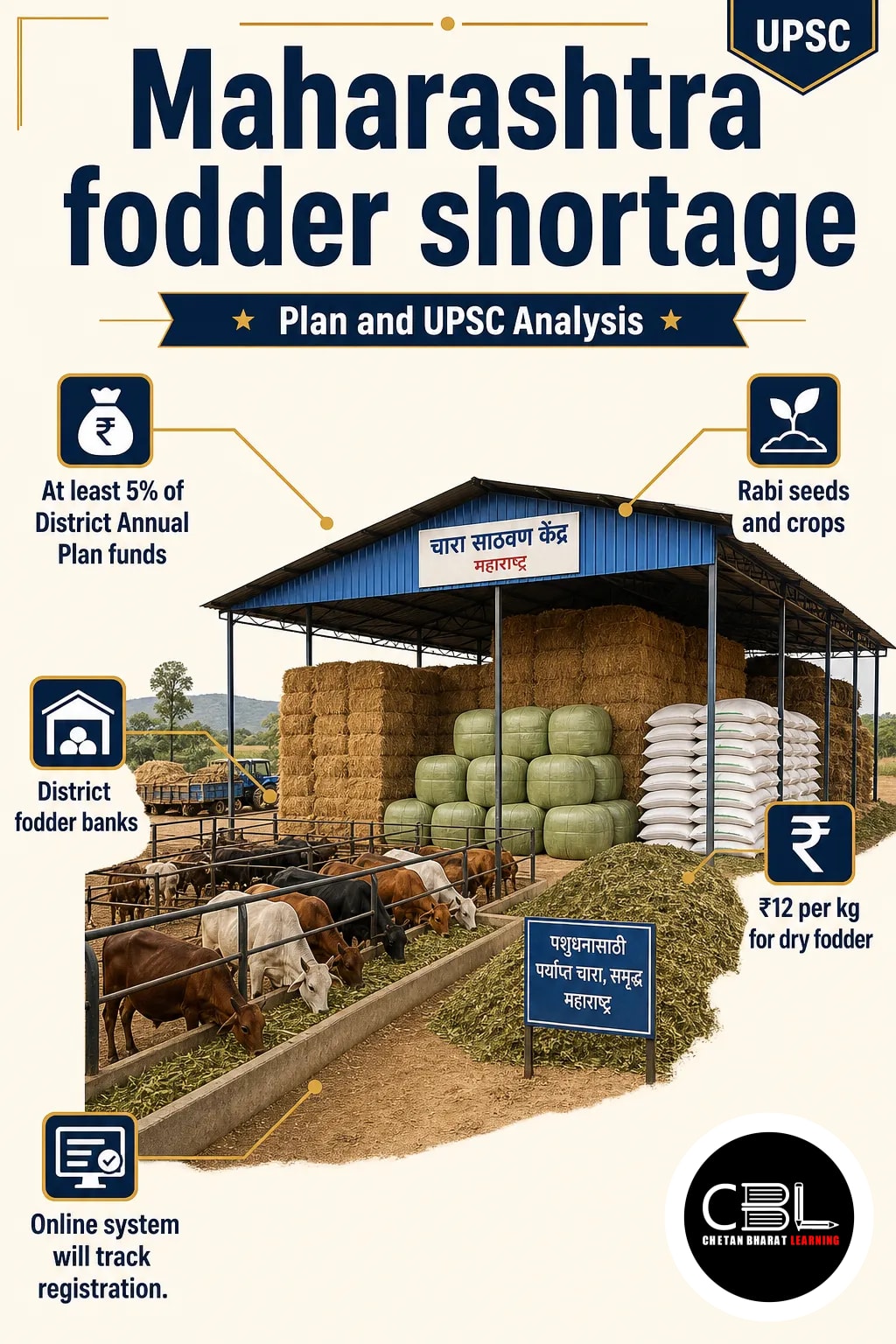

Maharashtra fodder shortage measures will channel district planning funds towards livestock feed production and conservation. The decision links agricultural policy and rural livelihoods with drought management.
Quick answer: Maharashtra has earmarked at least 5% of District Annual Plan funds for fodder production and conservation amid drought-like conditions. Its Government Resolution of 30 October 2026 provides for fodder banks, Rabi seed supply and digital cattle-camp monitoring. The plan also seeks to conserve feed before shortages deepen.
What is the Maharashtra fodder shortage plan?
The plan combines district funding, feed production, conservation and cattle-camp oversight to address drought-related shortages. It earmarks at least 5% of District Annual Plan funds for fodder production and conservation. Unlike a response centred only on camps, it also seeks to increase and preserve local supply.
Animal Husbandry Minister Pankaja Munde announced the measures. They follow recommendations from a study group constituted under the Revenue Department’s Additional Chief Secretary. A Cabinet sub-committee headed by Revenue Minister Chandrashekhar Bawankule approved them on 27 October 2026; the Government Resolution followed on 30 October.
For context on drought administration, see the Maharashtra drought declaration rules. The two measures address related problems, but the fodder plan has its own funding and implementation provisions.
How will the plan increase and conserve fodder?
The government will combine Rabi cultivation, district fodder banks and training in storage. The following provisions cover both fresh production and conservation.
| Measure | Provision |
|---|---|
| Rabi seeds and crops | Mahabeej and other agencies will supply seeds; maize, jowar and bajra will be encouraged as low-water-requirement crops. |
| Land use | Government agricultural land, grazing grounds and fallow land will be used for fodder production. |
| District fodder banks | Farmer Producer Organisations (FPOs), companies and non-governmental organisations (NGOs) will participate. |
| Maximum support prices | ₹12 per kg for dry fodder and ₹8 per kg for silage, excluding transport costs. |
| Alternative sources | Hydroponics, Azolla and thornless cactus cultivation will be promoted. |
Silage is preserved green fodder, generally stored after fermentation. Meanwhile, the Fodder Literacy Campaign will train livestock owners in silage preparation, storage and conservation. Better storage can help make feed produced in one season available later.
How will districts manage supplies and cattle camps?
District authorities will assess local needs, coordinate supplies and monitor camps. The Animal Husbandry Department will prepare district-wise fodder balance sheets and submit weekly reports on availability and requirements. These records can identify where supplies need to move.
During shortages, the plan prohibits fodder use for packaging, biofuel production and power generation. District Collectors will oversee restrictions on transport to neighbouring states; meanwhile, authorities will arrange inter-district supplies where necessary.
Guardian Minister-led district committees will oversee camp planning. Before approving camps, District Collectors will assess local fodder and water availability. Sugar factories, dairy cooperatives and voluntary organisations will participate; the government will also seek corporate social responsibility (CSR) funds for camp facilities.
Digital accountability at camps
The online Fodder Camp Monitoring and Management System will track registration, attendance, feed distribution, veterinary services and expenditure. Biometric or quick response (QR) code-based attendance, livestock verification and round-the-clock closed-circuit television (CCTV) surveillance will be mandatory. Therefore, the system can connect reported expenditure with recorded service delivery.
Why does fodder security matter?
Fodder security matters because livestock depend on a reliable feed supply, including during drought. Production, storage and distribution must work together: a district may need both local cultivation and supplies from elsewhere. The Telangana drought declaration provides a related example of state-level drought response.
The Maharashtra fodder shortage plan also shows why district-level information matters. A balance sheet can compare requirements with available feed, while camp records can help officials check whether assistance reaches registered livestock. However, the measures remain a policy framework; their outcomes depend on implementation.
What are the implementation challenges?
The main challenges concern timely delivery, reliable local estimates and coordination across agencies.
- Water and land: Low-water crops still need suitable growing conditions; therefore, districts must match cultivation plans to local water availability.
- Storage and transport: Fodder banks need usable storage and distribution arrangements. Moreover, transport costs lie outside the stated support-price ceilings.
- Competing uses: Restrictions can protect feed supplies during shortages; however, they also affect other users of fodder material.
- Digital access and verification: Camp oversight requires accurate records and functioning systems. In addition, officials must ensure that verification does not delay essential services.
- Local coordination: Collectors, departments, FPOs and other participants have distinct roles; consequently, delays in one part can affect the entire supply chain.
What should guide implementation?
Districts should use updated fodder and water assessments to sequence production, conservation and camp decisions. First, weekly balance sheets can guide seed distribution and inter-district transfers. Second, field training can help livestock owners preserve feed safely.
Moreover, officials should check storage capacity and transport arrangements alongside the support-price ceilings. Digital records should support timely veterinary care and feed delivery, rather than replace field verification. Finally, coordination across departments and local partners is essential to make the Maharashtra fodder shortage response work beyond the allocation itself.
Source: The Hindu, 1 November 2026
- Maharashtra Drought: Declaration Rules Explained (26 Sep 2026)
- Telangana drought: What the 365-mandal declaration means (28 Oct 2026)
State PCS General Studies can test fodder conservation, livestock management and the role of district administration in drought response. Moreover, candidates can compare policy tools without assuming that Punjab or Haryana has adopted this Maharashtra plan.
Prelims Practice Corner
Mains Practice Questions
Frequently Asked Questions
How much has Maharashtra earmarked for fodder?
At least 5% of District Annual Plan funds is earmarked for fodder production and conservation. The measure addresses drought-like conditions and also supports fodder banks.
What are the support-price ceilings for fodder?
The ceilings are ₹12 per kg for dry fodder and ₹8 per kg for silage. However, both amounts exclude transportation costs.
How will Maharashtra monitor cattle camps?
An online system will track registration, attendance, fodder distribution, veterinary services and expenditure. In addition, the plan mandates livestock verification, biometric or QR-based attendance and round-the-clock CCTV surveillance.
Related Current Affairs
Preparing for UPSC, PCS or HCS?
Talk to a mentor at Chetan Bharat Learning, Chandigarh. Free guidance on choosing the right exam and building a study plan.
Chat on WhatsAppCall 97793 53345UPSC / IAS / PCS coaching in Chandigarh · Trusted by aspirants across Punjab & Haryana

 Ananya RanaIAS · AIR 60
 Aditya SharmaIAS · AIR 70
 Ria Kaur SethiIPS · AIR 89
 Aman AloonIRS · AIR 295
 Sumer Singh VirkIRS · AIR 335
 Shivani PanchalIAS

Leave a Reply
You must be logged in to post a comment.