

Russian oil imports: India’s energy diplomacy and strategic autonomy
| Aug Russian Imports | Share in Crude Diet | Venezuela Surge | Hormuz Offline |
|---|---|---|---|
| 2.08 Million BPD | 45 Per Cent | 350,000 BPD | 40 Per Cent |
| Prelims | Mains |
|---|---|
| International Relations | GS Paper 2 & 3 |
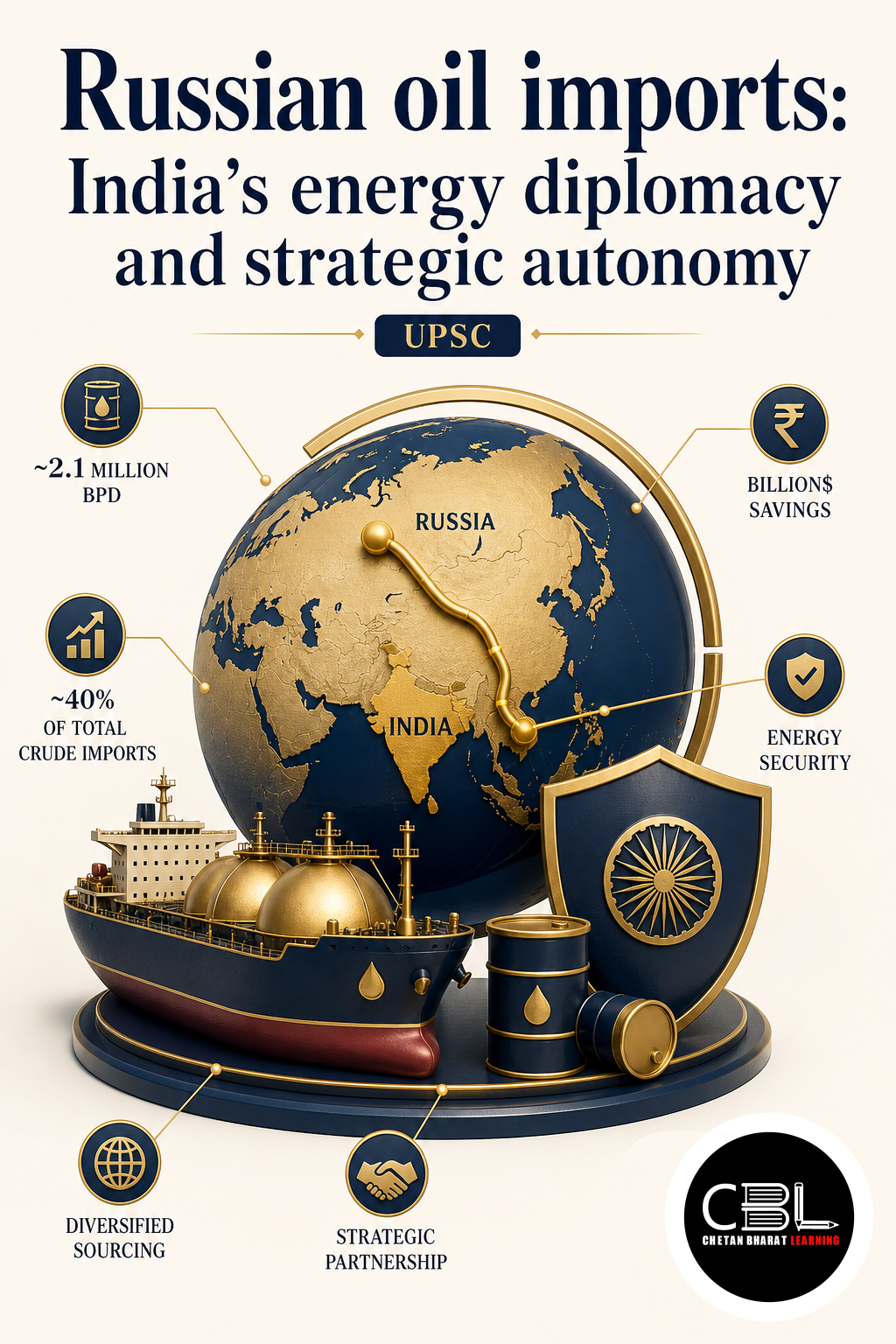
External Affairs Minister S. Jaishankar recently visited Kyiv to meet President Volodymyr Zelenskyy, advocating for dialogue and diplomacy while firmly defending India’s continued purchase of Russian crude to meet its massive national energy needs. This diplomatic tightrope walk highlights the core of India’s strategic autonomy. Simultaneously, provisional tanker data reveals that India’s Russian oil imports fell by 26 per cent in August, reflecting global supply pressures and shifting freight economics.
What is the strategy behind Russian oil imports?
India’s approach to Russian oil imports is fundamentally anchored in the concept of energy security, which encompasses availability, affordability, accessibility, and sustainability. As a rapidly growing economy with limited domestic crude reserves, India relies heavily on imports to fuel its transport, industrial, and agricultural sectors.
Purchasing discounted Russian crude has been a vital tool for macroeconomic management. It directly reduces the national import bill, cushions domestic consumers against global price shocks, and helps the central bank manage inflationary pressures and the Current Account Deficit (CAD). For New Delhi, energy is not merely an economic commodity but a strategic resource that shapes foreign policy and national power.
Why are Russian oil imports in News?
The diplomatic and market dimensions of India’s energy strategy are currently in sharp focus. During his visit to Kyiv, the External Affairs Minister reiterated that India’s energy purchases are guided strictly by national interest and the necessity of securing affordable fuel for its vast population, dismissing criticisms from Western allies. Simultaneously, market data shows that Russian volumes dropped to 2.08 million barrels per day (bpd) in August, down from a record 2.82 million bpd in July. This 26 per cent decline is attributed to tighter Russian export availability, aggressive competition from Chinese refiners, and maintenance shutdowns at Indian refineries. Furthermore, the ongoing crisis in West Asia has effectively taken nearly 40 per cent of India’s traditional Middle Eastern supplies offline due to severe disruptions around the Strait of Hormuz.
Key Features
- Source Diversification: To offset the drop in Gulf supplies, Indian refiners have diversified towards African, North American, and South American barrels. Imports from Venezuela surged by over 60 per cent to 350,000 bpd following US authorizations.
- Resource Geopolitics: Access to energy resources now dictates global alignments. India maintains strategic autonomy by engaging with multiple suppliers, including Russia, Iran, and the US, without joining exclusive geopolitical blocs.
- Sanctions Navigation: Indian entities must navigate the secondary effects of Western sanctions, managing complex banking restrictions, shipping risks, and higher insurance costs without violating international compliance.
- Freight Economics: Ukrainian drone attacks on Black Sea infrastructure have forced a rerouting of tankers. The increased cost and risk of navigating the Black Sea are pushing Russian exporters to utilize the Northern Sea Route.
Challenges
- Chokepoint Vulnerabilities: Reliance on maritime routes like the Strait of Hormuz, Bab-el-Mandeb, and the Malacca Strait leaves India’s energy supply chain vulnerable to conflicts and blockades.
- Shrinking Discounts: Global competition for Russian barrels—particularly from China—is narrowing the discounts Indian refiners initially enjoyed, impacting profit margins.
- Payment Mechanisms: Establishing secure, non-dollar payment channels remains a logistical challenge due to the dominance of the Western financial system.
- Imported Inflation: Any spike in global crude prices or freight rates translates into higher domestic transport costs, threatening macroeconomic stability and retail inflation targets.
Way Forward
The administration must accelerate the expansion of the Strategic Petroleum Reserve (SPR) to buffer against supply shocks. Strengthening maritime domain awareness and securing sea lanes with the Indian Navy is essential for protecting energy shipments. Diplomatically, India must continue to leverage its consumer market to negotiate favorable long-term contracts. In the long term, reducing fossil-fuel dependence through investments in solar, wind, green hydrogen, and biofuels will accelerate the national transition towards an energy-resilient economy.
Prelims Practice Corner
Q1. What was the primary reason for the 26 per cent drop in India’s Russian oil imports in August?
(a) Complete ban by the Indian government (b) Tighter Russian export availability and Chinese competition (c) UN Security Council sanctions (d) Shift entirely to domestic coal
Answer: Tighter Russian export availability, aggressive competition from Chinese refiners, and local refinery maintenance.
Q2. Which South American country saw a massive 60 per cent surge in oil exports to India recently due to US authorizations?
(a) Brazil (b) Argentina (c) Venezuela (d) Ecuador
Answer: Venezuela.
Q3. Approximately what percentage of India’s traditional crude imports transit through the Strait of Hormuz?
(a) 15 per cent (b) 25 per cent (c) 40 per cent (d) 65 per cent
Answer: About 40 per cent.
Q4. Which maritime route is seeing increased Russian tanker traffic due to drone threats in the Black Sea?
(a) Suez Canal (b) Cape of Good Hope (c) Northern Sea Route (d) Northwest Passage
Answer: Northern Sea Route.
Q5. In the context of India’s foreign policy, the continued purchase of Russian crude despite Western pressure is best described as an exercise in:
(a) Non-Alignment 1.0 (b) Strategic Autonomy (c) Bandwagoning (d) Economic Isolationism
Answer: Strategic Autonomy.
Mains Practice Questions
Q1. Discuss how India’s energy diplomacy balances macroeconomic stability with the geopolitical complexities of the Ukraine conflict and West Asian tensions. (10 marks)
Answer Structure:
- Introduction: Define energy security and highlight India’s strategic autonomy.
- Body: Explain how discounted crude controls the Current Account Deficit and inflation, and the vulnerabilities posed by the Strait of Hormuz crisis and source diversification.
- Conclusion: Diversified and resilient supply chains are indispensable for sustaining growth.
Q2. Analyze the statement: “Energy is no longer just an economic commodity; it is a strategic resource that shapes foreign policy and national power” in the context of India’s evolving crude import basket. (15 marks)
Answer Structure:
- Introduction: Introduce resource geopolitics and how chokepoints and sanctions dictate energy flows.
- Body: Impact of Black Sea drone threats, Western sanctions, Chinese competition, and multi-alignment strategy.
- Conclusion: Accelerate green transition, expand strategic reserves, and secure maritime routes.
FAQs on Russian oil imports
Why did India’s Russian oil imports drop in August despite high demand?
The drop was due to tighter Russian export availability, aggressive Chinese competition, and maintenance shutdowns at Indian refineries.
How does the crisis in the Strait of Hormuz affect India’s energy security?
About 40 per cent of India’s crude imports transit through the Strait of Hormuz. The crisis has taken a large portion of this supply offline, forcing diversification.
What are the secondary effects of Western sanctions on India’s oil trade?
Although India does not impose sanctions, Western banking, shipping, and insurance restrictions increase costs, complicate payments, and risk secondary sanctions.
Related Current Affairs
Preparing for UPSC, PCS or HCS?
Talk to a mentor at Chetan Bharat Learning, Chandigarh. Free guidance on choosing the right exam and building a study plan.
Chat on WhatsAppCall 97793 53345UPSC / IAS / PCS coaching in Chandigarh · Trusted by aspirants across Punjab & Haryana
Leave a Reply
You must be logged in to post a comment.