
UPSC Syllabus Mapping
- GS Paper: GS-II
- Subject: Government policies, Judiciary, Freedom of Speech and Expression
What is Film Certification?
Film Certification refers to the statutory process under the Cinematograph Act, 1952 through which films are examined before public exhibition in theatres. The responsibility lies with the Central Board of Film Certification (CBFC), functioning under the Ministry of Information and Broadcasting.
The CBFC classifies films into U, UA, A and S categories. Following the Cinematograph (Amendment) Act, 2023, the UA category has been divided into age-based classifications such as UA 7+, UA 13+ and UA 16+, while certificates have been made valid permanently instead of for ten years.
Why is Film Certification in News?
The issue gained attention after the Orissa High Court restrained the release of the animated film Mahaprabhu Jagannath, observing that its depiction of Lord Jagannath was inconsistent with traditional religious texts and that its screening during the Rath Yatra could affect public sentiments. Although the film had already received CBFC certification, the matter reached the Supreme Court, which postponed its release until after the festival while keeping broader legal issues open for consideration.
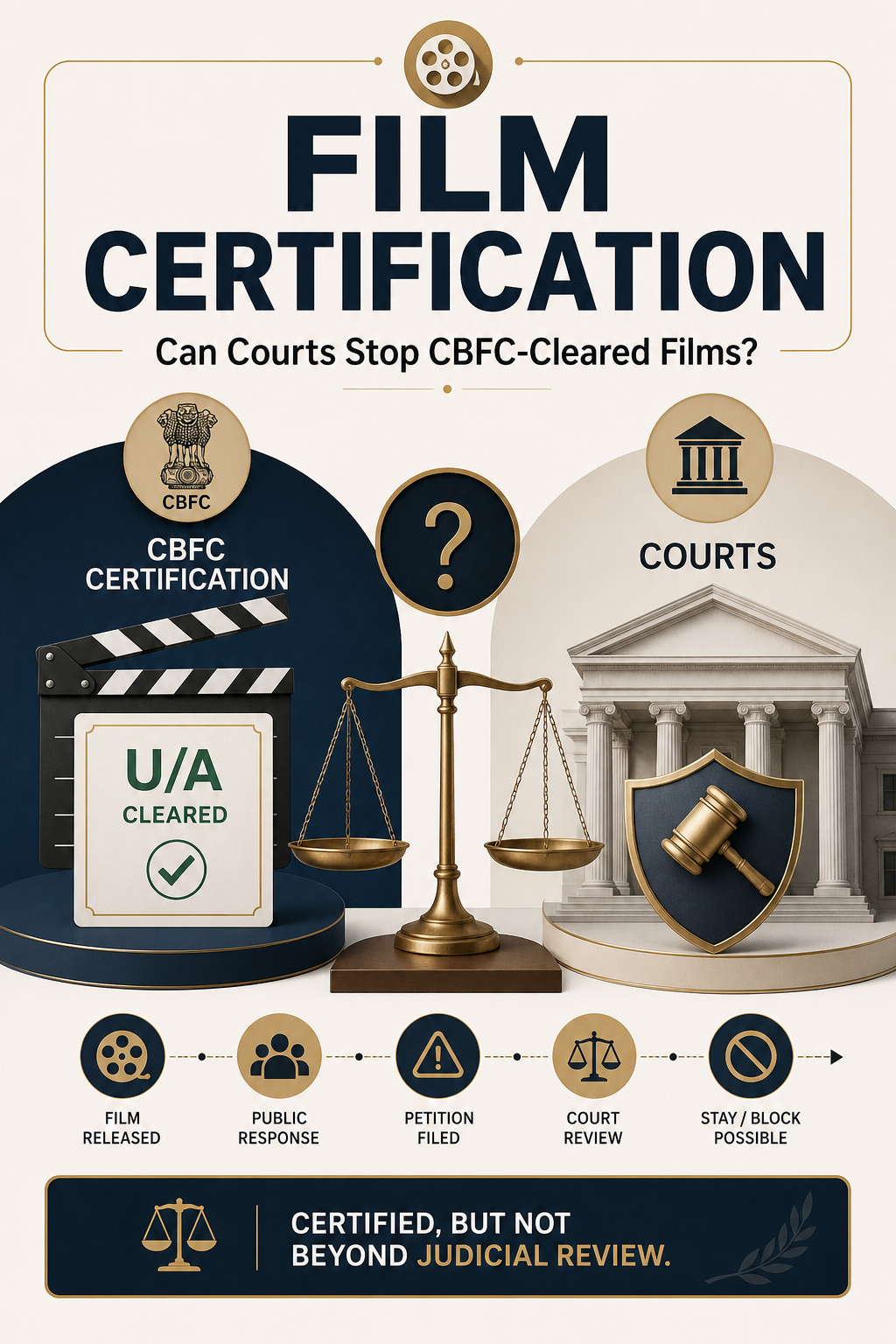
The controversy has revived debate on whether judicial intervention should override decisions of an expert statutory body and how courts should balance freedom of expression with concerns relating to public order and religious harmony.
Key Features of Film Certification
- Mandatory for public theatrical exhibition under the Cinematograph Act, 1952.
- CBFC acts as an expert statutory authority for examination of films.
- Certification categories include U, UA, A and S.
- The 2023 Amendment introduced age-based UA classifications and perpetual validity of certificates.
- The government retains limited powers to suspend or revoke certificates under specified legal conditions.
- Theatrical releases require certification, whereas OTT platforms are primarily governed through the Information Technology Rules, creating a different regulatory framework.
- Important judicial precedents include K.A. Abbas v. Union of India, S. Rangarajan v. P. Jagjivan Ram and Union of India v. K.M. Shankarappa (2000), which recognise prior certification while protecting constitutional freedoms.
Challenges Related to Film Certification
Article 19(1)(a) guarantees freedom of speech and expression, while Article 19(2) permits reasonable restrictions on grounds such as public order, decency and morality. Courts therefore face the challenge of balancing artistic freedom with competing constitutional interests.
Judicial review remains available where certification is alleged to violate statutory provisions or procedural fairness. However, courts generally defer to the expertise of the CBFC when it acts within the law. The ongoing debate is also relevant to the differing regulatory treatment of theatrical releases and OTT platforms.
Way Forward for Film Certification
A transparent, predictable and constitutionally consistent Film Certification regime is essential for protecting artistic freedom while maintaining public order. Judicial intervention should ordinarily remain limited to reviewing legality rather than reassessing artistic merit. Stronger procedural safeguards, timely adjudication and clearer regulatory standards for digital platforms can reduce uncertainty.
Further reforms should harmonise the regulation of cinema and OTT platforms while respecting constitutional rights and ensuring accountability of regulatory authorities.
Prelims Practice Corner
| Q1. Which body certifies films for public exhibition in India? | B. CBFC |
| Q2. Which Act governs theatrical film certification? | C. Cinematograph Act, 1952 |
| Q3. Freedom of speech is guaranteed under which Article? | B. Article 19(1)(a) |
| Q4. The 2023 amendment primarily introduced: | B. Permanent validity of certificates |
| Q5. Which judgment recognised the importance of CBFC decisions while limiting executive interference? | B. K.M. Shankarappa |
Mains Practice Questions
- 1. Discuss the constitutional balance between freedom of expression and reasonable restrictions in the context of Film Certification. (10 Marks)
- Introduction
- Legal framework
- Article 19 analysis
- Judicial precedents
- Way forward
- 2. Can courts restrain the release of films already certified by the CBFC? Examine with reference to recent judicial developments. (15 Marks)
- Background
- Role of CBFC
- Judicial review
- Recent case
- Conclusion
FAQs on Film Certification
- Can courts stop a CBFC-certified film?
- Yes. Courts may intervene through judicial review where legal or constitutional issues arise, though they generally defer to CBFC expertise.
- What is the role of the CBFC?
- The CBFC examines films and grants certification for public exhibition under the Cinematograph Act, 1952.
- Is OTT regulation the same as theatre regulation?
- No. Theatres are governed by the Cinematograph Act, while OTT platforms operate mainly under the Information Technology Rules, making the regulatory framework different.
Quick Revision
- Article 19(1)(a) – Freedom of Speech and Expression
- Article 19(2) – Reasonable Restrictions
- Cinematograph Act, 1952
- Cinematograph (Amendment) Act, 2023
- CBFC Categories: U, UA, A, S
- Landmark Case: Union of India v. K.M. Shankarappa (2000)
Related Current Affairs
Preparing for UPSC, PCS or HCS?
Talk to a mentor at Chetan Bharat Learning, Chandigarh. Free guidance on choosing the right exam and building a study plan.
Chat on WhatsAppCall 97793 53345UPSC / IAS / PCS coaching in Chandigarh · Trusted by aspirants across Punjab & Haryana
Leave a Reply
You must be logged in to post a comment.