
| Prelims | Mains |
|---|---|
| International Relations | GS Paper 2 |
| Summit Edition | Total Members | Core Focus | India’s Vision |
|---|---|---|---|
| 26th Edition | 10 Nations | Three Evils | SECURE Framework |
What is Bishkek Declaration?
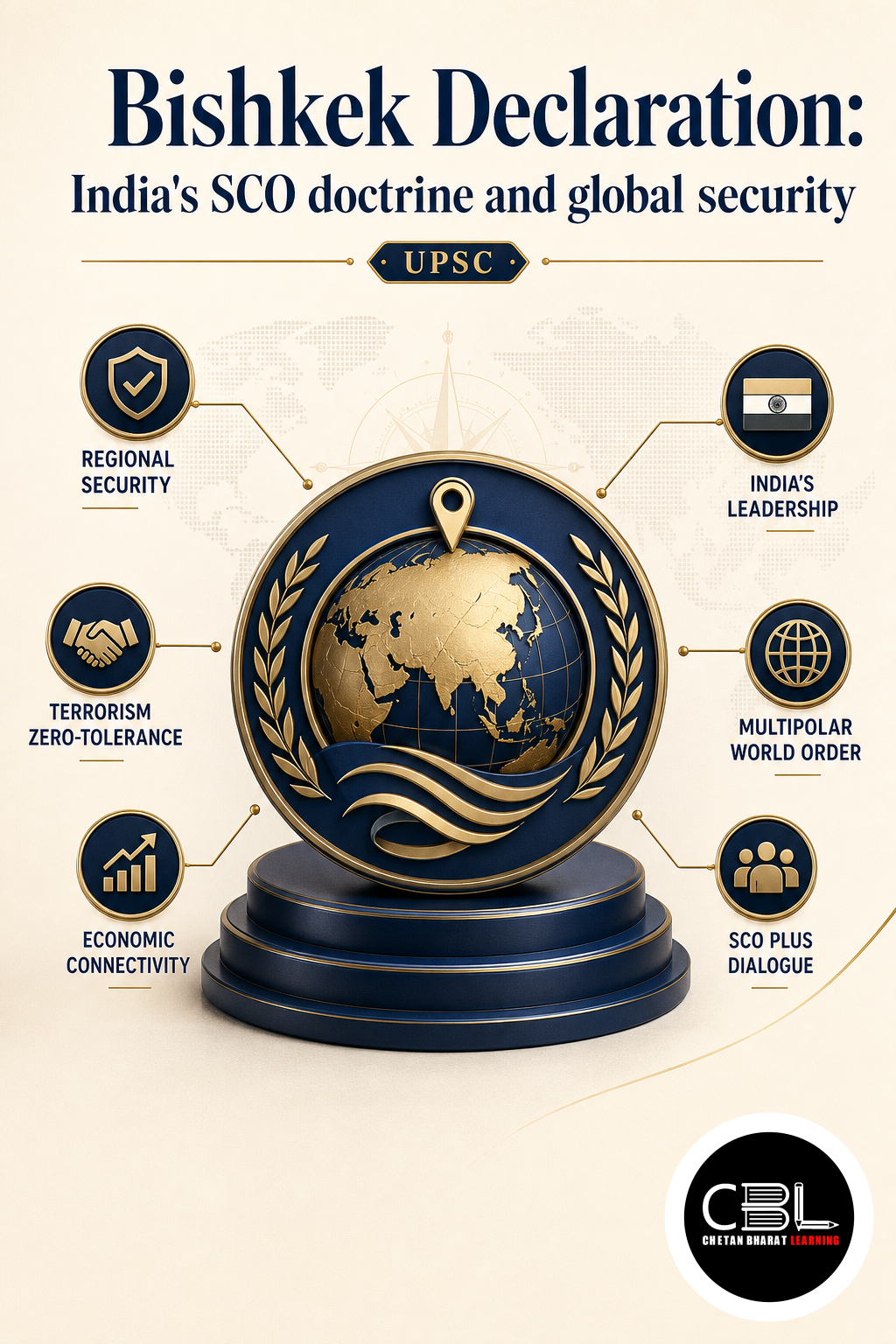
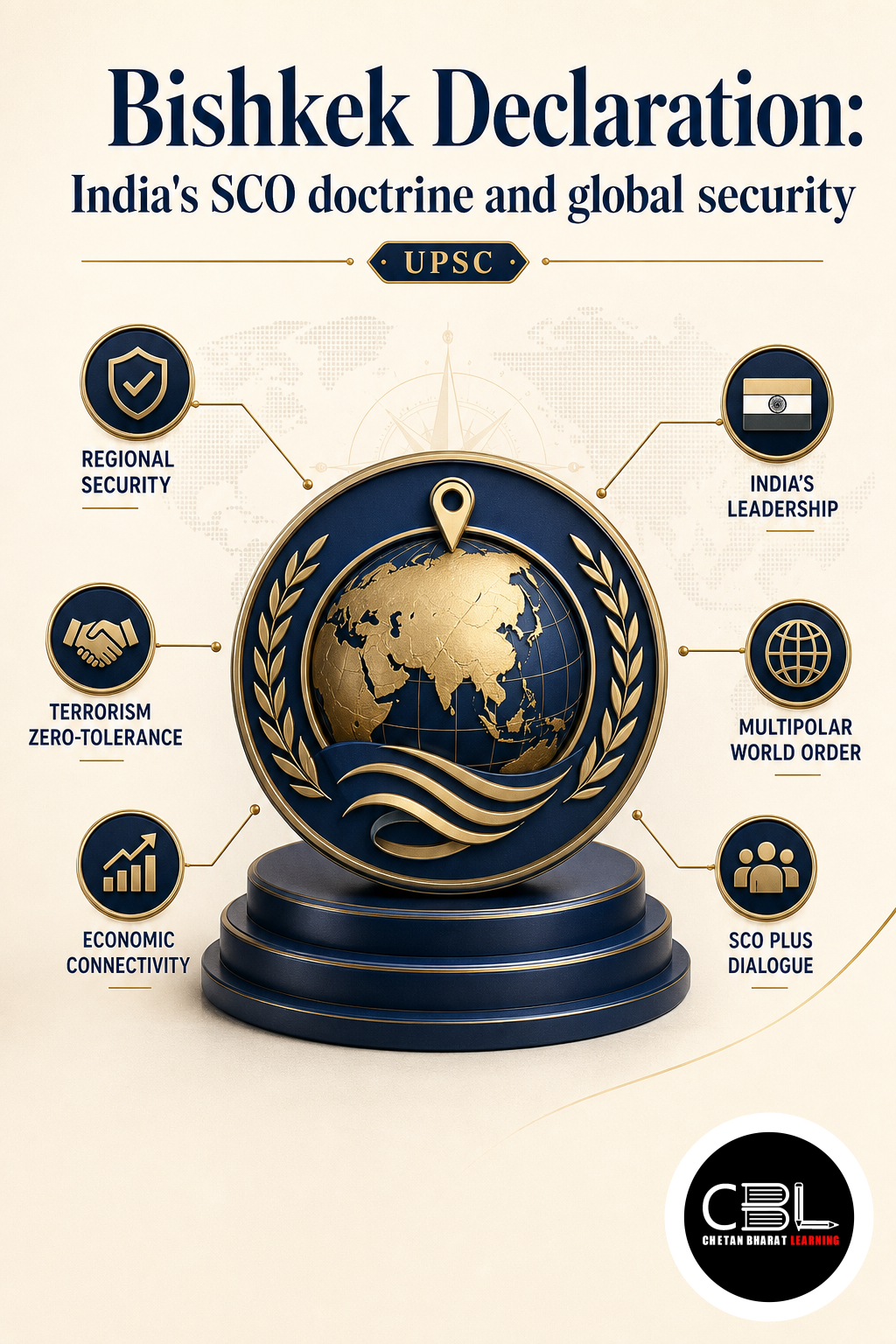
The Bishkek Declaration represents the joint consensus of the 10-member Eurasian grouping on critical security and economic issues. The document strongly condemns terrorism in all its forms and explicitly rejects double standards in counter-terrorism efforts. Member states called for dismantling the entire ecosystem of terror financing, recruitment, and safe havens.
Unlike standard diplomatic statements, this declaration specifically addressed the ongoing conflict in West Asia. The grouping advocated for a purely political and diplomatic resolution, reaffirming support for the sovereignty and territorial integrity of Iran. The strategic pivot recognizes that controlling underlying geopolitical friction guarantees long-term regional security.
Why is Bishkek Declaration in News?
The Indian Prime Minister recently outlined a clear doctrine for the SCO, emphasizing that a conflict in one region inevitably impacts global energy security and maritime trade. You can review official diplomatic stances via this MEA portal for precise foreign policy details.
Furthermore, India pushed for robust and reliable connectivity initiatives that strictly respect national sovereignty. This subtle messaging was aimed at projects like the China-Pakistan Economic Corridor (CPEC) that violate territorial integrity. Geopolitical analysts view India’s multi-alignment strategy as a vital tool to balance relations with Russia, China, and the West.
Key Features
The current Eurasian landscape relies on several strategic mechanisms to promote security and economic integration among member states.
- Counter-Terrorism: The declaration demands strict action against cross-border terrorism and rejects the use of militant groups as instruments of state policy.
- West Asia Stability: The SCO expressed deep concern over the US-Iran conflict, urging de-escalation and protecting critical maritime chokepoints like the Strait of Hormuz.
- Cyber Security: Member states agreed to strengthen coordination in international information security and combat the use of the internet for extremist purposes.
- Multipolar Governance: The grouping advocated for reforming global governance institutions, explicitly excluding bloc-based and confrontational approaches to international disputes.
Challenges
Despite the optimistic declarations, achieving genuine Eurasian integration faces several severe structural and geopolitical hurdles today.
- Geographic Constraints: India lacks direct overland access to Central Asia due to Pakistan’s hostility and the volatile security situation in Afghanistan.
- Internal Contradictions: The grouping includes historical rivals like India and Pakistan, and India and China, which frequently paralyzes consensus on critical security issues.
- Chinese Dominance: Beijing’s massive economic footprint and influence over Central Asian republics often marginalize New Delhi’s strategic and developmental initiatives.
- Sanctions Regime: Western sanctions on key members like Russia and Iran severely complicate cross-border financial transactions and trade settlements.
You can explore similar diplomatic strategies in our international relations section for deeper insights. Furthermore, the immense financial burden of developing alternative corridors like the INSTC strains the national exchequer significantly.
Way Forward
The administration must accelerate the operationalization of the Chabahar port and the International North-South Transport Corridor (INSTC) to bypass geographical bottlenecks. Promoting the ‘Nalanda Approach’—focusing on university partnerships, joint research, and historical ties—will build deep cultural resilience. Providing dedicated credit lines will drastically improve economic engagement with Central Asian republics.
Check the latest NITI Aayog reports for strategic Eurasian connectivity frameworks. The government must periodically review its multi-alignment strategies to ensure they reflect current global trade realities. Continuous refinement of the SCO engagement will guarantee that India shapes a balanced and multipolar global order.
Prelims Practice Corner
Q1. Which city hosted the 26th summit of the Shanghai Cooperation Organisation (SCO)?
(a) Astana (b) Samarkand (c) Bishkek (d) Dushanbe
Show answer
Answer: (c) The 26th SCO summit was held in Bishkek, the capital of the Kyrgyz Republic.
Q2. What are the “Three Evils” that the SCO was originally primarily established to combat?
(a) Poverty, Disease, Ignorance (b) Terrorism, Separatism, Extremism (c) Smuggling, Piracy, Cybercrime (d) Imperialism, Colonialism, Racism
Show answer
Answer: (b) The SCO’s core traditional security focus is combating terrorism, separatism, and extremism.
Q3. Which specific Iranian port is crucial for India’s connectivity strategy to Central Asia via the SCO region?
(a) Bandar Abbas (b) Bushehr (c) Chabahar (d) Qeshm
Show answer
Answer: (c) The Chabahar port provides India with vital overland access to Afghanistan and Central Asia.
Q4. What did the Bishkek Declaration explicitly reject regarding international counter-terrorism efforts?
(a) UN involvement (b) Double standards (c) Financial tracking (d) Extradition treaties
Show answer
Answer: (b) The declaration strongly emphasized that double standards in the fight against terrorism are unacceptable.
Q5. Which country became the 10th full member of the SCO, expanding its geographical footprint?
(a) Iran (b) Belarus (c) Turkey (d) Mongolia
Show answer
Answer: (b) Belarus recently joined the grouping, bringing the total number of full member states to ten.
Mains Practice Questions
Q1. Discuss the significance of the Bishkek Declaration in shaping India’s doctrine on counter-terrorism and Eurasian connectivity. (10 marks)
Answer Structure
- Intro: Introduce the 26th SCO summit and India’s push for a unified stance against cross-border terrorism without double standards.
- Body: Explain India’s SECURE framework, the necessity of sovereign-respecting connectivity projects like INSTC and Chabahar, and the geopolitical hurdles posed by Pakistan and China.
- Conclusion: Conclude that multi-alignment and strategic autonomy are essential for India to leverage the SCO for its extended neighborhood interests.
Q2. “The SCO is transitioning from a regional security bloc into a major voice for a multipolar global order.” Analyze this statement in the context of the West Asia crisis and global governance reforms. (15 marks)
Answer Structure
- Intro: Highlight the SCO’s expansion and its collective stance on the West Asia conflict, advocating for diplomatic resolutions over military interventions.
- Body: Analyze the grouping’s call for reforming global financial and political institutions, its rejection of bloc-based confrontation, and the internal contradictions that limit its cohesion.
- Conclusion: Suggest that while the SCO provides a crucial platform for the Global South, India must carefully navigate the China-Russia axis to protect its own strategic interests.
FAQs on Bishkek Declaration
Why does India emphasize “sovereignty” in SCO connectivity projects?
India’s emphasis on sovereignty is a direct diplomatic critique of the China-Pakistan Economic Corridor (CPEC), which passes through Pakistan-occupied Kashmir. New Delhi maintains that no regional connectivity initiative can be accepted if it violates a member state’s territorial integrity.
How does the SCO address the conflict in West Asia?
The Bishkek Declaration expressed deep concern over the military escalation in West Asia. The grouping advocated for a purely political and diplomatic resolution, reaffirming support for Iran’s sovereignty and warning against the disruption of critical maritime energy routes like the Strait of Hormuz.
What is the “Nalanda Approach” mentioned by India at the summit?
The Nalanda Approach refers to reviving ancient knowledge ecosystems that historically linked scholars and civilizations across Asia. India proposes using this civilizational familiarity to build modern university partnerships, joint research initiatives, and sustained intellectual dialogue with Central Asian republics.
Related Current Affairs
Preparing for UPSC, PCS or HCS?
Talk to a mentor at Chetan Bharat Learning, Chandigarh. Free guidance on choosing the right exam and building a study plan.
Chat on WhatsAppCall 97793 53345UPSC / IAS / PCS coaching in Chandigarh · Trusted by aspirants across Punjab & Haryana
Leave a Reply
You must be logged in to post a comment.