
UPSC Mapping
| Prelims | Economy |
|---|---|
| Mains | GS Paper 3 |
What is sugar price hike?
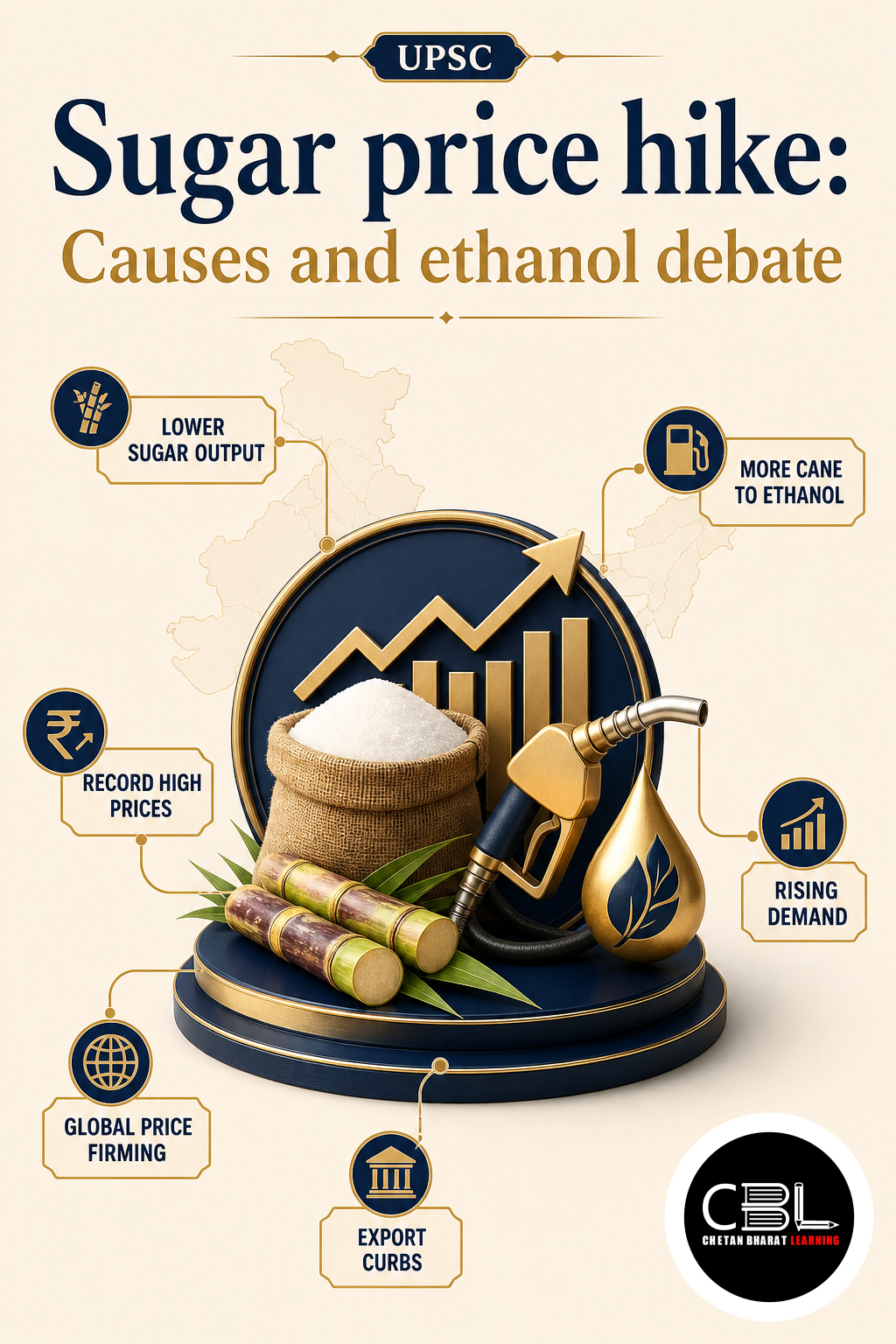
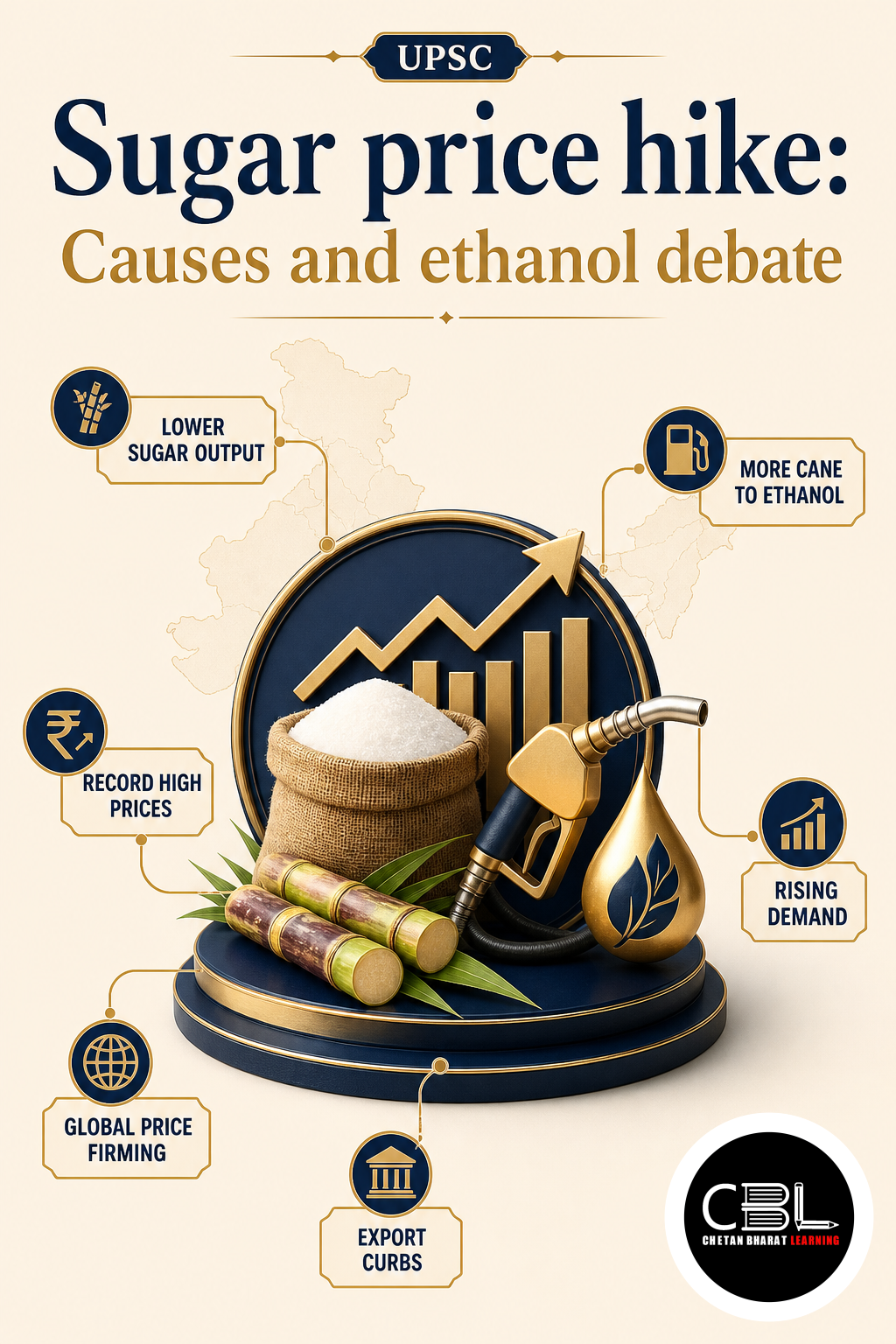
The recent sugar price hike represents a severe mismatch between domestic consumption requirements and actual agricultural output. India typically produces 32–34 million tonnes of sugar against a domestic consumption of 28–29 million tonnes. However, gross production for the current season plummeted to 30.6 million tonnes due to severe waterlogging and pest attacks.
The strategic pivot recognizes that controlling underlying agricultural vulnerabilities guarantees long-term food security. The government provides substantial financial incentives to domestic farmers to adopt resilient cane varieties. Local engineers can now access advanced drip-irrigation tools through dedicated state-backed support mechanisms to mitigate the impact of erratic monsoons.
Why is sugar price hike in News?
The Ministry of Consumer Affairs recently issued a detailed rebuttal against industry claims that the ethanol-blending programme was starving the domestic food market. You can review official agricultural data via this Ministry of Consumer Affairs portal for precise macroeconomic metrics.
Market analysts emphasize that excess rainfall and delayed monsoon withdrawals in Maharashtra and Karnataka severely damaged the standing crop. Furthermore, the dominant Co-0238 cane variety in Uttar Pradesh was devastated by Red Rot disease and Top Borer pests. To cool down the market, the government recently approved duty-free imports of raw sugar and imposed strict stock limits on dealers to prevent artificial scarcity.
Key Features
- Festive Demand: Rising consumption ahead of Dussehra and Diwali has added massive seasonal pressure on wholesale and retail markets.
- Global Deficit: International sugar prices rose over 16% driven by a projected global deficit of 3.3 million tonnes in the upcoming season.
- Ethanol Shift: Nearly three-fourths of India’s ethanol now comes from grains like maize, significantly reducing the historical burden on sugarcane juice.
- Stock Limits: The government imposed a strict 400-tonne cap on dealers and completely banned exports to prioritize domestic availability.
Challenges
- Weather Shocks: Erratic monsoon patterns and delayed withdrawals frequently threaten agricultural yields and trigger sudden spikes in retail food inflation.
- Nine-Year Low Stocks: Closing stocks are projected at 41 lakh tonnes, the lowest since 2016-17, leaving minimal buffer for unexpected supply chain shocks.
- Mill Liquidity: Liquidity-strapped mills historically oversold beyond their quotas, leaving little physical stock despite optimistic paper declarations.
- Hoarding Risks: Speculative buying by bulk consumers and artificial scarcity created by certain industry sections severely exacerbate retail price volatility.
Way Forward
The administration must accelerate the adoption of climate-resilient cane varieties to reduce vulnerability to waterlogging and devastating pests. Simplifying the ethanol-blending architecture to rely heavily on maize and agricultural waste will permanently protect the food supply chain. Providing dedicated credit guarantees will drastically improve capital access for ambitious micro-enterprises in the rural processing sector.
Check the latest Department of Food & Public Distribution guidelines for strategic buffer stock management. State governments must actively align their local crushing schedules with central guidelines to maximize regional synergies. This unified approach will significantly accelerate the national transition towards a self-reliant and stable agricultural economy.
Quick Facts
| Retail Peak | Gross Production | Ethanol Diversion | Closing Stocks |
|---|---|---|---|
| Rs 65 Per KG | 30.6 MT | 9 Per Cent | 9-Year Low |
Prelims Practice Corner
Q1. What primary factor did the government cite for rejecting the ethanol-diversion theory regarding the recent price spike?
- (a) Complete ban on ethanol
- (b) Shift towards grain-based ethanol and reduced sugarcane diversion
- (c) Massive sugar imports
- (d) Fall in domestic demand
Answer: (b) Nearly three-fourths of India’s ethanol now comes from grains, and sugarcane diversion actually declined to 9%.
Q2. Which specific disease severely impacted the dominant Co-0238 sugarcane variety in Uttar Pradesh?
- (a) Yellow Rust
- (b) Red Rot
- (c) Late Blight
- (d) Powdery Mildew
Answer: (b) The Co-0238 variety was heavily devastated by Red Rot disease and Top Borer pests.
Q3. What is the projected status of India’s closing sugar stocks for the current season?
- (a) Highest in a decade
- (b) Stable at 100 lakh tonnes
- (c) Nine-year low at 41 lakh tonnes
- (d) Completely exhausted
Answer: (c) Closing stocks are projected at 41 lakh tonnes, marking the lowest levels since 2016-17.
Q4. Which administrative measure did the government recently implement to curb artificial scarcity and hoarding?
- (a) Nationalization of mills
- (b) Stock limits of 400 tonnes on dealers
- (c) Complete ban on retail sales
- (d) Fixed retail pricing
Answer: (b) The government imposed a strict 400-tonne cap on dealers and ordered physical stock verifications.
Q5. What percentage of India’s ethanol production currently comes from grains rather than sugarcane?
- (a) Nearly 25%
- (b) Nearly 50%
- (c) Nearly 75%
- (d) Nearly 90%
Answer: (c) Nearly three-fourths (75%) of India’s ethanol is now derived from grains like maize.
Mains Practice Questions
Q1. Discuss the structural factors driving the recent surge in domestic sugar prices and the government’s multi-pronged response to ensure food security. (10 marks)
- Intro: Define the recent retail price spike and highlight the government’s rejection of the ethanol-diversion theory.
- Body: Explain the impact of weather shocks, Red Rot disease, and festive demand, while detailing administrative responses like stock limits, duty-free imports, and physical verifications.
- Conclusion: Conclude that promoting climate-resilient cane varieties and early crushing schedules are essential for long-term price stability.
Q2. “Balancing the national ethanol-blending targets with stable domestic food inflation requires a strategic shift towards grain-based feedstocks.” Analyze. (15 marks)
- Intro: Introduce the historical structural surplus of sugar in India and the rationale behind the ethanol blending programme.
- Body: Analyze the vulnerabilities of relying on sugarcane for fuel amid erratic monsoons, the success of maize-based ethanol, and the necessity of protecting closing buffer stocks for domestic consumption.
- Conclusion: Suggest that diversifying feedstocks and improving mill liquidity will ensure both energy security and affordable food prices.
FAQs on sugar price hike
Why did the government reject the claim that ethanol production caused the price spike?
The government noted that the share of sugar diverted for ethanol actually declined to 9%. Furthermore, nearly 75% of India’s ethanol is now produced from grains like maize, meaning the fuel programme is no longer heavily dependent on sugarcane juice.
How did weather and pests impact the current sugarcane harvest?
Excess rainfall and delayed monsoon withdrawals in Maharashtra and Karnataka caused severe waterlogging, reducing sucrose accumulation. Simultaneously, the dominant cane variety in Uttar Pradesh was heavily damaged by Red Rot disease and Top Borer pests, causing a massive 30 lakh tonne production shortfall.
What steps has the government taken to cool down retail sugar prices?
The administration imposed strict stock limits on dealers, banned all exports, and approved duty-free imports of raw sugar. Additionally, joint central-state teams were ordered to physically verify mill stocks to eliminate hoarding and artificial scarcity.
Related Current Affairs
Preparing for UPSC, PCS or HCS?
Talk to a mentor at Chetan Bharat Learning, Chandigarh. Free guidance on choosing the right exam and building a study plan.
Chat on WhatsAppCall 97793 53345UPSC / IAS / PCS coaching in Chandigarh · Trusted by aspirants across Punjab & Haryana
Leave a Reply
You must be logged in to post a comment.