
UPSC Mapping
| Exam | Topic |
|---|---|
| Prelims | Governance & Economy |
| Mains | GS Paper 2 & GS Paper 3 |
Quick Facts
| Parameter | Details |
|---|---|
| Work Days | 125 Days |
| State Share | 40% |
| Agri-Pause | 60 Days |
| Allocation Basis | 16th Finance Commission Formula |
What is VB-G RAM G?
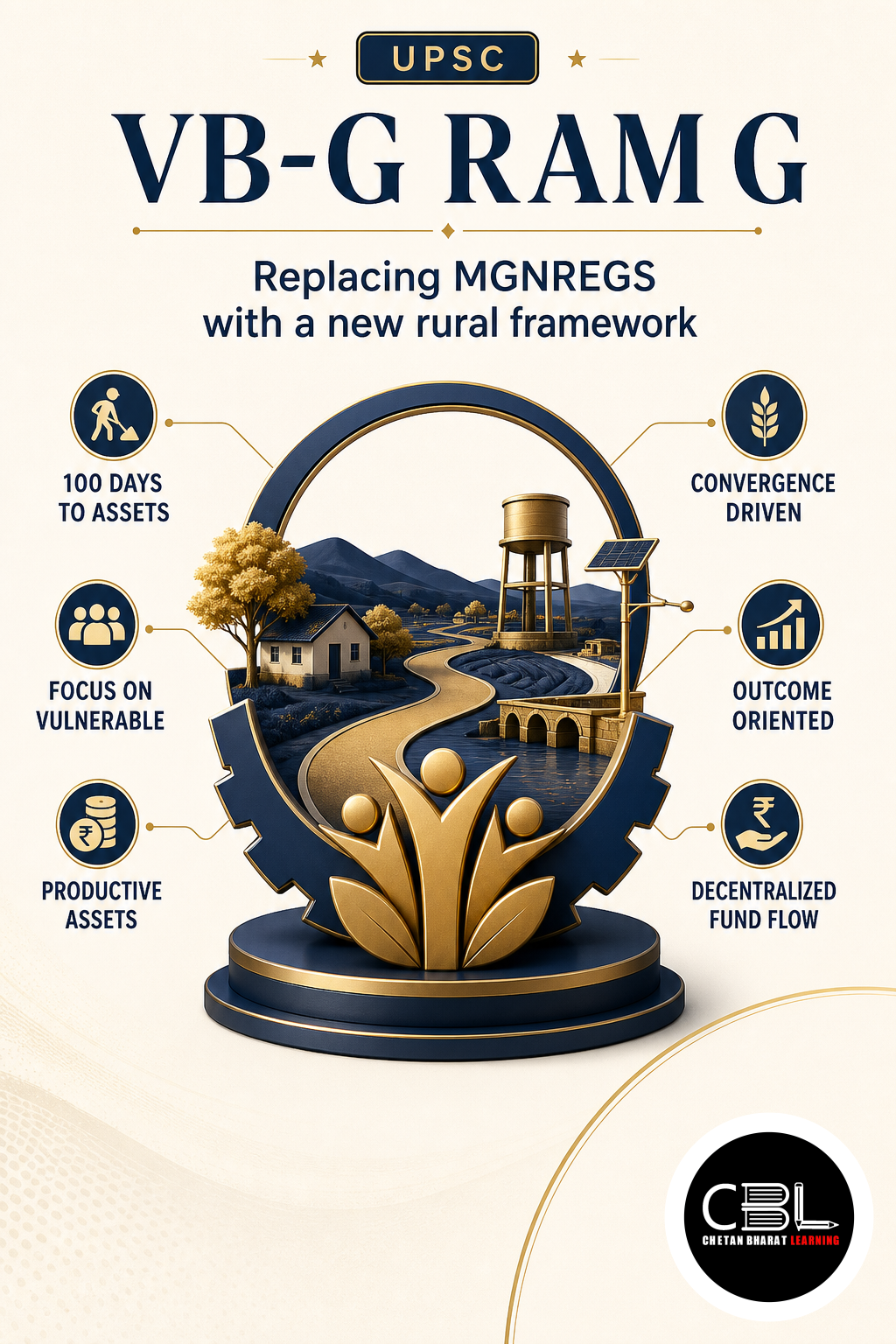
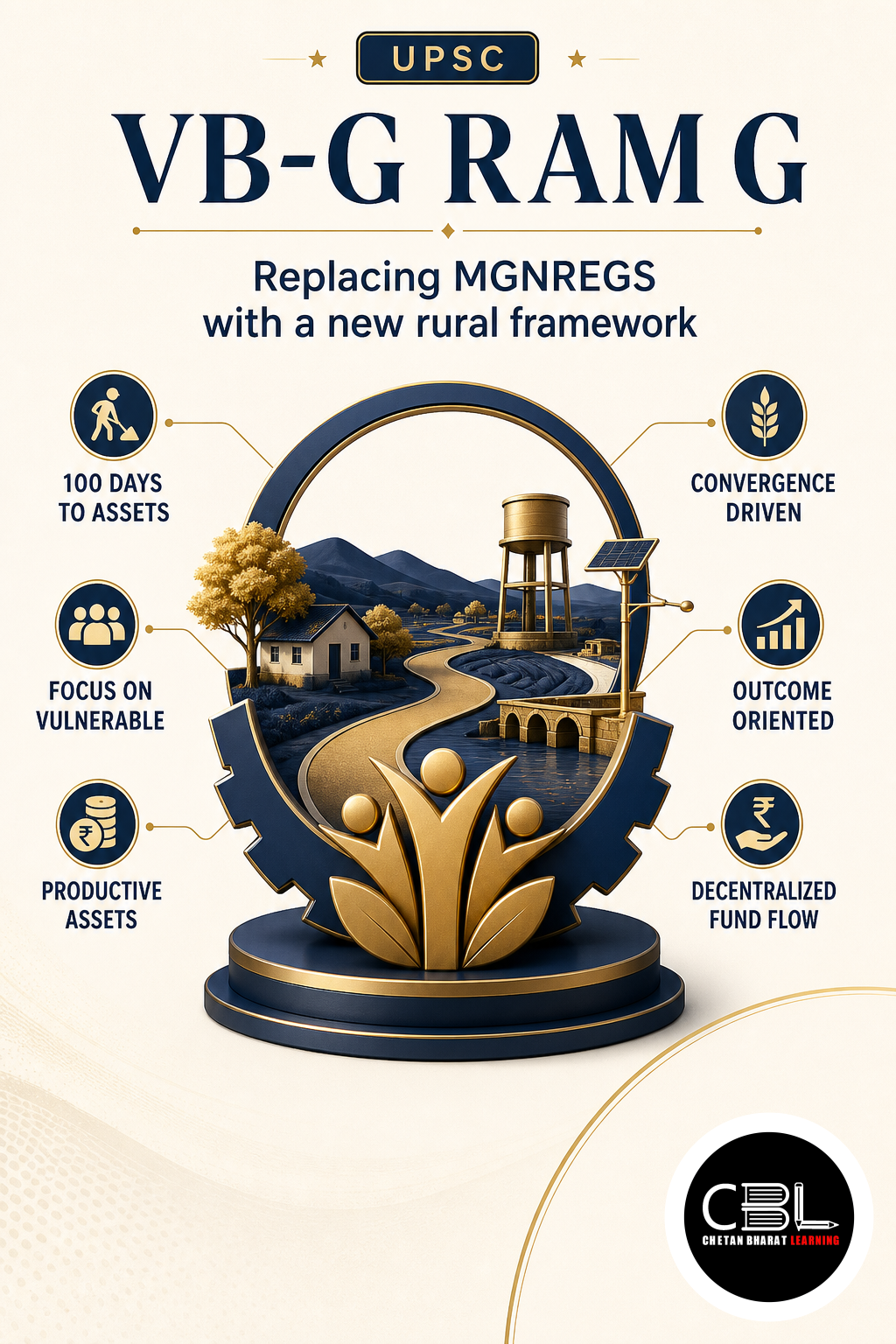
The VB-G RAM G is the successor framework to MGNREGA, designed to provide enhanced rural employment guarantees while fundamentally altering the fiscal and administrative architecture of the scheme. While MGNREGA guaranteed 100 days of wage employment entirely funded by the Centre, the new Act increases this to 125 days but introduces a 60-day seasonal pause during peak agricultural sowing and harvesting periods.
The most significant structural shift is the funding mechanism. Under the new framework, state governments must bear 40% of the wage burden, a massive departure from the historical model where the Centre bore 100% of the costs. This transition aims to enforce greater state ownership and align rural employment generation with local agricultural labour requirements.
Why is VB-G RAM G in News?
The Ministry of Rural Development recently released eight draft rules covering key aspects of the scheme, including grievance redressal, administrative expenses, and normative allocation parameters. You can review the official guidelines via the Ministry portal for precise statutory frameworks.
The transition has sparked a massive debate regarding cooperative federalism and the financial capacity of state exchequers. Furthermore, the shift from a demand-driven model to a top-down allocation model based on the 16th Finance Commission formula has created distinct ‘winners’ and ‘losers’ among states, fundamentally altering the political economy of rural welfare distribution.
Key Features
- Enhanced Guarantee with Caveats: The scheme provides 125 days of work, but mandates a 60-day pause to ensure adequate farm labour availability during critical agricultural windows.
- Fiscal Burden Sharing: States must now fund 40% of the wage bill, with exceptions only for Northeastern, Himalayan states, and UTs without legislatures.
- Top-Down Allocation: The Centre determines normative allocations using the 16th Finance Commission’s horizontal devolution formula, replacing the previous demand-driven labour budget system.
- Performance-Based Withholding: The Centre can withhold a portion of funds, releasing them only upon meeting compliance metrics like timely wage payments and social audits.
- Seamless Transition: Existing MGNREGA job cards will remain valid post e-KYC verification until states issue new Gramin Rozgar Guarantee Cards.
Challenges
- State Fiscal Strain: High-demand states like Rajasthan, Andhra Pradesh, and Tamil Nadu face massive fiscal risks, especially if the new formula allocates them lower shares compared to their historical demand.
- Demand vs. Allocation Mismatch: The top-down approach removes the safety net aspect of the scheme. If a state faces an unexpected climate shock like a drought, it must bear 100% of the excess expenditure beyond the central allocation.
- Vulnerability of Landless Labour: The 60-day agricultural pause assumes farm work will be available and adequately paid during those months, which may not hold true for marginalised landless labourers.
- Centralisation of Control: Tying fund releases to central performance metrics reduces the fiscal autonomy of states to respond to localised rural distress.
Way Forward
The administration must ensure that the transition to VB-G RAM G does not compromise the fundamental ‘right to work’ ethos of the original 2005 Act. Establishing a robust, independent grievance redressal mechanism will protect workers from administrative delays. Providing dedicated central assistance to poorer states will drastically reduce the risk of wage payment defaults.
State governments must actively align their local agricultural calendars with the central pause windows to maximize regional synergies and build a self-reliant, resilient rural economy.
Prelims Practice Corner
Q1. How many days of guaranteed employment does the new VB-G RAM G framework provide annually?
- (a) 100 days
- (b) 125 days
- (c) 150 days
- (d) 200 days
Answer: (b) The scheme increases the guarantee from 100 to 125 days per year.
Q2. What percentage of the wage burden must state governments now bear under the new Act?
- (a) 10%
- (b) 25%
- (c) 40%
- (d) 50%
Answer: (c) States must bear 40% of the funding burden, a major shift from the 100% central funding under MGNREGA.
Q3. Which formula will the Centre use to determine normative allocations to states under VB-G RAM G?
- (a) 14th Finance Commission
- (b) 15th Finance Commission
- (c) 16th Finance Commission
- (d) NITI Aayog Multidimensional Poverty Index
Answer: (c) The Centre will use the 16th Finance Commission’s horizontal devolution formula for top-down allocations.
Q4. What is the primary objective of the 60-day seasonal pause built into the employment guarantee?
- (a) To save government funds
- (b) To ensure adequate farm labour during sowing and harvesting
- (c) To allow for machinery maintenance
- (d) To conduct social audits
Answer: (b) The pause is designed to ensure adequate availability of agricultural labour during critical farming seasons.
Q5. What happens if a state’s employment demand exceeds its normative allocation under the new rules?
- (a) The Centre automatically provides unlimited funds
- (b) The state must bear all additional expenditure
- (c) The scheme is suspended in that state
- (d) Workers are shifted to urban schemes
Answer: (b) If expenditure exceeds the normative allocation, the state must bear all additional costs, creating a significant fiscal risk.
Mains Practice Questions
Q1. Discuss the structural shifts introduced by the VB-G RAM G framework and its potential impact on state finances and rural livelihoods. (10 marks)
Answer Structure
- Intro: Introduce the transition from MGNREGA to VB-G RAM G, highlighting the increase to 125 days of work and the new funding architecture.
- Body: Analyze the shift of 40% wage burden to states, the move from demand-driven to top-down 16th FC allocations, and the implications of the 60-day agricultural pause on landless labourers.
- Conclusion: Conclude that while the scheme aims to align welfare with agricultural cycles, it requires robust central support to prevent fiscal distress in high-demand states.
Q2. “The transition from a demand-driven employment guarantee to a top-down normative allocation model raises critical questions regarding cooperative federalism and the state’s role as an employer of last resort.” Analyze. (15 marks)
Answer Structure
- Intro: Define the historical significance of MGNREGA as a rights-based, demand-driven safety net and introduce the new VB-G RAM G framework.
- Body: Examine the federal tensions arising from the 40% state funding mandate, the risks of capping central liability during climate-induced distress (droughts/floods), and the centralization of control via performance-based fund withholding.
- Conclusion: Suggest that maintaining the ‘right to work’ ethos requires flexible contingency funds and a collaborative approach between the Centre and States to manage rural distress effectively.
FAQs on VB-G RAM G
Will existing MGNREGA workers lose their jobs during the transition?
No. The draft rules specify that existing MGNREGA job cards will remain valid for seeking employment once renewed and verified through e-KYC. Workers will not be left without access to work during the transition period until states issue new Gramin Rozgar Guarantee Cards.
Why are some states considered ‘losers’ under the new allocation formula?
Under MGNREGA, funds were allocated based on actual labour budgets submitted by states (demand-driven). The new scheme uses the 16th Finance Commission formula for top-down allocation. Consequently, states with high historical demand but lower 16th FC shares (like Tamil Nadu, Rajasthan, and Andhra Pradesh) may receive lower central allocations than their actual employment generation requires.
What is the rationale behind the 60-day agricultural pause?
The government introduced the 60-day pause during peak sowing and harvesting seasons to prevent MGNREGA from competing with private agriculture for labour. By pausing the guarantee, the scheme aims to ensure that local farmers have adequate access to workforce during critical agricultural windows.
Related Current Affairs
Preparing for UPSC, PCS or HCS?
Talk to a mentor at Chetan Bharat Learning, Chandigarh. Free guidance on choosing the right exam and building a study plan.
Chat on WhatsAppCall 97793 53345UPSC / IAS / PCS coaching in Chandigarh · Trusted by aspirants across Punjab & Haryana
Leave a Reply
You must be logged in to post a comment.