
UPSC Mapping
- Prelims: Economy
- Mains: GS Paper 3
Article
| Key | Value |
|---|---|
| Global Manufacturing Share | 30 % |
| Trade Surplus | $1.2 Trillion |
| Key Sectors | Solar, EVs, Batteries |
| Core Driver | State Subsidies |
What is Chinese overcapacity?
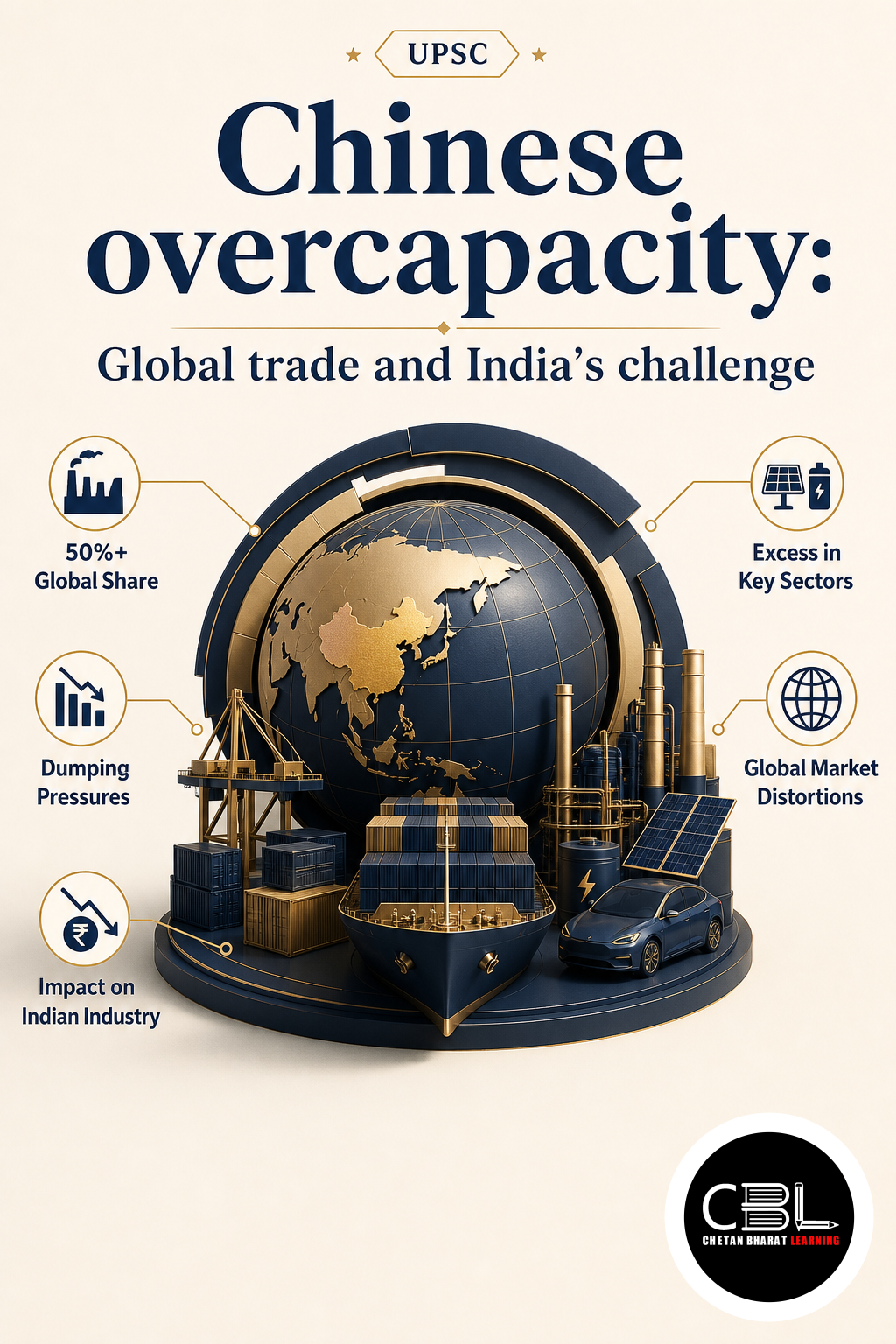
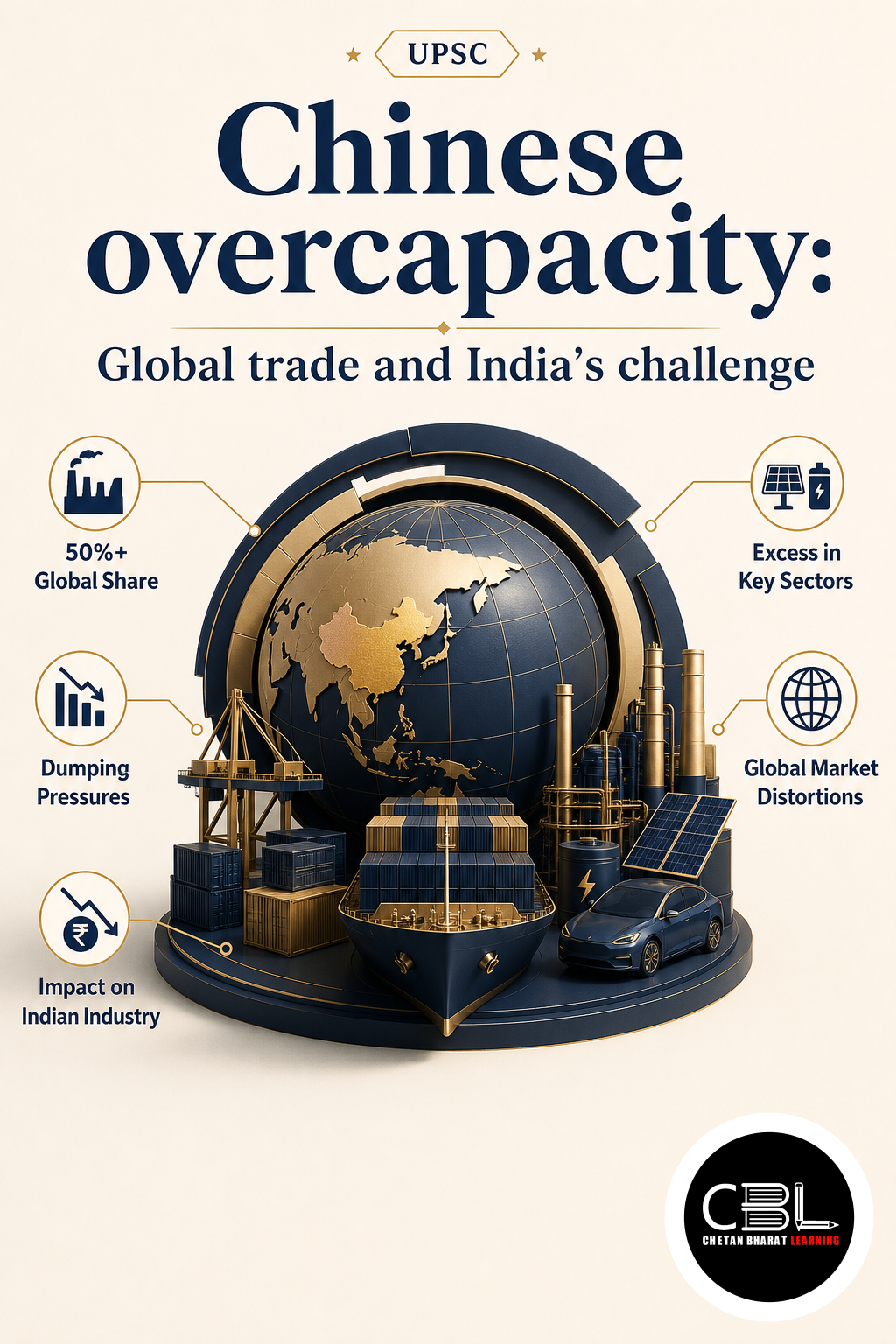
Chinese overcapacity occurs when the nation’s manufacturing capabilities vastly exceed its domestic market demand. This massive surplus forces producers to aggressively export goods at razor-thin or even negative margins. State-directed financial systems provide cheap credit, allowing firms to expand market share without worrying about traditional profitability.
This strategy has created an ‘absolute advantage’ in manufacturing. The success reflects not just low-cost production, but unparalleled scale, dense supplier networks, and state-supported industrial ecosystems. Consequently, China dominates the production of everything from basic textiles to advanced clean technology products.
Why is Chinese overcapacity in News?
Global economies are increasingly raising concerns about the asymmetric pressures created by these massive industrial subsidies. Developing nations face a severe ‘late industrialisation dilemma’ as their domestic producers simply cannot compete with artificially cheap imports. You can review global trade disputes via the WTO portal for precise trade remedy frameworks.
Furthermore, China’s dominance is transforming the geography of global value chains. In the electric vehicle sector alone, it controls 65 % of lithium refining, 70 % of cobalt refining, and over 80 % of battery manufacturing. This sheer dominance generates significant strategic vulnerabilities for countries that rely excessively on a single supplier.
Key Features
- Consumer Benefits: Low-cost imports reduce the prices of consumer goods and intermediate inputs, supporting infrastructure development in developing economies.
- Market Distortion: Heavy government subsidies enable zero-sum price wars that drive international competitors out of the market.
- Value Chain Control: Beijing occupies critical nodes across multiple stages of the manufacturing network, making decoupling extremely difficult.
- Strategic Leverage: Dominance in critical minerals and green technology provides immense geopolitical leverage during international disputes.
Challenges for India
- MSME Vulnerability: Small domestic manufacturers lack the scale to compete, severely undermining local industrialisation imperatives.
- Import Dependence: Critical sectors like solar modules, telecom components, and active pharmaceutical ingredients remain heavily reliant on foreign supplies.
- Pincer Dilemma: Export curbs could restrict access to key inputs like solar wafers, while India’s production-linked incentives face WTO challenges over local content rules.
- Capability Thwarting: Continuous reliance on cheap imports weakens the long-term incentives to foster domestic upstream industries and R&D.
Way Forward
India must adopt a strategic middle path that balances the immediate need for cheap goods with the long-term necessity of building industrial capacity. Identifying and protecting truly strategic sectors is essential for national security. Utilizing legal trade remedies like anti-dumping duties will help level the playing field against unfair market distortions.
Check the latest NITI Aayog reports for strategic supply chain diversification recommendations. The government must actively promote complete domestic ecosystems—from raw materials to final assembly—rather than just isolated assembly plants. Continuous refinement of industrial policies will guarantee that the nation achieves genuine technological sovereignty.
Prelims Practice Corner
-
Q1. What percentage of global manufacturing output does China currently account for?
- (a) 15 %
- (b) 20 %
- (c) 30 %
- (d) 45 %
Answer: (c) China accounts for roughly 30 % of global manufacturing output.
-
Q2. Which specific term describes the difficulty developing nations face when trying to build domestic industries against cheap imports?
- (a) Middle-income trap
- (b) Late industrialisation dilemma
- (c) Dutch disease
- (d) Balance of payments crisis
Answer: (b) The ‘late industrialisation dilemma’ refers to the inability of new domestic firms to compete with established, subsidized foreign giants.
-
Q3. What is the approximate value of China’s current trade surplus?
- (a) $500 billion
- (b) $800 billion
- (c) $1.2 trillion
- (d) $2.5 trillion
Answer: (c) China runs a massive trade surplus valued at approximately 1.2 trillion dollars.
-
Q4. In the electric vehicle sector, what percentage of global battery manufacturing does China control?
- (a) Over 50 %
- (b) Over 65 %
- (c) Over 80 %
- (d) Over 95 %
Answer: (c) China controls over 80 % of global battery manufacturing, dominating the EV supply chain.
-
Q5. What does the ‘pincer dilemma’ refer to in the context of India’s manufacturing policies?
- (a) High inflation and low growth
- (b) Facing export curbs on inputs while WTO challenges local content rules
- (c) High tariffs and poor infrastructure
- (d) Lack of skilled labour and capital
Answer: (b) India faces potential export curbs on critical inputs while its PLI schemes face WTO challenges over local content requirements.
Mains Practice Questions
-
Q1. Discuss the implications of Chinese manufacturing overcapacity on the ‘late industrialisation dilemma’ faced by developing economies like India. (10 marks)
Answer Structure:
- Intro: Define overcapacity and highlight how state-backed subsidies create an ‘absolute advantage’ in global manufacturing.
- Body: Explain the late industrialisation dilemma where domestic MSMEs cannot compete with razor-thin margin imports, thwarting capability building and value chain upgradation.
- Conclusion: Conclude that developing nations must strategically identify critical sectors and utilize legal trade remedies to protect nascent domestic industries.
-
Q2. “Excessive concentration of manufacturing in a single geography creates severe strategic vulnerabilities for global supply chains.” Analyze this statement in the context of the green energy transition. (15 marks)
Answer Structure:
- Intro: Introduce the paradox of globalization where China dominates critical nodes like lithium refining and battery manufacturing for the green transition.
- Body: Analyze the ‘pincer dilemma’ faced by India, the risks of export curbs on critical inputs, and the necessity of building complete domestic ecosystems rather than just assembly hubs.
- Conclusion: Suggest that a globally coordinated approach, similar to the historical Plaza Accord, may be needed to gradually rebalance the global manufacturing landscape.
FAQs on Chinese overcapacity
- Are cheap imports always bad for the domestic economy?
- Not necessarily. Cheap imports lower prices for consumers and provide affordable intermediate goods that support local infrastructure and downstream industries. The problem arises when predatory pricing destroys domestic capacity and creates irreversible strategic dependence.
- What is the infant industry argument?
- The infant industry argument suggests that new domestic industries need temporary protection from established foreign competitors to achieve economies of scale and build technological capabilities. Once competitive, this protection should ideally be removed.
- How is India responding to this strategic challenge?
- India is utilizing Production Linked Incentive (PLI) schemes to boost domestic manufacturing in strategic sectors like electronics and solar. Simultaneously, it is deploying trade remedies like anti-dumping duties and actively pursuing ‘China+1’ supply chain diversification strategies.
Related Current Affairs
Preparing for UPSC, PCS or HCS?
Talk to a mentor at Chetan Bharat Learning, Chandigarh. Free guidance on choosing the right exam and building a study plan.
Chat on WhatsAppCall 97793 53345UPSC / IAS / PCS coaching in Chandigarh · Trusted by aspirants across Punjab & Haryana
Leave a Reply
You must be logged in to post a comment.