
UPSC Mapping
- Prelims: Environment & Economy
- Mains: GS Paper 3
Quick Facts
| Target Capacity | Investment Needed | Key Legislation | Current Hurdle |
|---|---|---|---|
| 100 GWe by 2047 | $228 Billion | SHANTI Act | Green Taxonomy Exclusion |
Article
What is nuclear green energy status?
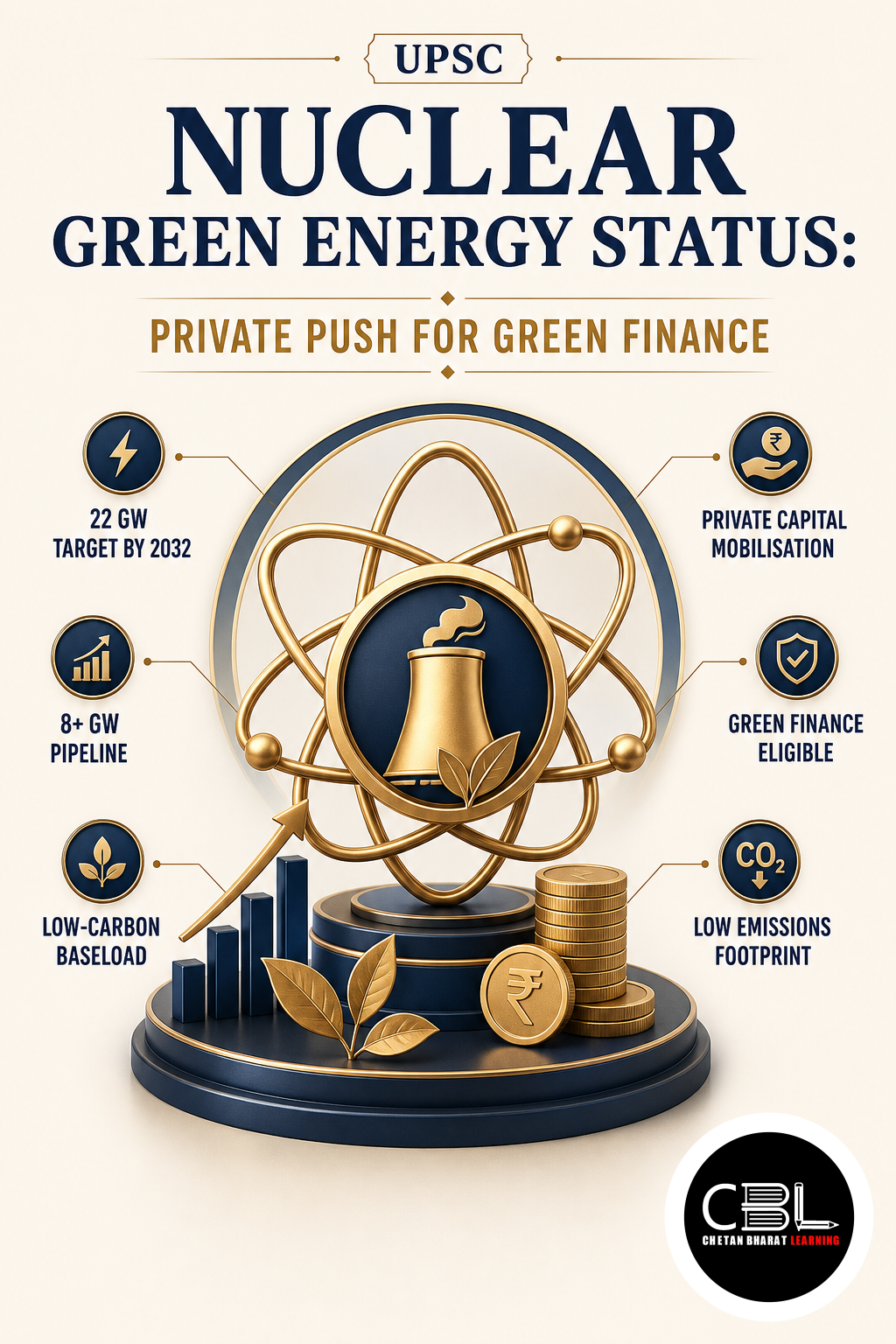
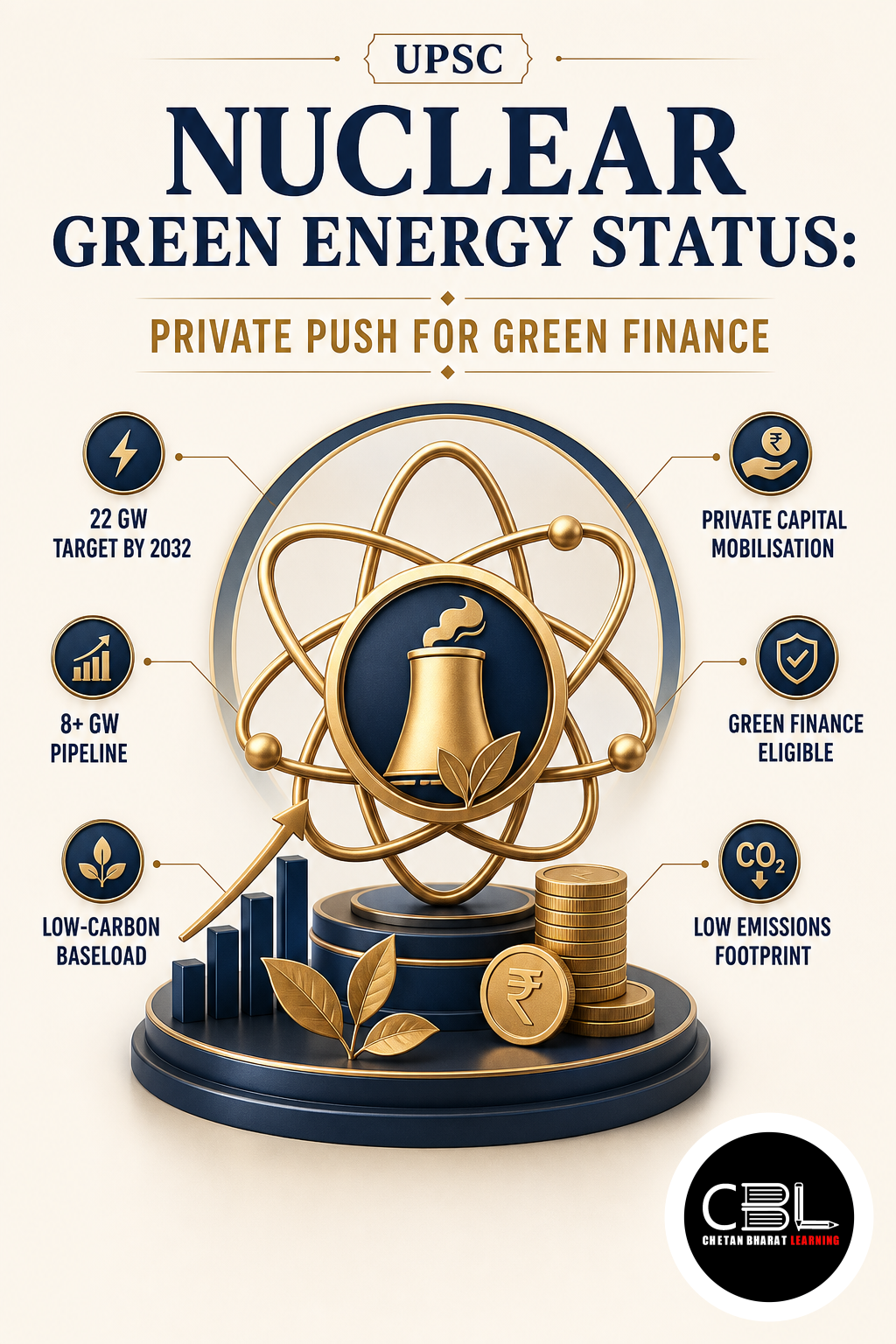
The nuclear green energy status refers to the formal classification of atomic power as an environmentally sustainable activity under national and global green finance taxonomies. Currently, major domestic frameworks—including the Ministry of Finance’s Sovereign Green Bond Framework, the RBI’s green deposit rules, and SEBI’s green debt securities guidelines—strictly exclude nuclear power.
Granting this status would allow nuclear projects to access low-cost green bonds, green loans, and blended financing mechanisms. While nuclear energy produces virtually zero greenhouse gas emissions during operation, its classification remains highly debated due to the unresolved challenges of radioactive waste management and long-term decommissioning costs.
Why is nuclear green energy status in News?
During a recent stakeholder consultation hosted by NITI Aayog, industry participants strongly advocated for reviewing these restrictive financial frameworks. NITI Aayog member Abhay Karandikar noted that even multilateral institutions like the World Bank and the Asian Development Bank are actively reconsidering their historical bans on nuclear investments. You can review India’s energy transition goals via the NITI Aayog portal for precise policy directives.
Furthermore, the Central Electricity Authority (CEA) recently announced that the final rules under the new SHANTI Act will be ready in the next two to three months. This legislation aims to streamline the private sector’s entry into the civil nuclear space, which was tightly regulated until last year. The CEA also stressed the critical need to develop indigenous thorium-based technologies to guarantee long-term national energy security.
Key Features
- Massive Capital Requirement: Achieving the national target of 100 GWe by 2047 requires at least $228 billion in investment, making cheap long-term financing absolutely critical.
- Infrastructure Status: While nuclear power is already covered under the DEA’s Harmonised Master List of Infrastructure Sub-sectors, explicit green financial status remains elusive.
- Baseload Reliability: Unlike intermittent solar and wind power, nuclear provides stable, firm baseload electricity essential for grid reliability and heavy industrialization.
- Thorium Focus: The regulatory push heavily emphasizes the development of advanced thorium reactor technologies to utilize the country’s vast domestic reserves.
Challenges
- The Nuclear Paradox: While atomic energy provides firm, low-carbon power, it simultaneously generates long-lived radioactive waste and carries severe, albeit rare, accident risks.
- Greenwashing Fears: Environmentalists argue that green finance should not fund projects with unresolved decommissioning liabilities and ecological contamination risks.
- High Upfront Costs: Nuclear projects historically suffer from massive time overruns and cost escalations, making private investors highly risk-averse without state guarantees.
- Site Selection Delays: Identifying geologically stable and socially acceptable locations for new reactors remains a major bottleneck for rapid capacity addition.
Way Forward
The administration must establish a conditional green taxonomy that grants climate capital only to projects meeting stringent safety, waste-management, and decommissioning benchmarks. Finalizing the SHANTI Act rules will provide the necessary legal clarity and liability frameworks for private investors. Providing dedicated sovereign guarantees will drastically lower the cost of capital for these mega-projects.
Check the latest CEA guidelines for strategic infrastructure planning. The government must periodically review the baseline methodologies to ensure they reflect current global climate finance realities. Continuous refinement of the nuclear green energy status will guarantee that India achieves its decarbonisation targets without compromising ecological safety.
Prelims Practice Corner
-
Q1. What is the primary objective of private players seeking ‘green energy’ status for nuclear power?
(a) To bypass environmental clearances (b) To access green bonds, loans, and blended financing (c) To eliminate safety regulations (d) To export uranium
Answer: (b) Green status allows nuclear projects to access low-cost climate capital and green financing mechanisms. -
Q2. Which of the following domestic frameworks currently excludes nuclear power from its green definitions?
(a) RBI’s Green Deposit Framework (b) SEBI’s Green Debt Securities (c) Sovereign Green Bond Framework (d) All of the above
Answer: (d) All major domestic green finance frameworks currently exclude atomic energy. -
Q3. What is India’s targeted nuclear power capacity by the year 2047?
(a) 25 GWe (b) 50 GWe (c) 100 GWe (d) 250 GWe
Answer: (c) India targets 100 gigawatt-electric (GWe) of nuclear power capacity by 2047. -
Q4. Which upcoming legislation is expected to finalize rules for private sector participation in the nuclear space?
(a) Atomic Energy Act (b) SHANTI Act (c) Civil Liability for Nuclear Damage Act (d) Energy Conservation Act
Answer: (b) The final rules under the SHANTI Act are expected to be ready in the coming months. -
Q5. Which indigenous fuel cycle did the CEA recently stress developing for long-term energy security?
(a) Uranium-235 (b) Plutonium-239 (c) Thorium-based technologies (d) Deuterium-Tritium fusion
Answer: (c) The CEA stressed the need to develop thorium-based technologies to utilize domestic reserves.
Mains Practice Questions
-
Q1. Discuss the ‘Nuclear Paradox’ in the context of green finance taxonomies and India’s energy trilemma. (10 marks)
Answer Structure:- Intro: Define the energy trilemma (security, affordability, sustainability) and the private sector’s push for nuclear green status.
- Body: Explain the paradox: nuclear offers zero-carbon baseload power essential for grid stability, but faces opposition due to radioactive waste, accident risks, and high decommissioning costs.
- Conclusion: Conclude that a conditional green taxonomy with strict safety and waste-management safeguards is the most pragmatic path forward.
-
Q2. “Achieving India’s 100 GWe nuclear target requires shifting from a public finance model to a robust private capital ecosystem.” Analyze the regulatory and financial bottlenecks in this transition. (15 marks)
Answer Structure:- Intro: Highlight the massive $228 billion investment requirement and the recent opening of the civil nuclear sector to private players.
- Body: Analyze the exclusion from green finance frameworks, the challenges of site selection, long gestation periods, and the necessity of finalizing the SHANTI Act rules to provide liability and regulatory certainty.
- Conclusion: Suggest that blending sovereign guarantees with international climate capital and focusing on indigenous thorium technologies will ensure strategic energy independence.
FAQs on nuclear green energy status
-
Why do private investors demand green status for nuclear projects?
Nuclear power plants require massive upfront capital, suffer from long construction periods, and carry high interest costs during the gestation phase. Green status unlocks access to a much larger pool of climate-focused institutional investors, significantly lowering the cost of long-term debt and making projects financially viable.
-
Are international financial institutions changing their stance on nuclear funding?
Yes. Historically, institutions like the World Bank and Asian Development Bank restricted nuclear investments due to safety and waste concerns. However, the urgent global need for decarbonisation and reliable baseload power is forcing a review of these restrictions, aligning global finance with net-zero targets.
-
What is the significance of the SHANTI Act in this context?
The SHANTI Act is expected to provide the comprehensive legal and regulatory framework required for private sector participation in nuclear energy. Finalizing its rules will clarify liability, streamline site-selection processes, and establish the independent regulatory oversight that private capital demands before committing billions of dollars.
Related Current Affairs
Preparing for UPSC, PCS or HCS?
Talk to a mentor at Chetan Bharat Learning, Chandigarh. Free guidance on choosing the right exam and building a study plan.
Chat on WhatsAppCall 97793 53345UPSC / IAS / PCS coaching in Chandigarh · Trusted by aspirants across Punjab & Haryana
Leave a Reply
You must be logged in to post a comment.