
UPSC Mapping
- Prelims: Economy
- Mains: GS Paper 3
Quick Facts
| Rating Agency | New Rating | Previous Rating | Historical Context |
|---|---|---|---|
| JCRA | A- (Stable) | BBB+ | First ‘A’ since 1988 |
What is JCRA sovereign rating?
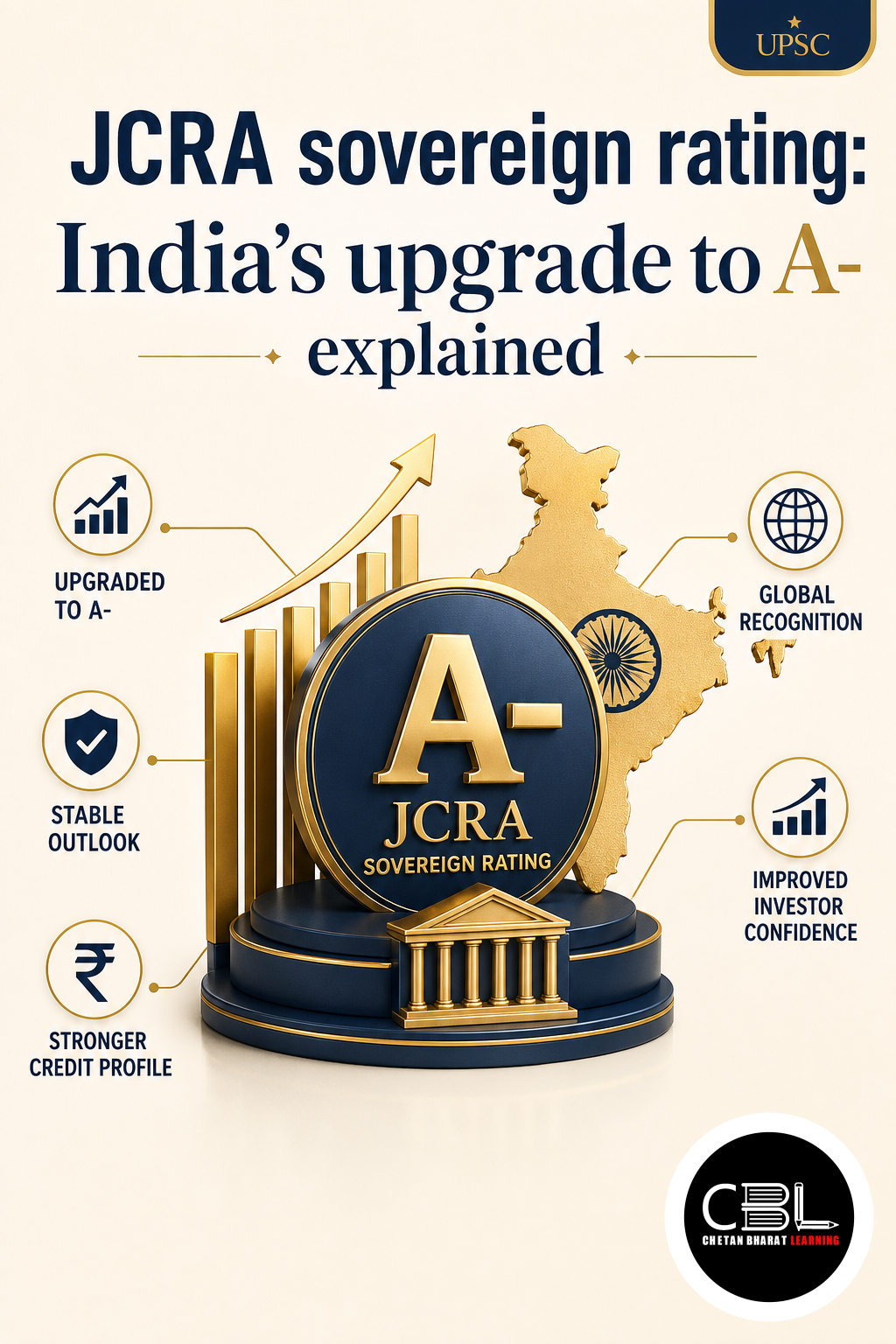
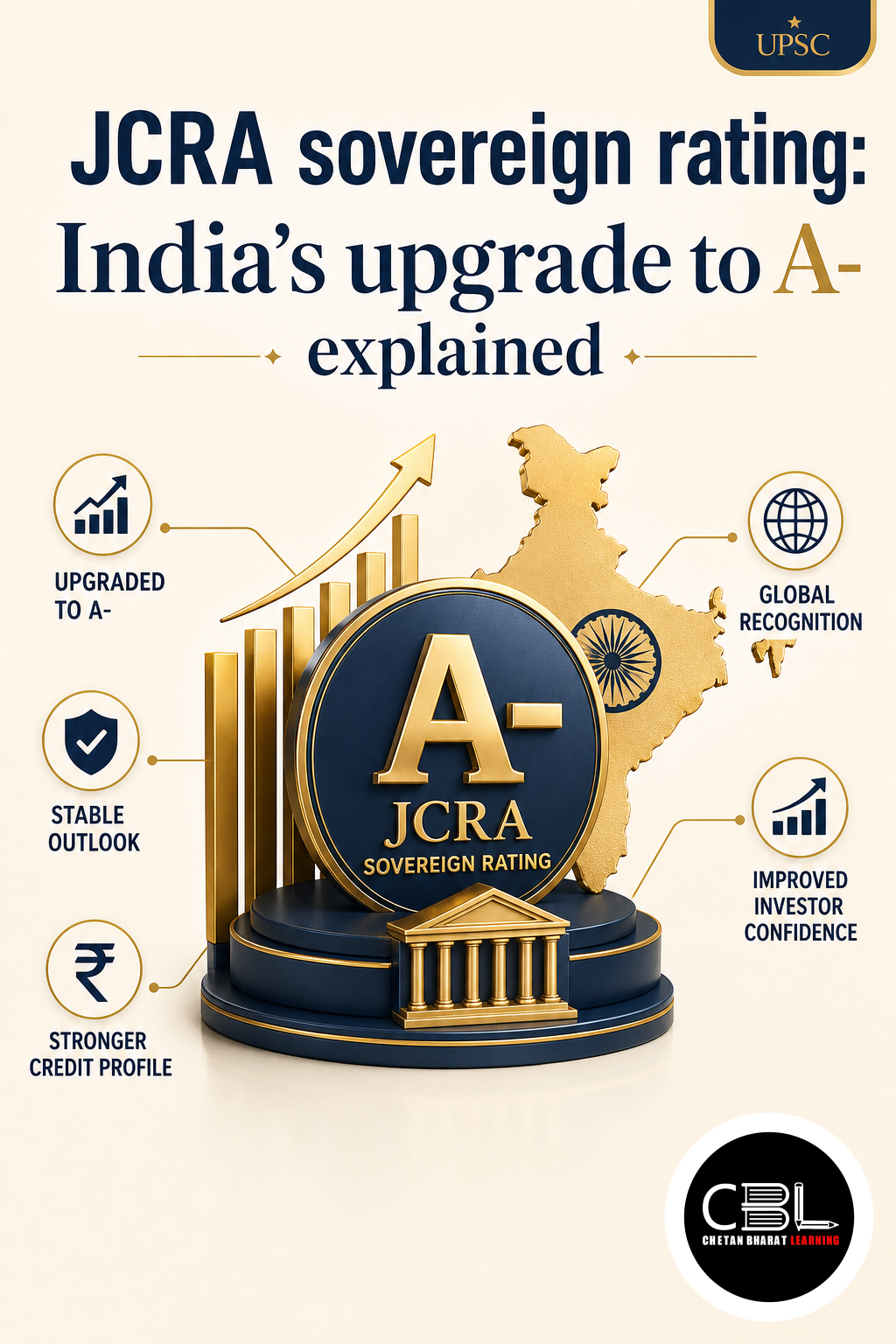
A sovereign credit rating measures a national government’s financial reliability and its capacity to meet debt obligations. The Japan Credit Rating Agency (JCRA) evaluates macroeconomic strength, external sector resilience, and institutional credibility. An upgrade to the ‘A’ category signals a relatively strong capacity to meet financial commitments, albeit slightly more vulnerable than the highest-rated sovereigns.
For developing economies, a strong sovereign rating directly influences the borrowing cost channel. Higher creditworthiness lowers the perceived risk premium, resulting in cheaper access to global capital markets. This benefit eventually cascades down to domestic corporations and financial institutions seeking foreign investment.
Why is JCRA sovereign rating in News?
The Japanese agency recently upgraded India’s foreign and local currency long-term issuer ratings by one notch to ‘A-‘ with a stable outlook. The Ministry of Finance welcomed the decision, citing solid economic growth and the improved soundness of the financial system. You can review official macroeconomic data via this Ministry of Finance portal for precise statistical details.
This upgrade carries immense historical significance. The last time India held an ‘A’ category rating was in 1988, when Moody’s assigned an A2 rating. The country subsequently lost this prestigious status during the severe Balance of Payments crisis of 1990-91. Regaining this status after 35 years underscores the structural resilience of the modern Indian economy.
Key Features
- Growth Momentum: The economy has maintained a high growth rate of around 7 per cent, supported by robust private consumption and massive public investment.
- Policy Effectiveness: Steady implementation of structural reforms has strengthened the foundational pillars for long-term productivity and industrial expansion.
- Financial Soundness: Clean corporate and bank balance sheets have drastically improved the overall stability of the domestic financial system.
- External Resilience: Strong foreign exchange reserves and a resilient services export sector provide a massive buffer against global economic shocks.
Challenges
- Electoral Cycles: Fiscal management remains susceptible to political and electoral cycles, which can sometimes derail long-term consolidation targets.
- Intergovernmental Relations: Complex fiscal transfer arrangements between the Centre and States occasionally complicate unified debt management strategies.
- Public Debt Burden: While growth remains strong, the absolute level of general government debt remains higher than the median for emerging market peers.
- Global Headwinds: Ongoing geopolitical conflicts and volatile energy prices continuously test the resilience of the current account and inflation trajectories.
You can explore similar macroeconomic concepts in our economy section for deeper insights into national accounting frameworks.
Way Forward
The administration must focus on sustainable fiscal consolidation to ensure that high growth translates into long-term debt sustainability. Strengthening cooperative fiscal federalism will help align state-level borrowing with national macroeconomic targets. Maintaining low inflation and robust external buffers remains crucial for preserving this hard-earned credibility.
Check the latest RBI macroeconomic reports for strategic growth analysis. A strong credit rating should always be the natural consequence of sound economic fundamentals rather than the primary objective of policy. Continuous structural reforms will guarantee that the national economy remains resilient against future global shocks.
Prelims Practice Corner
Q1. Which international agency recently upgraded India’s sovereign rating to ‘A-‘?
(a) Moody’s (b) S&P Global (c) Fitch Ratings (d) Japan Credit Rating Agency
Answer: (d) The Japan Credit Rating Agency (JCRA) elevated the rating from BBB+ to A-.
Q2. When did India last hold an ‘A’ category sovereign rating before this recent upgrade?
(a) 1991 (b) 2008 (c) 1988 (d) 2001
Answer: (c) India last held an ‘A’ rating in 1988 (Moody’s A2) before losing it during the 1990-91 BoP crisis.
Q3. What does a ‘stable outlook’ accompanying a credit rating upgrade typically indicate?
(a) Immediate further upgrades (b) Rating expected to remain broadly unchanged (c) Impending downgrade (d) Default risk is zero
Answer: (b) A stable outlook means the rating is expected to remain broadly unchanged under current economic assumptions.
Q4. Which specific domestic structural challenge did the rating agency flag regarding India’s fiscal management?
(a) Lack of tax base (b) Susceptibility to electoral cycles (c) High corporate tax rates (d) Absence of GST
Answer: (b) The agency noted that fiscal management remains susceptible to political and electoral cycles.
Q5. How does a sovereign rating upgrade primarily benefit domestic corporations?
(a) Eliminates all taxes (b) Lowers the perceived risk premium and borrowing costs (c) Guarantees government subsidies (d) Increases domestic monopoly rights
Answer: (b) Higher sovereign creditworthiness lowers the country risk premium, reducing borrowing costs for domestic firms.
Mains Practice Questions
Q1. Discuss the significance of sovereign credit ratings for a developing economy and how they influence the cost of global capital. (10 marks)
- Intro: Define sovereign credit ratings and highlight the recent JCRA upgrade to ‘A-‘ after a gap of 35 years.
- Body: Explain the borrowing cost channel, how lower risk premiums attract foreign investment, and the cascading benefits for domestic corporations and infrastructure financing.
- Conclusion: Conclude that maintaining macroeconomic stability and fiscal discipline is essential to retain investor confidence.
Q2. “A strong credit rating should be the consequence of sound economic fundamentals rather than the primary objective of economic policy.” Analyze. (15 marks)
- Intro: Introduce the limitations of credit rating models and their tendency to be backward-looking or pro-cyclical.
- Body: Analyze the structural challenges flagged by agencies, such as electoral cycles and complex intergovernmental fiscal relations, while emphasizing the need for sustainable growth over mere rating chasing.
- Conclusion: Suggest that focusing on productive investments, low inflation, and institutional credibility will naturally result in favorable sovereign ratings.
FAQs on JCRA sovereign rating
How does a sovereign rating differ from a corporate credit rating?
A sovereign rating assesses the country-level credit risk and the government’s ability to repay its national debt. A corporate rating evaluates entity-specific credit risk. While sovereign risk influences corporate risk, high national growth alone does not guarantee corporate profitability.
Why did India lose its ‘A’ rating in the early 1990s?
India lost its prestigious Moody’s A2 rating during the severe Balance of Payments crisis of 1990-91. The country faced a massive shortage of foreign exchange reserves, making it extremely difficult to meet external debt obligations and triggering a severe downgrade.
Does a rating upgrade automatically reduce domestic interest rates?
Not automatically. While an upgrade lowers the foreign currency borrowing costs and reduces the sovereign risk premium, domestic interest rates are primarily determined by the central bank’s monetary policy, domestic inflation trajectories, and local liquidity conditions.
Related Current Affairs
Preparing for UPSC, PCS or HCS?
Talk to a mentor at Chetan Bharat Learning, Chandigarh. Free guidance on choosing the right exam and building a study plan.
Chat on WhatsAppCall 97793 53345UPSC / IAS / PCS coaching in Chandigarh · Trusted by aspirants across Punjab & Haryana
Leave a Reply
You must be logged in to post a comment.