

UPSC Mapping
| Prelims | Science & Technology |
|---|---|
| Mains | GS Paper 3 |
Quick Facts
| Nodal Lab | CSIR-NPL |
|---|---|
| Core Tech | Atomic Clocks |
| Network Tech | White Rabbit |
| Backup System | NavIC |
Article
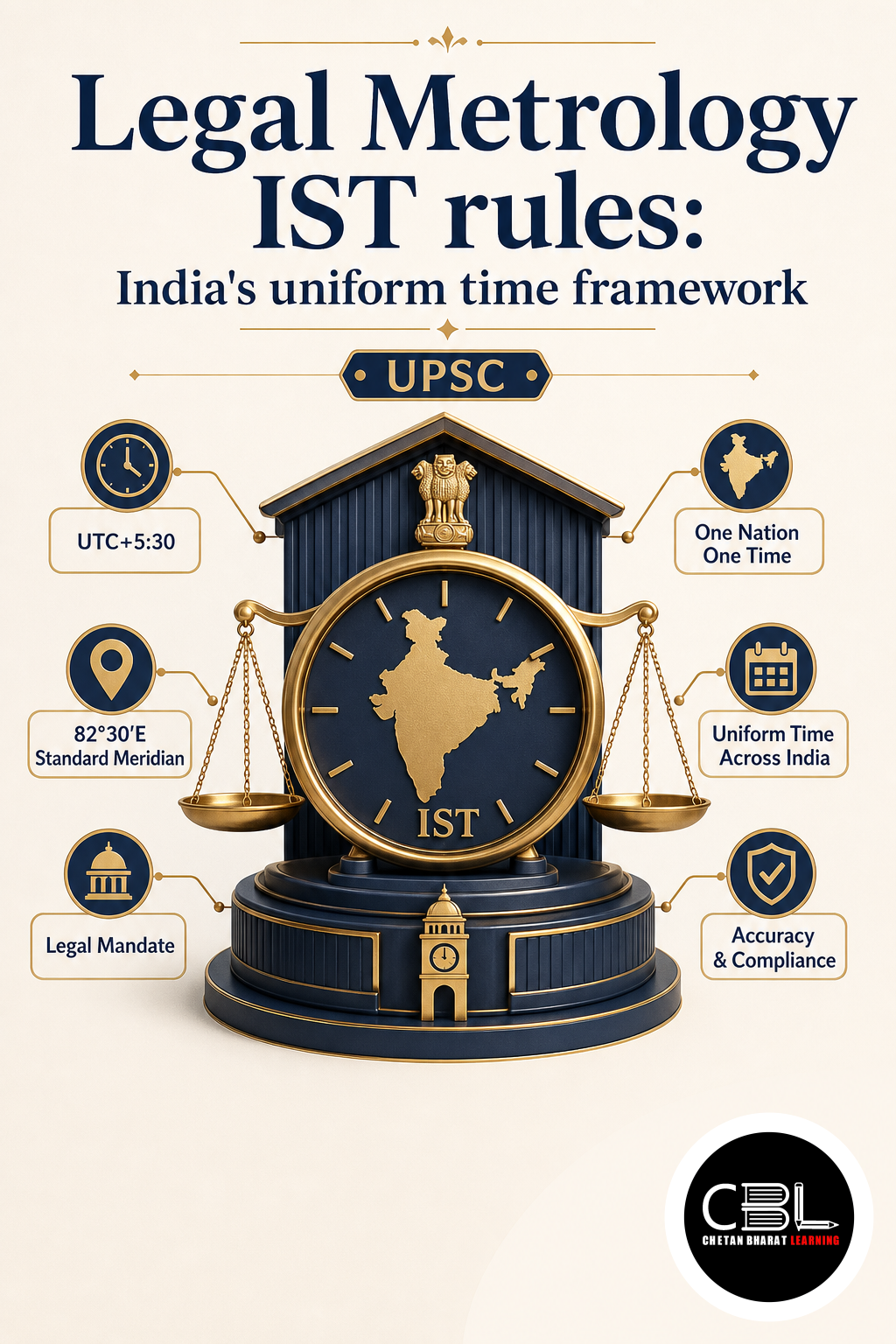
The newly notified Legal Metrology IST rules mandate a uniform time framework across India’s critical infrastructure. The Union Consumer Affairs Ministry recently made Indian Standard Time the legally enforceable reference for official and commercial systems. Policymakers designed this intervention to improve cybersecurity and ensure precise sequencing of digital events. Students can track similar updates in our daily current affairs archive regularly. The administration actively promotes domestic timing infrastructure to resolve strategic vulnerabilities.
What are Legal Metrology IST rules?
The Legal Metrology IST rules require time-dependent systems in government and critical sectors to use a traceable and authorised Indian Standard Time reference. Previously, organizations obtained time from various indirect sources like GPS or default network servers, leading to dangerous synchronization lags. The new framework legally mandates that every critical clock must ultimately link back to the national standard.
The Council of Scientific and Industrial Research-National Physical Laboratory (CSIR-NPL) maintains this precise national standard. A bank of extremely accurate caesium atomic clocks helps the NPL maintain the country’s time within a few nanoseconds of the global Coordinated Universal Time. These clocks are so stable that they would lose only one second in about three lakh years.
Why are Legal Metrology IST rules in News?
The Union Consumer Affairs Ministry recently notified these rules to make IST the country’s common time reference for commercial and legal purposes. This unified framework drastically improves cybersecurity and helps investigators accurately reconstruct the sequence of digital events during fraud probes. You can review official scientific standards via this CSIR portal for precise metrological data.
Furthermore, the push for IST uniformity aligns with India’s strategic effort to reduce reliance on external satellite navigation systems. Most devices currently obtain time through the US-owned GPS network. The historical denial of GPS signals during the Kargil War highlighted the severe strategic vulnerability of depending on foreign timing infrastructure.
Key Features
- Legal Traceability: Organizations must now prove that their system clocks are synchronised and traceable to the authoritative NPL reference.
- Atomic Precision: The national time scale relies on caesium atomic transitions, providing a universally reproducible and highly stable frequency standard.
- White Rabbit Technology: This open-source networking technology synchronises computer clocks over fibre-optic networks by measuring and adjusting for signal travel delays.
- Financial Sequencing: Stock exchanges already operate under strict SEBI mandates to synchronise system clocks with microsecond precision for accurate trade ordering.
- Strategic Redundancy: The indigenous NavIC satellite system and terrestrial fibre-optic networks provide secure domestic backup routes for critical infrastructure.
Challenges
Despite the robust framework, maintaining absolute time synchronization presents several technical and strategic hurdles for network administrators.
- Network Delays: Signals traveling over standard internet protocols experience variable latency, causing minor but critical clock drifts across distributed systems.
- Quartz Limitations: Standard local quartz clocks are heavily affected by temperature, ageing, and environmental factors, requiring constant external correction.
- External Dependence: Excessive reliance on foreign satellite timing signals creates severe strategic vulnerabilities during geopolitical conflicts or military standoffs.
- Infrastructure Costs: Deploying dedicated fibre-optic timing networks and specialized atomic hardware requires massive capital investment for regional laboratories.
You can explore similar technological advancements in our science and technology section for deeper insights into digital sovereignty.
Way Forward
The administration must accelerate the deployment of terrestrial timing networks to ensure critical sectors possess secure, domestic backup mechanisms. Strengthening the regional reference standards laboratories will drastically improve local access to traceable time signals. Treating precise time as a core component of national infrastructure is essential for modern digital governance.
Check the latest ISRO updates for strategic NavIC expansion plans. The government must periodically review the baseline methodologies to ensure they reflect current global cybersecurity realities. Continuous refinement of the Legal Metrology IST rules will guarantee that the national digital economy remains resilient against external shocks.
Prelims Practice Corner
Q1. Which institution is mandated to maintain and disseminate the official Indian Standard Time?
- (a) ISRO
- (b) CSIR-NPL
- (c) NIC
- (d) DRDO
Answer
The CSIR-National Physical Laboratory maintains the national time standard using atomic clocks.
Q2. What specific technology is being used to synchronise clocks over fibre-optic networks under the new framework?
- (a) Bluetooth
- (b) White Rabbit
- (c) Li-Fi
- (d) 5G NR
Answer
White Rabbit is an open-source technology that measures and adjusts for signal travel delays over fibre-optics.
Q3. Which indigenous satellite navigation system provides a strategic backup for precise timing in India?
- (a) GLONASS
- (b) Galileo
- (c) NavIC
- (d) BeiDou
Answer
NavIC provides regional satellite-navigation coverage and secure timing signals over India.
Q4. Why are caesium atomic clocks preferred over standard quartz clocks for national timekeeping?
- (a) They are cheaper
- (b) They rely on stable atomic transitions unaffected by environment
- (c) They use less electricity
- (d) They connect directly to Wi-Fi
Answer
Atomic transitions are far more stable and universally reproducible than conventional quartz oscillations.
Q5. Which sector already operates under strict SEBI mandates for microsecond clock synchronisation?
- (a) Agriculture
- (b) Financial markets
- (c) Healthcare
- (d) Public transport
Answer
Stock exchanges require precise sequencing of orders and trades, mandating strict clock synchronisation.
Mains Practice Questions
Q1. Discuss the significance of establishing a legally traceable time framework for India’s critical digital infrastructure. (10 marks)
Introduction: Define the new Legal Metrology IST rules and the concept of time as a critical component of national infrastructure.
Body: Explain the necessity of traceability to the CSIR-NPL, the role of atomic clocks, and how precise timestamps help reconstruct cyber incidents and sequence financial trades.
Conclusion: Conclude that trusted time is becoming an essential pillar of the chain of trust in modern cybersecurity and digital governance.
Q2. “Excessive dependence on external satellite timing signals creates severe strategic vulnerabilities.” Analyze this statement in the context of India’s push for domestic timing infrastructure. (15 marks)
Introduction: Highlight the historical precedent of GPS denial during the Kargil War and the inherent risks of relying on foreign-owned navigation networks.
Body: Analyze the strategic necessity of indigenous backups like NavIC and terrestrial fibre-optic networks (White Rabbit) to ensure resilience for defence, telecom, and power grids.
Conclusion: Suggest that achieving digital sovereignty requires treating precise time dissemination as a matter of national security, not just administrative convenience.
FAQs
How does the new framework impact ordinary citizens?
Very little changes for the ordinary user directly. However, as service providers and telecom networks comply with the rules, the time supplied automatically to personal devices will become highly accurate and legally traceable, which aids in resolving digital disputes.
What is the concept of ‘traceability’ in this context?
Traceability means that an organization can definitively prove its system clock is ultimately linked to the official Indian Standard Time maintained by the National Physical Laboratory. This eliminates the chaos of different systems referencing random, unsynchronised internet servers.
Why is precise time crucial for financial markets?
Financial systems generate and process millions of orders in fractions of a second. Accurate timestamps are legally required to establish the exact sequence in which trades happened, which is vital for regulators investigating market manipulation or resolving transaction disputes.
Related Current Affairs
Preparing for UPSC, PCS or HCS?
Talk to a mentor at Chetan Bharat Learning, Chandigarh. Free guidance on choosing the right exam and building a study plan.
Chat on WhatsAppCall 97793 53345UPSC / IAS / PCS coaching in Chandigarh · Trusted by aspirants across Punjab & Haryana
Leave a Reply
You must be logged in to post a comment.