
UPSC Mapping
| Prelims | Science and Technology, Digital Infrastructure |
|---|---|
| Mains | GS Paper III — Science, Technology and Infrastructure |
Quick Facts
| Capacity in 2020 | 375 MW |
|---|---|
| Capacity by August 2026 | About 1.57 GW |
| Estimated Capacity by 2030 | Nearly 8 GW |
| Leading Hub | Mumbai Metropolitan Region |
What are Data Centres?
Data Centres are specialised facilities that house servers, storage systems and networking equipment. They also contain power backups, cooling systems, fire protection and physical security controls. Operators design these facilities to process, store and distribute digital information continuously, even during equipment or electricity failures.
The ecosystem includes enterprise facilities used by individual organisations, multi-tenant colocation facilities, hyperscale campuses and smaller edge facilities. Hyperscale campuses support large cloud and artificial-intelligence workloads, while edge infrastructure processes information closer to users. Operators commonly track efficiency through Power Usage Effectiveness, which divides total facility energy consumption by the energy used by computing equipment.
Why are Data Centres in News?
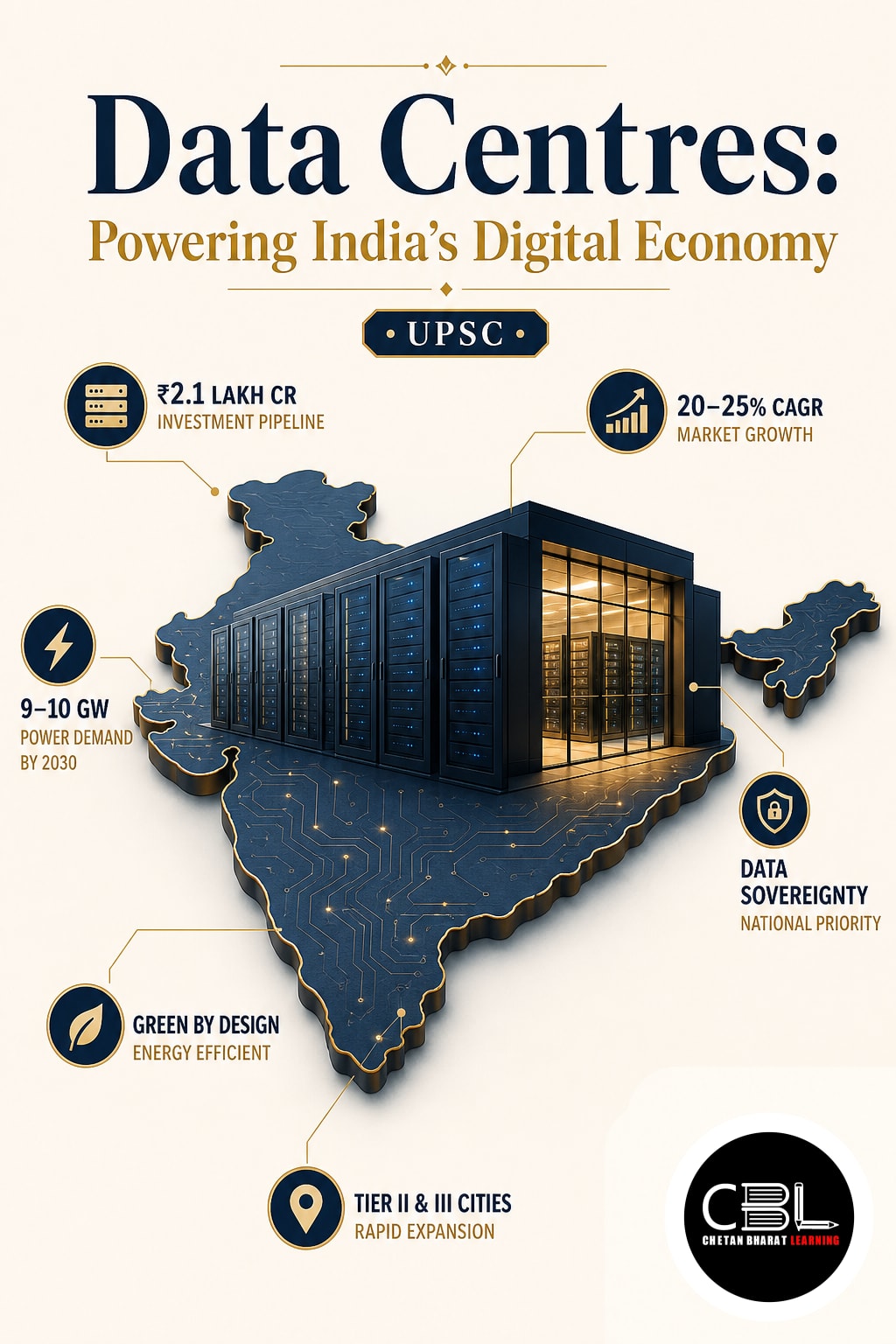
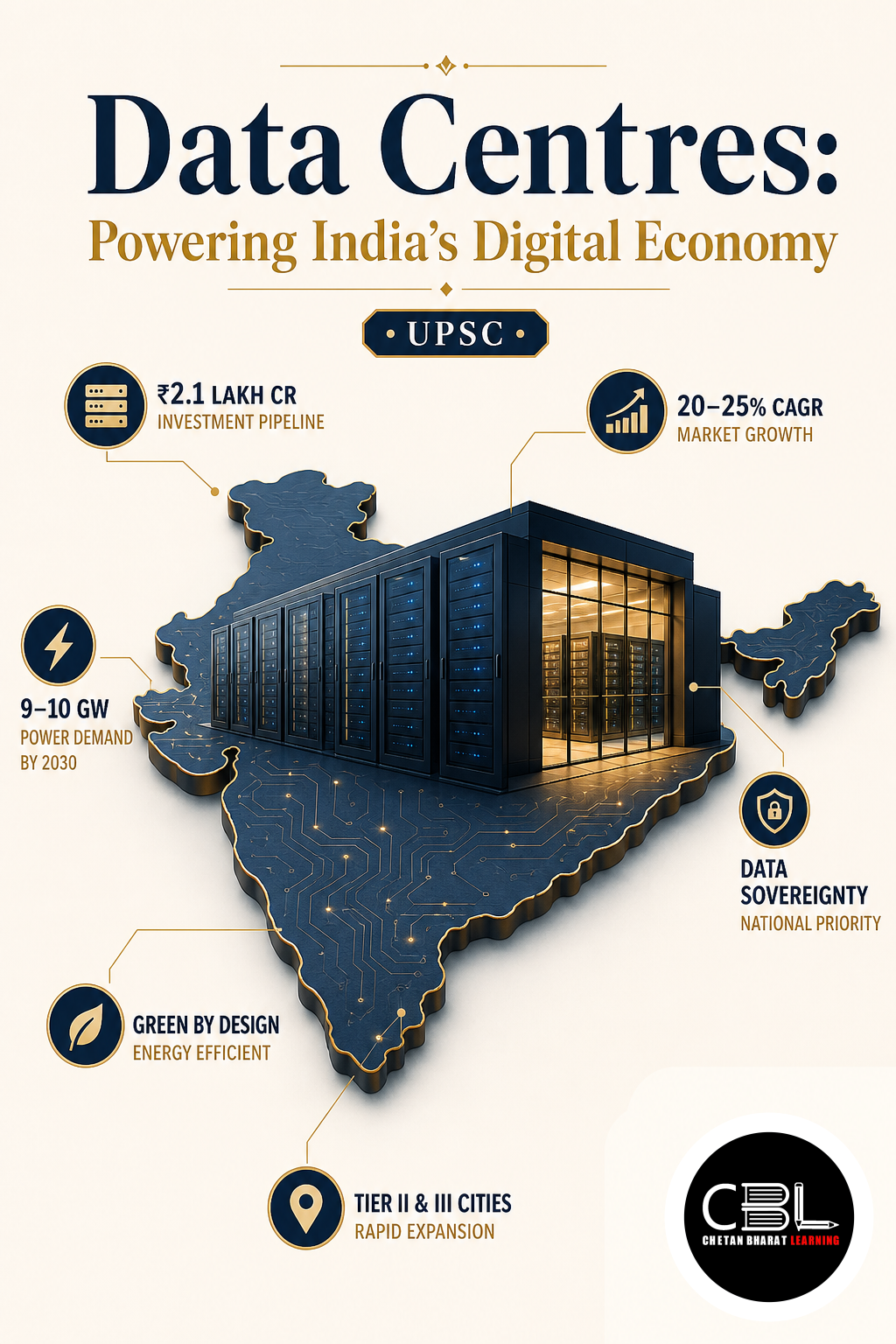
Data Centres have entered the policy spotlight because India’s installed capacity has expanded rapidly. According to a recent PIB backgrounder, capacity increased from about 375 MW in 2020 to approximately 1.57 GW by August 2026. Current estimates suggest that capacity could approach 8 GW by 2030 if announced investments and infrastructure plans materialise.
Demand comes from cloud computing, generative artificial intelligence, digital payments, video streaming, e-commerce and public digital platforms. The IndiaAI Mission also requires reliable domestic computing resources for model development and deployment. This expansion can strengthen technological capacity, but it can also create concentrated demand for electricity, water, land, fibre connectivity and specialised skills.
Key Features
- Continuous service: Redundant power supplies, backup generators, batteries and multiple network connections help operators maintain uptime during equipment or grid failures.
- Strategic connectivity: Locations near fibre networks, internet exchanges and submarine-cable landing stations can reduce latency while improving domestic and international data movement.
- Scalable architecture: Colocation and hyperscale models allow enterprises and cloud providers to expand computing resources without constructing separate facilities for every organisation.
- Security and compliance: Layered physical controls, encryption, access management and monitoring protect sensitive workloads from intrusion, theft and operational disruption.
- Economic linkages: Large clusters encourage investment in renewable power, telecommunications, construction, cooling technology, cyber security and specialised maintenance services.
Challenges
- Electricity demand: Round-the-clock computing and cooling can increase grid loads, peak demand and fossil-fuel consumption when renewable electricity lacks firm storage or transmission support.
- Water stress: Water-based cooling can compete with households, agriculture and industry in water-scarce regions, especially during hotter months when cooling requirements rise.
- Electronic waste: Frequent replacement of servers, batteries and networking equipment generates hazardous waste that requires traceable collection, recycling and safe material recovery.
- Import dependence: India still imports many advanced servers, processors and cooling components, exposing projects to exchange-rate movements and global supply disruptions.
- Regional and regulatory gaps: Capacity remains concentrated in a few cities, while land approvals, electricity rules and local incentives vary across states; related issues regularly feature in CBL’s science and technology coverage.
Way Forward
India should treat Data Centres as strategic infrastructure while applying clear sustainability standards. Governments can coordinate site selection with grid capacity, renewable-energy availability, water conditions and fibre connectivity. Transparent reporting of Power Usage Effectiveness, water use, carbon emissions and renewable procurement would improve accountability and help investors compare facilities.
Operators should adopt efficient chips, liquid or air-based cooling suited to local conditions, treated wastewater and renewable electricity backed by storage. India must also strengthen domestic hardware manufacturing, technical skills, cyber-security audits, disaster recovery and geographically distributed edge capacity. Linking these measures with the IndiaAI portal can support an inclusive compute ecosystem without ignoring resource security or climate commitments.
Prelims Practice Corner
Q1. Which statement best describes a data centre?
- (a) A facility used only for manufacturing processors
- (b) A facility housing computing, storage and networking systems
- (c) A portal regulating digital payments
- (d) A satellite-based broadcasting station
Answer: (b) It houses interconnected systems used to process, store and distribute digital information.
Q2. Power Usage Effectiveness compares which of the following?
- (a) Total facility energy with computing-equipment energy
- (b) Water use with land area
- (c) Storage capacity with internet speed
- (d) Revenue with capital expenditure
Answer: (a) PUE divides total facility energy consumption by the energy used by computing equipment.
Q3. What is the principal advantage of edge computing facilities?
- (a) They eliminate electricity consumption
- (b) They manufacture semiconductor wafers
- (c) They process information closer to users and reduce latency
- (d) They replace all hyperscale facilities
Answer: (c) Proximity to users reduces the distance and time required for data transmission.
Q4. Consider the following statements about Power Usage Effectiveness:
1. A lower value generally indicates lower energy overhead.
2. It directly measures water consumption.
3. Its calculation includes energy used by cooling systems.
Which statements are correct?
- (a) 1 only
- (b) 1 and 3 only
- (c) 2 and 3 only
- (d) 1, 2 and 3
Answer: (b) PUE includes facility overhead such as cooling but does not directly measure water consumption.
Q5. Which of the following can support environmentally sustainable digital infrastructure?
- (a) Renewable power procurement
- (b) Efficient cooling systems
- (c) Responsible electronic-waste recycling
- (d) All of the above
Answer: (d) All three measures can reduce the environmental footprint of digital infrastructure.
Mains Practice Questions
Q1. Examine the role of digital infrastructure in strengthening India’s economic growth, technological capacity and data sovereignty. (15 marks)
Answer Structure
- Intro: Define the infrastructure and connect its growth with cloud services, artificial intelligence and public digital platforms.
- Body: Discuss economic linkages, secure domestic capacity, low-latency services and innovation alongside energy, water, import and cyber-security concerns.
- Conclusion: Emphasise resilient, geographically balanced and environmentally sustainable capacity expansion.
Q2. Rapid expansion of computing infrastructure creates both energy opportunities and environmental challenges. Discuss and suggest a sustainable policy framework. (15 marks)
Answer Structure
- Intro: Link rising computing demand with electricity, cooling and resource requirements.
- Body: Cover grid pressure, emissions, water stress and electronic waste, followed by renewable procurement, efficiency disclosure, recycling and careful site selection.
- Conclusion: Advocate outcome-based regulation that aligns digital growth with energy security and climate commitments.
FAQs on Data Centres
What do Data Centres do?
They provide secure environments for computing, storage and networking equipment. Their backup power, cooling and security systems help digital services remain continuously available.
Why has Mumbai emerged as India’s leading hub?
Mumbai benefits from submarine-cable connectivity, financial-sector demand, established fibre networks and a large commercial market. Its concentration also highlights the need for disaster recovery and wider geographic distribution.
How can India make digital infrastructure more sustainable?
India can promote renewable electricity, efficient cooling, treated wastewater and responsible electronic-waste recycling. Public reporting of energy, water and emissions performance can encourage measurable improvements.
Related Current Affairs
Preparing for UPSC, PCS or HCS?
Talk to a mentor at Chetan Bharat Learning, Chandigarh. Free guidance on choosing the right exam and building a study plan.
Chat on WhatsAppCall 97793 53345UPSC / IAS / PCS coaching in Chandigarh · Trusted by aspirants across Punjab & Haryana
Leave a Reply
You must be logged in to post a comment.