
Use up and down arrow keys to resize the meta box pane.
Move upMove downShow or hide panel
Optimize your content for discovery or get new content suggestions.Get content suggestions
Focus keyphrase
Focus keyphrase
Use the main word or phrase you want your content found for across search, AI, and beyond. Learn more about best practices for keyphrases.(Opens in a new browser tab)
Discover related keyphrases(Opens in a new browser tab)
Search appearance
Determine how your post should look in the search results.Google preview
MobileGoogle preview: Switch to desktop preview. Currently showing mobile preview.
Desktop
Url preview:

Current Affairs Chetan Bharatcurrentaffairs.chetanbharat.com
SEO title preview:
H-1B Visa Fee: $100,000 Legal Route, Impact on India
Meta description preview:
Sep 1, 2026 - Please provide a meta description by editing the snippet below. If you don’t, Google will try to find a relevant part of your post to show in the search results.
SEO titleInsert variableGenerate SEO title
H-1B Visa Fee: $100,000 Legal Route, Impact on India
Slug
Meta descriptionInsert variableGenerate meta description
SEO analysisGoodH-1B visa fee
Add related keyphrasePremiumTrack SEO performance
Content blocksNew
Internal linking suggestionsPremium
Cornerstone content
Advanced
Insights
Move upMove downShow or hide panelPostBlock
Classic
Use the classic WordPress editor.Skip to the selected blockOpen save panel

UPSC Mapping
| Exam | Syllabus Areas |
|---|---|
| Prelims | International Relations / Economy |
| Mains | GS Paper II – International Relations, GS Paper III – Economy |
Quick Facts
| Proposed fee | $100,000 |
|---|---|
| Visa type | H-1B temporary work visa |
| Main users | Indian IT professionals |
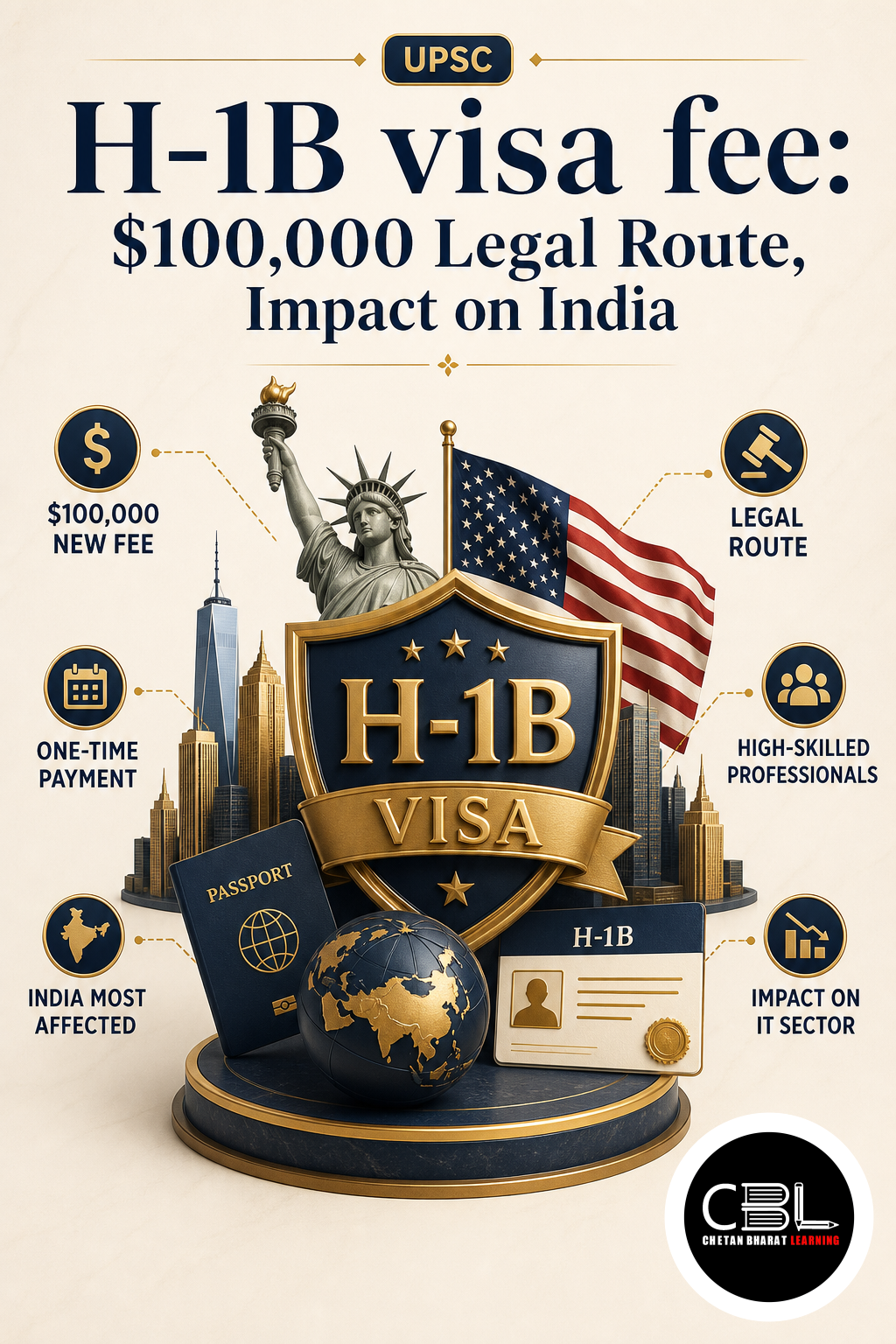
The H-1B visa fee has become a major policy debate after reports emerged that the US is pursuing a legal route to impose a $100,000 fee on such visas. This move would significantly affect Indian professionals and IT companies that depend on the programme. Aspirants can track such immigration policy shifts in the daily current affairs archive.
What is H-1B Visa Fee?
The H-1B visa is a non-immigrant work permit that allows US employers to hire foreign workers in specialty occupations requiring theoretical or technical expertise. Indian professionals have historically received the largest share of H-1B visas. The proposed $100,000 fee is an additional cost aimed at making the visa more expensive and encouraging companies to hire local workers instead.
The fee would be charged to sponsoring employers, but in practice it can affect salary offers, job mobility and overall cost competitiveness. The legal route being pursued suggests the administration may attempt to implement it through executive action or rulemaking rather than legislation. This has raised concerns about protectionism and its impact on global talent flows.
Why is H-1B Visa Fee in News?
The H-1B visa fee is in news because the proposed $100,000 charge would be a dramatic increase from current fees and could reshape the business model of Indian IT companies. Indian firms use H-1B visas to deliver on-site services and manage client relationships in the United States. A steep fee would raise operating costs and may force companies to hire locally or shift work offshore.
The Al Jazeera report highlights that the move is part of a broader protectionist shift in US immigration policy. It also reflects the tension between globalisation and protectionism in the technology sector.
Key Features
The proposed fee hike has several components that are important for understanding its impact.
- $100,000 fee: The new charge would be the highest ever for an H-1B visa, far exceeding current processing and filing fees.
- Employer payment: US companies sponsoring H-1B workers would bear the cost, affecting hiring decisions.
- Indian IT impact: Indian tech firms that deploy engineers to US client sites face higher expenses and reduced margins.
- Legal route: The administration is reportedly pursuing the change through regulatory mechanisms rather than new legislation.
- Protectionist logic: The fee aims to protect local jobs and raise revenue while discouraging dependence on foreign workers.
Challenges
The proposed fee creates several challenges for India, US businesses and the global tech ecosystem.
- Higher costs: Indian companies will face significantly increased expenses, squeezing profit margins and competitiveness.
- Job displacement concerns: US employers may replace Indian workers with local hires or automate processes.
- Trade tensions: The move could strain India-US economic relations and complicate broader trade negotiations.
- Innovation impact: Reduced access to global talent may slow technological innovation and project delivery.
- Visa uncertainty: Frequent policy changes create unpredictability for international workers and businesses.
For more trade and policy updates, see the international relations current affairs section.
Way Forward
India should engage diplomatically with the US to seek predictability and fairness in visa policies. At the same time, Indian IT companies can reduce dependence on H-1B workers by increasing local hiring in the US and expanding delivery centres in other countries. The government could also negotiate a bilateral trade agreement that addresses services and mobility issues.
The PIB release indicates India is monitoring such policy changes closely. A long-term strategy should focus on building higher-value services and innovation capacity at home to reduce vulnerability to visa restrictions.
Prelims Practice Corner
Q1. H-1B visa is issued by which country?
(a) United Kingdom (b) United States (c) Canada (d) Australia
Show answer
Answer: (b) United States.
Q2. What is the proposed new fee for H-1B visas?
(a) $10,000 (b) $50,000 (c) $100,000 (d) $5,000
Show answer
Answer: (c) $100,000.
Q3. Which community is likely to be most affected by the fee hike?
(a) Indian IT professionals (b) European tourists (c) African students (d) Japanese chefs
Show answer
Answer: (a) Indian IT professionals.
Q4. The H-1B visa is classified as which type of permit?
(a) Permanent residence (b) Non-immigrant work visa (c) Student visa (d) Tourist visa
Show answer
Answer: (b) Non-immigrant work visa.
Q5. The proposed fee hike reflects which policy stance?
(a) Globalisation (b) Protectionism (c) Free trade (d) Open borders
Show answer
Answer: (b) Protectionism.
Mains Practice Questions
Q1. Analyse the impact of the proposed H-1B visa fee on Indian IT companies and India-US relations. (15 marks)
Answer Structure
Intro: Mention the $100,000 fee proposal.
Body: Cover cost increase, margin pressure, local hiring shift, trade tensions and diplomatic response.
Conclusion: Suggest diversification and negotiation.
Q2. Discuss the broader debate between globalisation and protectionism in immigration policy with reference to the H-1B visa issue. (10 marks)
Answer Structure
Intro: Define globalisation and protectionism.
Body: Cover arguments for and against visa restrictions, impact on talent flow, innovation and labour markets.
Conclusion: Suggest balanced policy approach.
FAQs on H-1B Visa Fee
What is the H-1B visa?
The H-1B visa is a non-immigrant work permit that allows US employers to hire foreign workers in specialty occupations.
Why is the $100,000 fee proposed?
The fee aims to discourage employers from hiring foreign workers and encourage local hiring, while generating revenue.
How will Indian professionals be affected?
Indian professionals may face reduced job opportunities, higher costs to employers and increased uncertainty in US work visas.
Related Current Affairs
Preparing for UPSC, PCS or HCS?
Talk to a mentor at Chetan Bharat Learning, Chandigarh. Free guidance on choosing the right exam and building a study plan.
Chat on WhatsAppCall 97793 53345UPSC / IAS / PCS coaching in Chandigarh · Trusted by aspirants across Punjab & Haryana
Leave a Reply
You must be logged in to post a comment.