
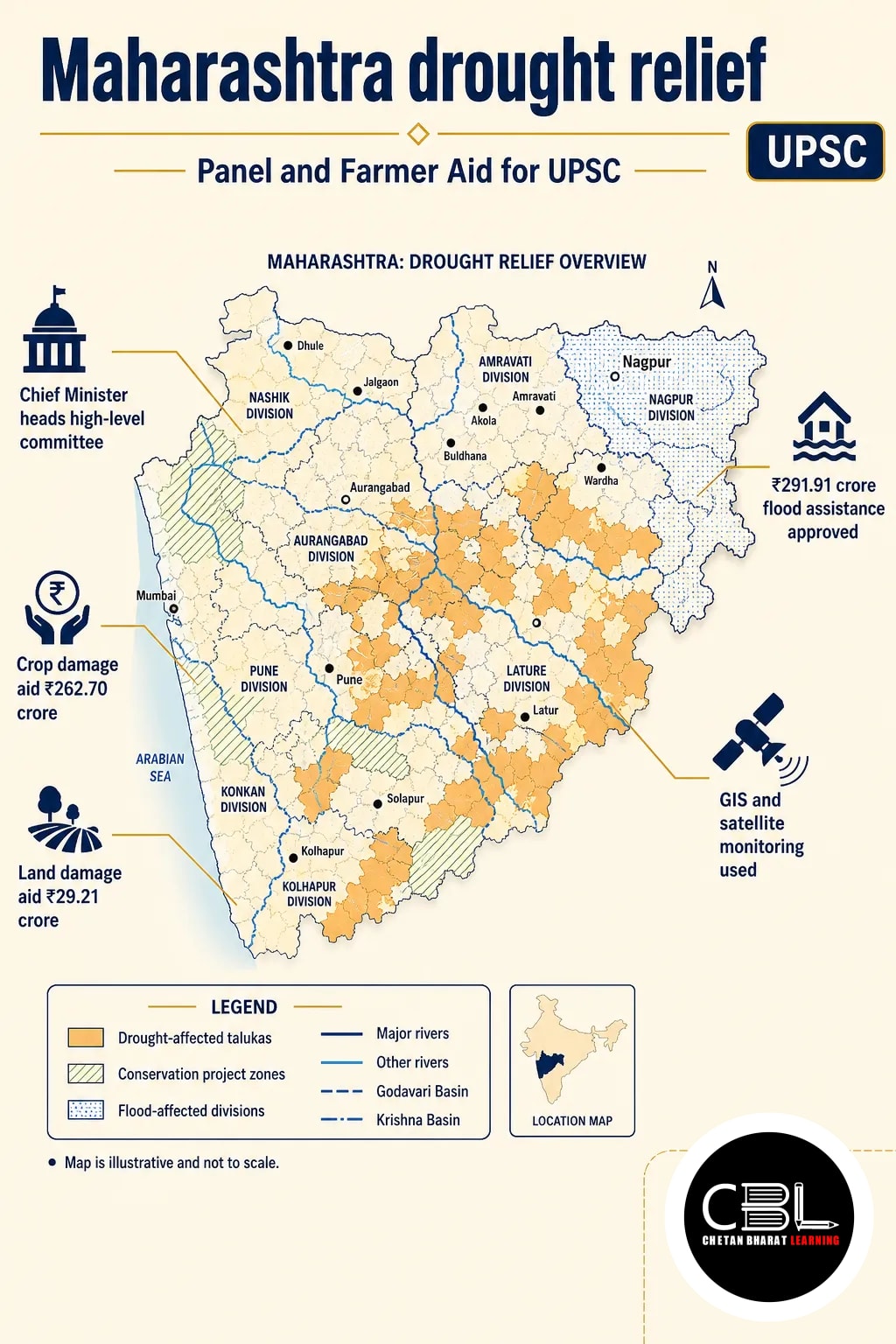
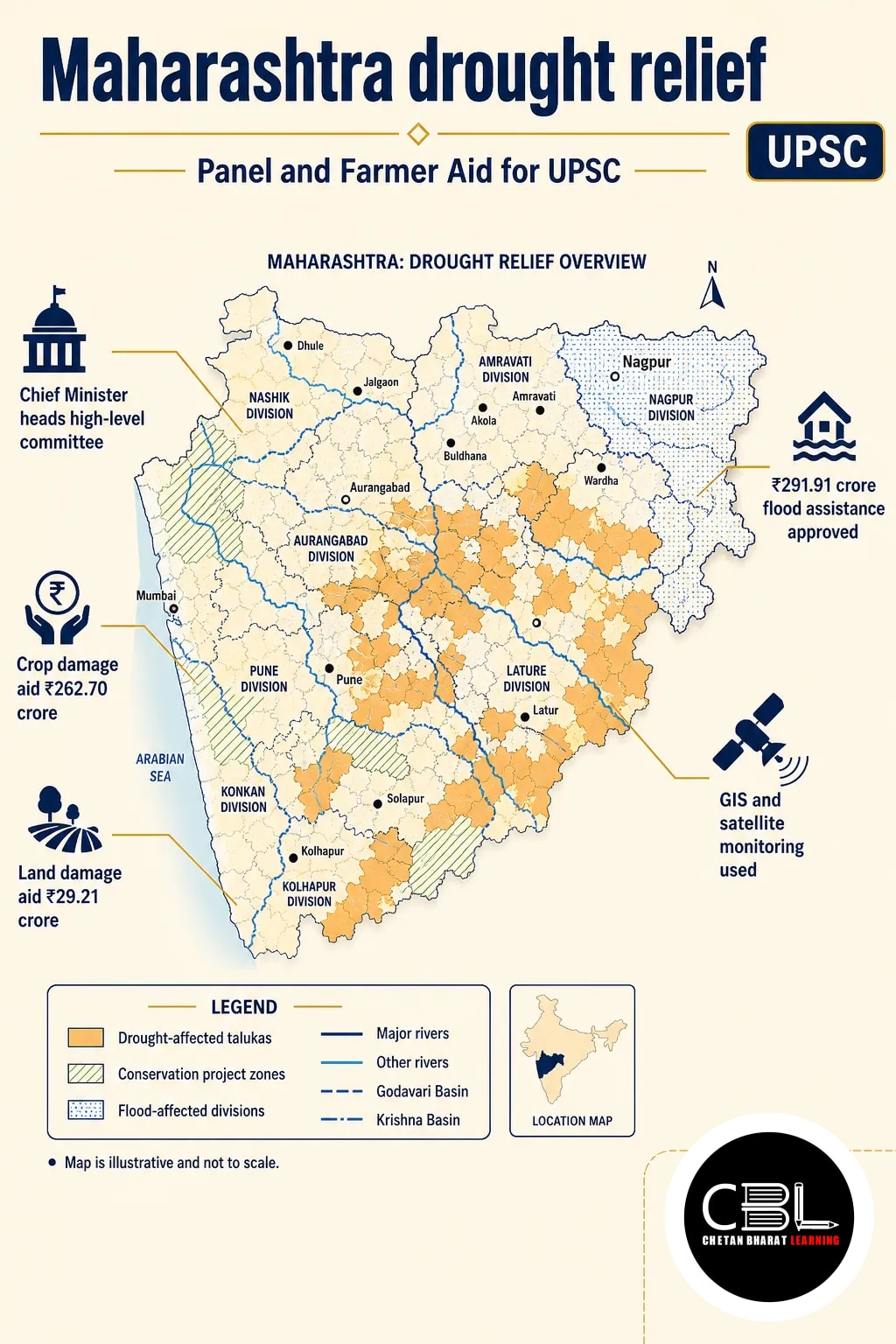
Maharashtra drought relief now combines a high-level conservation panel with separate financial assistance for flood-hit farmers. The decisions illustrate the challenges of managing contrasting rainfall impacts; explore more environment and disaster management coverage.
Quick answer: Maharashtra drought relief includes a Chief Minister-led panel to monitor soil and water conservation in drought-affected areas. Separately, the state approved ₹291.91 crore for farmers affected by heavy rain and floods between June and August 2026. The measures follow deficient rainfall and drought declarations in talukas identified under the Kharif Trigger-1 assessment.
What has Maharashtra announced?
The state has paired drought-mitigation oversight with separate assistance for rain and flood damage. Deficient rainfall led to drought declarations in talukas identified under the Kharif season’s Trigger-1 assessment. Meanwhile, heavy rain and floods damaged crops and agricultural land between June and August 2026.
These measures address different needs: conservation seeks to reduce drought vulnerability, while compensation and restoration support recovery after flooding. For background, see CBL’s explanation of Maharashtra’s drought declaration rules.
How will the drought mitigation panel work?
The Chief Minister will head the high-level committee overseeing soil and water conservation projects in drought-affected areas. According to the government resolution issued on 2 November, all Deputy Chief Ministers will serve as co-chairpersons.
Ministers from agriculture, water resources, rural development and employment guarantee will also participate. Thus, the panel brings departments with complementary roles under one oversight mechanism.
Soil and Water Conservation Minister Sanjay Rathod said the committee would monitor projects undertaken through non-governmental organisations (NGOs), including Paani Foundation and Chandra Foundation. In addition, the state plans to revive Paani Foundation’s Water Cup competition to encourage community participation.
A separate executive committee, chaired by the Principal Secretary of the Water Resources Department, will coordinate implementation and meet at least once a month. It will use geographical information systems (GIS), satellite imagery, mobile-based monitoring and online dashboards to track progress.
How is the flood assistance divided?
The ₹291.91 crore package has distinct allocations for crop damage and agricultural land damage.
| Component | Allocation and coverage |
|---|---|
| Crop damage | ₹262.70 crore for damage affecting 3,09,289 farmers across six revenue divisions |
| Agricultural land damage | ₹29.21 crore for 7,675.40 hectares belonging to 34,984 farmers |
| Eligible land restoration | Includes removal of flood-deposited sand, silt and salt |
| Land assistance limit | Up to two hectares for small and marginal landowners, subject to prescribed norms |
The six divisions are Pune, Nagpur, Chhatrapati Sambhajinagar, Amravati, Konkan and Nashik. Relief and Rehabilitation Minister Makarand Jadhav Patil announced the allocation; the two beneficiary counts concern different damage categories and should not be added as unique individuals.
Crop compensation will go directly to eligible farmers’ bank accounts. Moreover, district collectors must ensure banks do not divert disaster relief payments towards loan repayments or other recoveries.
Why does the combined response matter?
The response recognises that agricultural recovery and long-term water conservation require different instruments. Crop compensation can support affected households, whereas land restoration addresses physical damage that may obstruct cultivation.
Similarly, watershed-based soil and water conservation can help retain rainfall and reduce runoff. However, conservation outcomes depend on suitable site selection, maintenance and local participation, not merely the completion of works.
Rainfall shortages can also affect livestock-dependent households. Therefore, the Maharashtra fodder shortage response offers a useful parallel for examining drought-related livelihood risks.
What are the implementation challenges?
The main challenges concern accurate assessment, timely delivery and sustained conservation outcomes.
- Damage assessment: Crop losses and land restoration needs require separate verification; otherwise, assistance may not match the type of damage.
- Last-mile delivery: Direct transfers require correct beneficiary and bank details; moreover, collectors must enforce the protection against loan recovery.
- Coordination: Multiple departments and NGOs can contribute complementary expertise, but unclear responsibilities may delay work.
- Monitoring limits: Satellite imagery and dashboards can track progress; however, they cannot by themselves establish whether structures function well on the ground.
- Equity: The stated land-restoration limit applies to eligible small and marginal landowners; therefore, coverage questions for other cultivators merit scrutiny under applicable norms.
What should the way forward include?
Implementation should link transparent relief delivery with locally maintained conservation works.
- Verify and communicate: Publish clear eligibility, assessment and grievance procedures; additionally, give applicants a way to correct account details.
- Protect payments: Collectors should monitor bank compliance and provide a channel to report unauthorised recoveries.
- Combine monitoring methods: Use GIS and satellite data alongside field inspections; consequently, dashboards can capture both physical progress and functionality.
- Plan by watershed: Select conservation works according to local drainage, soil and community needs; moreover, assign responsibility for maintenance.
- Review outcomes: The executive committee should examine transfer delays, restoration progress and conservation performance during its monthly meetings.
Overall, Maharashtra drought relief will be judged not only by the funds sanctioned, but also by access, recovery and durable water-conservation outcomes.
Source: The Hindu, 3 November 2026
- Maharashtra Fodder Shortage: Plan and UPSC Analysis (1 Nov 2026)
- Maharashtra Drought: Declaration Rules Explained (26 Sep 2026)
- El Niño impact: Monsoon risks and agricultural vulnerability (4 Sep 2026)
Asked in UPSC: Previous Year Questions
- UPSC CSE Mains 2020 (GS Paper I): Critically examine whether river interlinking can address the interrelated problems of droughts, floods and interrupted navigation.
- UPSC CSE Mains 2016 (GS Paper I): In what way do micro-watershed development projects help water conservation in drought-prone and semi-arid regions of India?
UPSC connects drought management with water conservation and the trade-offs in water infrastructure.
Punjab PCS and Haryana HCS candidates can use this case to revise agricultural disaster relief and state-level water governance. In addition, compare the roles of district administration, field verification and community participation in implementing relief.
Prelims Practice Corner
Mains Practice Questions
Frequently Asked Questions
Who heads Maharashtra’s drought mitigation committee?
The Chief Minister heads the high-level committee. In addition, all Deputy Chief Ministers serve as co-chairpersons.
How much flood assistance has Maharashtra approved?
Maharashtra approved ₹291.91 crore for crop and agricultural land damage. Of this, ₹262.70 crore addresses crop damage, while ₹29.21 crore covers land damage.
Can banks recover loans from the disaster relief payments?
No: the government has directed collectors to prevent banks from diverting the payments towards loans or other recoveries. Crop compensation will also go directly to eligible farmers’ bank accounts.
Related Current Affairs
Preparing for UPSC, PCS or HCS?
Talk to a mentor at Chetan Bharat Learning, Chandigarh. Free guidance on choosing the right exam and building a study plan.
Chat on WhatsAppCall 97793 53345UPSC / IAS / PCS coaching in Chandigarh · Trusted by aspirants across Punjab & Haryana

 Ananya RanaIAS · AIR 60
 Aditya SharmaIAS · AIR 70
 Ria Kaur SethiIPS · AIR 89
 Aman AloonIRS · AIR 295
 Sumer Singh VirkIRS · AIR 335
 Shivani PanchalIAS

Leave a Reply
You must be logged in to post a comment.