

UPSC Mapping
- Prelims: Disaster Management / Geography
- Mains: GS Paper III – Disaster Management, Environment
Quick Facts
| Trigger | Ice-rock avalanche |
|---|---|
| Missing | Hundreds including 100 Indians |
| Region | Nepal Himalayas |
What is Nepal Flash Floods?
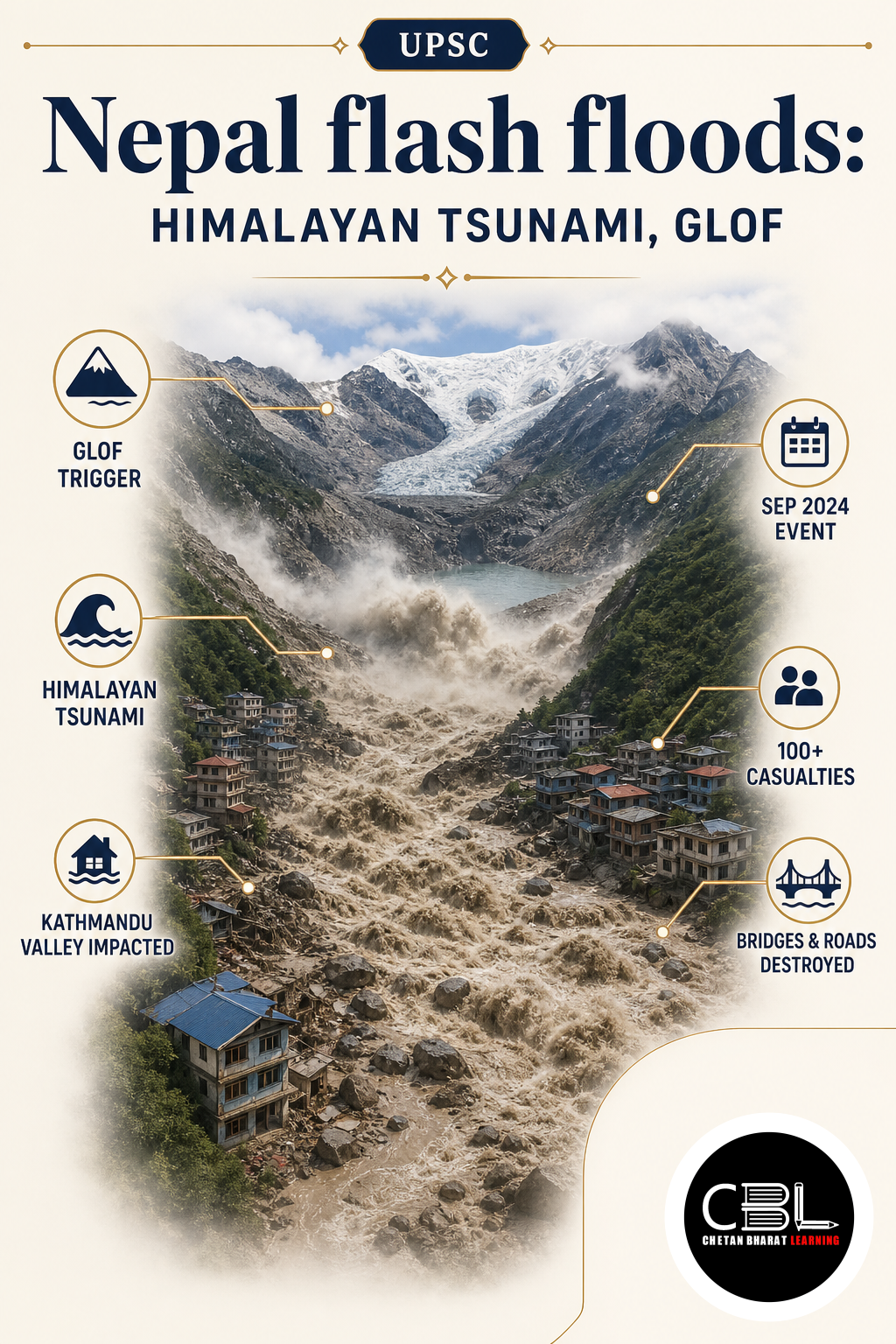
Nepal flash floods are sudden, high-intensity water flows in the Himalayan region often caused by glacier lake outburst floods, avalanche-induced displacement or intense rainfall. The current event was triggered by an ice-rock avalanche that sent a large volume of water and debris downstream. Such floods are called Himalayan tsunami because they arrive with little warning and can wipe out settlements.
A flash flood is a rapid flood in low-lying areas within six hours of heavy rain or a sudden release of water. A GLOF occurs when a glacial lake bursts its natural dam. An avalanche flood results from snow, ice or rock falling into a water body and displacing water. The Nepal event appears to combine avalanche and flash flood dynamics.
Why is Nepal Flash Floods in News?
Nepal flash floods are in news because over 100 Indians remain missing among hundreds affected after the Himalayan tsunami shattered settlements in Nepal. The disaster crossed national borders, raising concerns about cross-border early warning and search-and-rescue coordination. India has launched assistance and tracking of missing citizens.
The event also highlights the vulnerability of the Himalayan region to cascading disasters driven by climate change. Glacial retreat, permafrost thaw and unstable slopes increase the likelihood of ice-rock avalanches. The ICIMOD has repeatedly warned that Himalayan hazards are becoming more frequent and severe.
Key Features
- Ice-rock avalanche trigger: A mass of ice and rock broke off a high slope and displaced a large volume of water instantly.
- Transboundary impact: The flood affected Nepal and downstream areas, with Indian citizens among the missing.
- Himalayan tsunami behaviour: The wave of water and debris arrived suddenly, leaving little time for evacuation.
- Cascading hazard: The event combined avalanche, flood and landslide processes, complicating response.
- Climate link: Warming temperatures have increased glacial lake instability and slope failures in the region.
Challenges
- Early warning gap: Remote Himalayan valleys often lack real-time monitoring and alert systems for sudden floods.
- Access difficulties: Debris, damaged roads and rugged terrain slow rescue and relief operations.
- Risk assessment: Mapping avalanche and GLOF risk across the entire Himalayan arc remains incomplete.
- Cross-border coordination: Timely sharing of hazard information between India and Nepal needs strengthening.
- Climate uncertainty: Warming and glacial retreat make historical risk patterns less reliable for future planning.
Way Forward
The immediate priority is search and rescue for missing persons and support for affected families. India and Nepal should activate joint disaster management protocols and share satellite imagery to locate survivors. Long-term, both countries must invest in early warning stations, risk mapping and resilient infrastructure in high-risk zones.
ICIMOD and similar institutions can help build a regional Himalayan risk information system. The PIB indicates India is closely monitoring the situation and providing assistance. Climate adaptation, glacial lake monitoring and slope stabilisation should become permanent policy priorities.
Prelims Practice Corner
- What triggered the recent Nepal flash floods? (a) Cyclone (b) Ice-rock avalanche (c) Dam failure (d) Tsunami
Answer: (b) Ice-rock avalanche. - What does GLOF stand for? (a) Glacier Lake Outburst Flood (b) Global Land Ocean Flow (c) Ground Level Overflow (d) Glacial Landslide Over Flow
Answer: (a) Glacier Lake Outburst Flood. - Which organisation warns about Himalayan hazards? (a) ICIMOD (b) UNEP (c) WMO (d) IPCC
Answer: (a) ICIMOD. - A flash flood typically occurs within how many hours of the triggering event? (a) 24 hours (b) 12 hours (c) 6 hours (d) 48 hours
Answer: (c) 6 hours. - The Nepal flash floods affected which neighbouring country’s citizens? (a) China (b) Bhutan (c) India (d) Bangladesh
Answer: (c) India.
Mains Practice Questions
- Evaluate the vulnerabilities of the Himalayan region to cascading disasters like flash floods and GLOFs. (15 marks)
Answer Structure
Intro: Mention the recent Nepal flash floods.
Body: Cover geographical factors, climate change, glacial retreat, avalanche risk and transboundary impacts.
Conclusion: Suggest regional cooperation and early warning systems.
- Discuss the differences between flash floods, GLOFs and avalanche floods with suitable examples. (10 marks)
Answer Structure
Intro: Define each term briefly.
Body: Explain causes, triggers, timescales and Indian Himalayan examples.
Conclusion: Highlight need for integrated monitoring.
FAQs on Nepal Flash Floods
What is a Himalayan tsunami?
A Himalayan tsunami is a sudden, destructive flood in the mountains caused by an avalanche or landslide displacing water, arriving with little warning.
What caused the recent Nepal flash floods?
The floods were triggered by an ice-rock avalanche that sent a large volume of water and debris downstream.
Why are Himalayan regions prone to such disasters?
Rising temperatures, glacial retreat, steep slopes and limited monitoring make the Himalayas highly vulnerable to cascading hazards.
Related Current Affairs
Preparing for UPSC, PCS or HCS?
Talk to a mentor at Chetan Bharat Learning, Chandigarh. Free guidance on choosing the right exam and building a study plan.
Chat on WhatsAppCall 97793 53345UPSC / IAS / PCS coaching in Chandigarh · Trusted by aspirants across Punjab & Haryana
Leave a Reply
You must be logged in to post a comment.