

UPSC Syllabus Mapping
| Exam | Topic |
|---|---|
| Prelims | Science & Technology |
| Mains | GS Paper III |
What is an Endoscopic Camera?
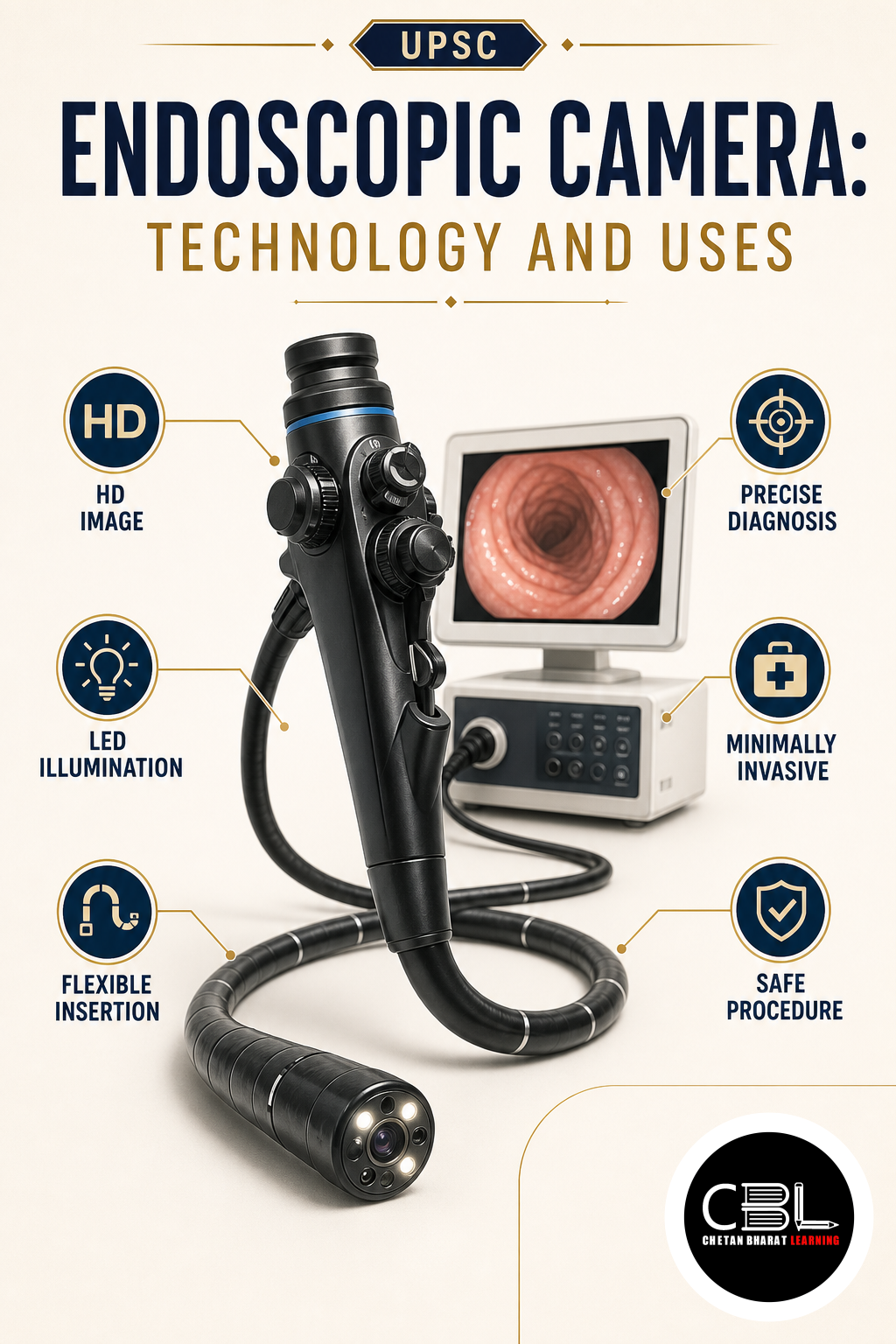
An endoscopic camera is a miniature camera attached to a thin, flexible or rigid tube that allows capturing images and videos from narrow, enclosed, or difficult-to-access spaces. The camera is usually coupled with a light source to illuminate the interior. The term ‘endoscope’ comes from Greek (endon = inside, skopein = to view).
Endoscopic cameras come in various forms: flexible (used in gastrointestinal procedures), rigid (used in laparoscopy), and capsule-based (swallowable pill camera). They enable minimally invasive procedures and are also used in industrial inspection, such as checking aircraft engines or pipelines.
Why is the Endoscopic Camera in News?
The endoscopic camera recently made headlines because it was allegedly used in a technology-enabled examination paper leak. The device was reportedly used to capture images of question papers from inside sealed envelopes or test centres, then transmitted outside for solving.
This misuse highlights the dual-use nature of such technologies—they can be used for legitimate purposes like medicine and industrial inspection, but also for unethical activities. The incident has prompted discussions on exam security and the need for stricter surveillance. For official statements, refer to the PIB on exam integrity measures.
Key Features of Endoscopic Cameras
- Miniaturisation: Extremely small cameras, sometimes less than a few millimetres in diameter.
- Flexibility: Flexible scopes can navigate tortuous paths inside the human body or machinery.
- Illumination: Built-in fibre-optic or LED lights provide bright illumination in dark cavities.
- Image transmission: High-definition images can be transmitted in real-time to external monitors.
- Versatility: Used in medical diagnosis, surgery, industrial non-destructive testing, and security.
Challenges in Regulating Endoscopic Camera Use
- Dual-use dilemma: The same technology that saves lives can be used for cheating or espionage.
- Miniaturisation: Small size makes them easy to conceal and difficult to detect with conventional screening.
- Wireless transmission: Many modern endoscopes can transmit wirelessly, making interception possible.
- Lack of specific regulation: There is no specific law governing the possession or use of endoscopic cameras; they fall under general surveillance laws.
- Rapid technological advancement: Newer models with higher resolution and smaller form factors emerge quickly, outpacing regulations.
For more on technology and society, visit the science & technology current affairs section.
Way Forward for Endoscopic Camera Use
To prevent misuse of endoscopic cameras in examinations, exam bodies should employ metal detectors, electronic sniffers, and signal jamming devices. Stronger penalties for possession of such devices in exam centres can act as a deterrent. Education and awareness among students about the legal and ethical implications of cheating are essential.
On the medical front, continued innovation in endoscopic technology will improve diagnostics and reduce patient trauma. Industrial applications will benefit from enhanced inspection capabilities. For global standards on medical endoscopy, refer to the WHO guidelines on medical devices.
Prelims Practice Corner
- Q1. What is the primary purpose of an endoscopic camera?
- (a) Taking aerial photographs
- (b) Capturing images from narrow spaces
- (c) Recording audio
- (d) Night vision
Answer: (b) Endoscopic cameras are used to capture images from narrow, enclosed spaces.
- Q2. Which of the following is NOT a type of endoscope?
- (a) Flexible
- (b) Rigid
- (c) Wireless
- (d) Capsule
Answer: (c) While some endoscopes have wireless components, the main types are flexible, rigid, and capsule-based.
- Q3. What recent controversy involved endoscopic cameras in India?
- (a) Used in medical malpractice
- (b) Allegedly used in an examination paper leak
- (c) Used for industrial espionage
- (d) Used in terrorist attacks
Answer: (b) An endoscopic camera was allegedly used to photograph a question paper during an exam leak.
- Q4. What is a capsule endoscope?
- (a) A large external camera
- (b) A swallowable pill with a camera
- (c) A camera mounted on a drone
- (d) A microscopic camera
Answer: (b) A capsule endoscope is a pill-sized device that contains a camera, light, and transmitter, used for gastrointestinal imaging.
- Q5. Which technology is often used with endoscopes for illumination?
- (a) Laser
- (b) Fibre optics / LED
- (c) Fluorescence
- (d) Ultrasound
Answer: (b) Endoscopes use fibre optics or LED lights to illuminate the interior area.
Mains Practice Questions
- Q1. Discuss the ethical and legal challenges posed by dual-use technologies, with reference to the recent misuse of endoscopic cameras in examination leaks. (15 marks)
- Answer Structure:
- Intro: Define dual-use technologies and give examples.
- Body: Focus on endoscopic cameras: legitimate uses (medicine, industry) vs. illicit use (cheating). Discuss challenges in regulation, detection, and enforcement. Suggest measures to prevent misuse while not hampering beneficial applications.
- Conclusion: Emphasise the need for balanced regulation, technological countermeasures, and public awareness.
- Answer Structure:
- Q2. What are the advancements in endoscopic technology and their impact on healthcare and other fields? (10 marks)
- Answer Structure:
- Intro: Briefly trace the evolution of endoscopy.
- Body: Discuss advancements: higher resolution, wireless, capsule, robotic-assisted. Impact on healthcare—minimally invasive surgery, early cancer detection. Also mention industrial and surveillance applications.
- Conclusion: Highlight the need to address misuse through policy while fostering innovation.
- Answer Structure:
FAQs on Endoscopic Camera
- What is the difference between an endoscope and an endoscopic camera?
- An endoscope is the entire device including the tube, camera, light source, and control system. An endoscopic camera refers specifically to the camera component at the tip.
- Are endoscopic cameras only used in medicine?
- No, they are also used in industrial inspection (pipelines, aircraft engines), building inspection, and even in security and surveillance.
- How can examination centres detect hidden endoscopic cameras?
- They can use metal detectors, radio frequency detectors, and CCTV surveillance. Jamming wireless signals can also prevent transmission of captured images.
Related Current Affairs
Preparing for UPSC, PCS or HCS?
Talk to a mentor at Chetan Bharat Learning, Chandigarh. Free guidance on choosing the right exam and building a study plan.
Chat on WhatsAppCall 97793 53345UPSC / IAS / PCS coaching in Chandigarh · Trusted by aspirants across Punjab & Haryana
Leave a Reply
You must be logged in to post a comment.