
UPSC Mapping
| Prelims | Polity & Economy |
|---|---|
| Mains | GS Paper 2 (Federalism) & GS Paper 3 (Economy) |
Quick Facts
| SC Judgment (2024) | Mineral Area Development Authority v. SAIL |
|---|---|
| Key Provision | Prohibits future state levies |
What is MMDR Amendment Federalism?
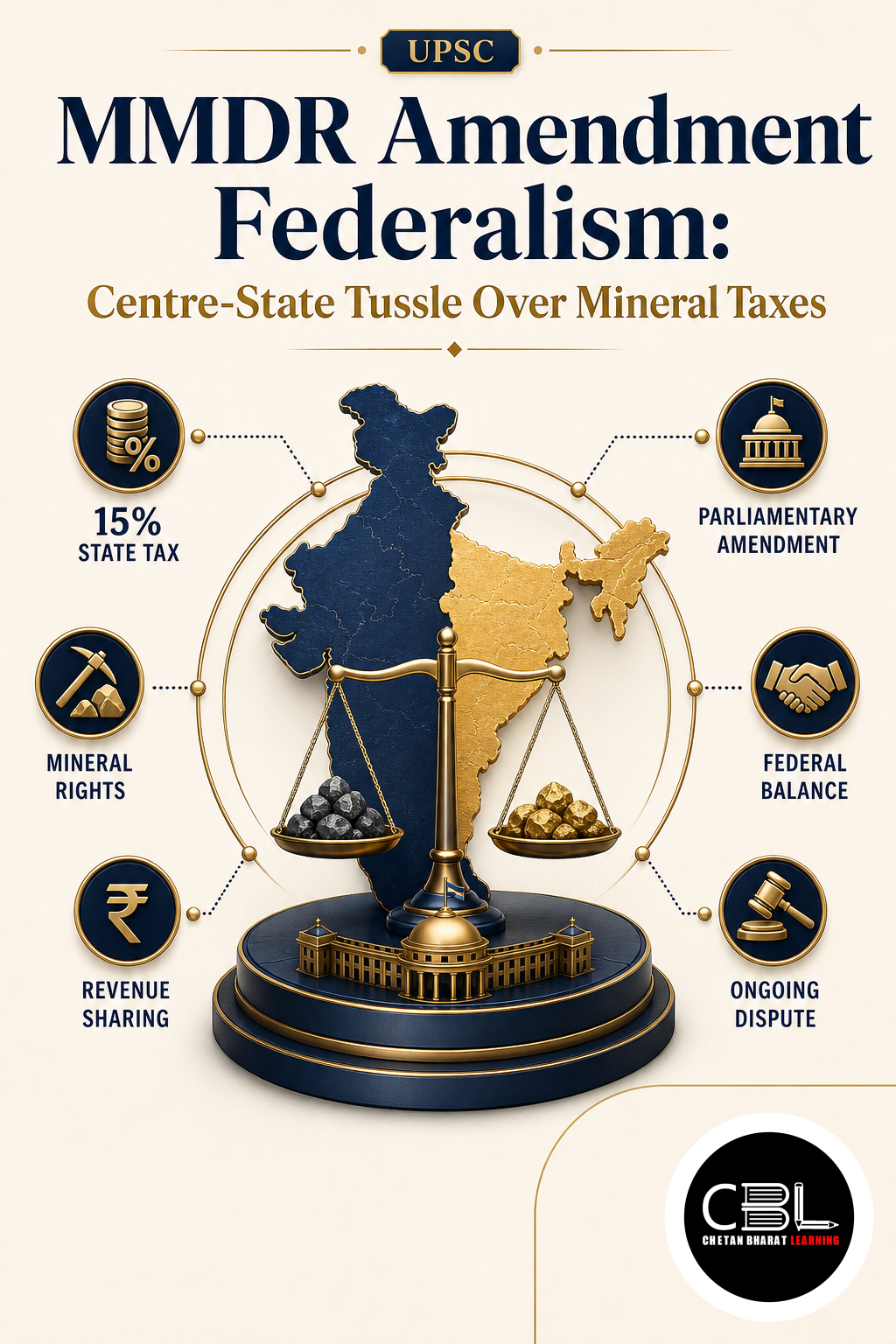
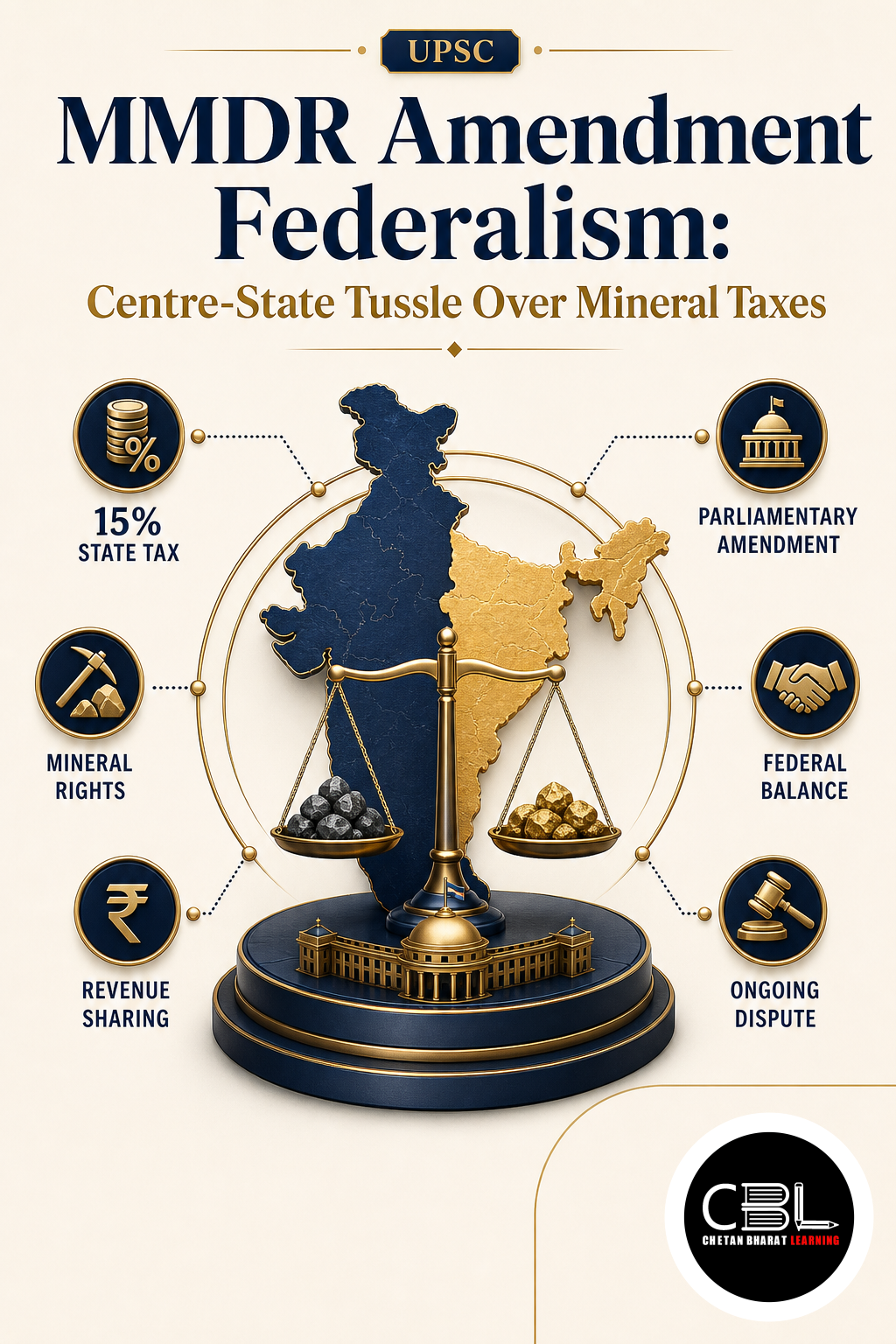
MMDR Amendment Federalism refers to the constitutional and fiscal debate arising from the MMDR Amendment Bill, 2026, which restricts states from imposing taxes, cesses, and other levies on mineral rights and mineral-bearing lands. The Bill uses Parliament’s power under Entry 54 of the Union List to regulate mines and mineral development, effectively overriding states’ power under Entry 50 of the State List.
States like Jharkhand and Kerala have opposed the Bill, arguing that it undermines fiscal autonomy and federal principles. Jharkhand Chief Minister Hemant Soren noted that mining revenue accounted for approximately 84.9% of the state’s own non-tax revenue in 2024-25, with the Mineral Bearing Land Cess expected to generate about ₹11,000 crore annually.
Why is MMDR Amendment Federalism in News?
MMDR Amendment Federalism is in the news because the Bill was passed in August 2026, triggering sharp opposition from mineral-rich states. The Bill extinguishes unpaid or unrecovered dues (estimated at around ₹2 lakh crore) from state levies imposed before the Act’s commencement, while not refunding taxes already paid.
The Centre argues that unchecked state levies could raise the cost of key minerals, feeding into inflation and infrastructure costs. Mining industry experts support the Bill for providing greater fiscal certainty. However, states argue it erodes their constitutional powers and fiscal capacity. For more details, refer to the PIB release.
Key Features of MMDR Amendment Federalism
- State Taxation Limits: Prohibits states from imposing taxes, cesses, or levies on mineral rights not already collected.
- Retrospective Clause: Extinguishes unpaid dues from pre-amendment levies, without refunding already paid taxes.
- Constitutional Basis: Centre uses Entry 54 (Union List) to regulate mineral development, limiting Entry 50 (State List).
- Industry Support: Provides fiscal certainty and reduces compliance burden for mining companies.
- State Opposition: States argue it undermines federal structure and fiscal autonomy.
Challenges in MMDR Amendment Federalism
- Fiscal Centralisation: Concentrating revenue control with the Union violates federal principles.
- State Revenue Loss: Mineral-rich states like Jharkhand (84.9% of non-tax revenue from mining) face significant fiscal impact.
- Judicial Undermining: The Bill effectively nullifies the 2024 SC judgment upholding states’ taxing power.
- Equality Concerns: Erasing unpaid dues while not refunding paid dues raises Article 14 concerns.
- Cooperative Federalism: Unilateral centralisation undermines the principle of cooperative federalism. For more on federalism, visit the federalism section.
Way Forward for MMDR Amendment Federalism
To address MMDR Amendment Federalism concerns, the Centre should engage in structured consultation with mineral-producing states to build consensus. A revenue-sharing mechanism that ensures states receive adequate compensation for lost taxing powers is essential.
Establishing reasonable and transparent guardrails, while ensuring adequate consultation, can balance national interests with state autonomy. The retrospective clause should be reconsidered to avoid Article 14 violations. Ultimately, cooperative federalism—where the Centre and states work together on mineral governance—is preferable to unilateral centralisation. For international best practices, refer to the IMF.
Prelims Practice Corner
-
Q1. The MMDR Amendment Bill, 2026, amends which Act?
(a) Mines Act, 1952 (b) MMDR Act, 1957 (c) Coal Mines Act (d) Mineral Concession Rules
Answer: (b) It amends the MMDR Act, 1957.
-
Q2. What did the Supreme Court hold in Mineral Area Development Authority v. SAIL (2024)?
(a) States cannot tax mineral rights (b) States have power to tax mineral rights (c) Only the Centre can tax minerals (d) Royalty is a tax
Answer: (b) The SC held states have power to tax mineral rights.
-
Q3. What is the estimated value of outstanding dues extinguished by the Bill?
(a) ₹50,000 crore (b) ₹1 lakh crore (c) ₹2 lakh crore (d) ₹5 lakh crore
Answer: (c) Estimates put outstanding dues at around ₹2 lakh crore.
-
Q4. What percentage of Jharkhand’s non-tax revenue comes from mining?
(a) 50% (b) 65% (c) 84.9% (d) 95%
Answer: (c) Mining revenue accounts for 84.9% of Jharkhand’s non-tax revenue.
-
Q5. Under which entry does the Centre regulate mines and minerals?
(a) Entry 23, State List (b) Entry 50, State List (c) Entry 54, Union List (d) Entry 17, Concurrent List
Answer: (c) Entry 54 of the Union List gives Parliament power to regulate mines.
Mains Practice Questions
Q1. Critically examine the constitutional and federalism implications of the MMDR Amendment Bill, 2026. (250 words, 15 marks)
Answer Structure:
- Intro: Introduce the Bill and its objectives.
- Body: Discuss the constitutional framework (Entry 54, Entry 50). Analyse the Bill’s provisions: taxation limits, retrospective clause. Evaluate criticisms: fiscal centralisation, judicial undermining, state revenue loss. Suggest a cooperative federalism approach.
- Conclusion: Emphasise the need for consultation and revenue-sharing.
Q2. What is the difference between royalty and tax in the context of mineral governance, and why does it matter? (150 words, 10 marks)
Answer Structure:
- Intro: Define royalty and tax.
- Body: Explain that royalty is a payment for extraction rights, while tax is a compulsory sovereign levy. The SC held that royalty is not a tax, and states can tax mineral rights. This distinction is central to the federalism debate.
- Conclusion: Conclude that the distinction affects the constitutional allocation of taxing powers.
FAQs on MMDR Amendment Federalism
What is the MMDR Amendment Bill, 2026?
It amends the MMDR Act, 1957, to restrict states from imposing taxes on mineral rights, using Entry 54 of the Union List.
Why are states opposing the Bill?
States argue it undermines fiscal autonomy, erodes constitutional powers, and reduces revenue critical for local development.
What is the retrospective clause?
It extinguishes unpaid dues from state levies imposed before the Act’s commencement, without refunding taxes already paid.
Related Current Affairs
Preparing for UPSC, PCS or HCS?
Talk to a mentor at Chetan Bharat Learning, Chandigarh. Free guidance on choosing the right exam and building a study plan.
Chat on WhatsAppCall 97793 53345UPSC / IAS / PCS coaching in Chandigarh · Trusted by aspirants across Punjab & Haryana
Leave a Reply
You must be logged in to post a comment.