

UPSC Mapping
- Prelims: Environment & Biodiversity
- Mains: GS Paper 3 (Environment & Ecology)
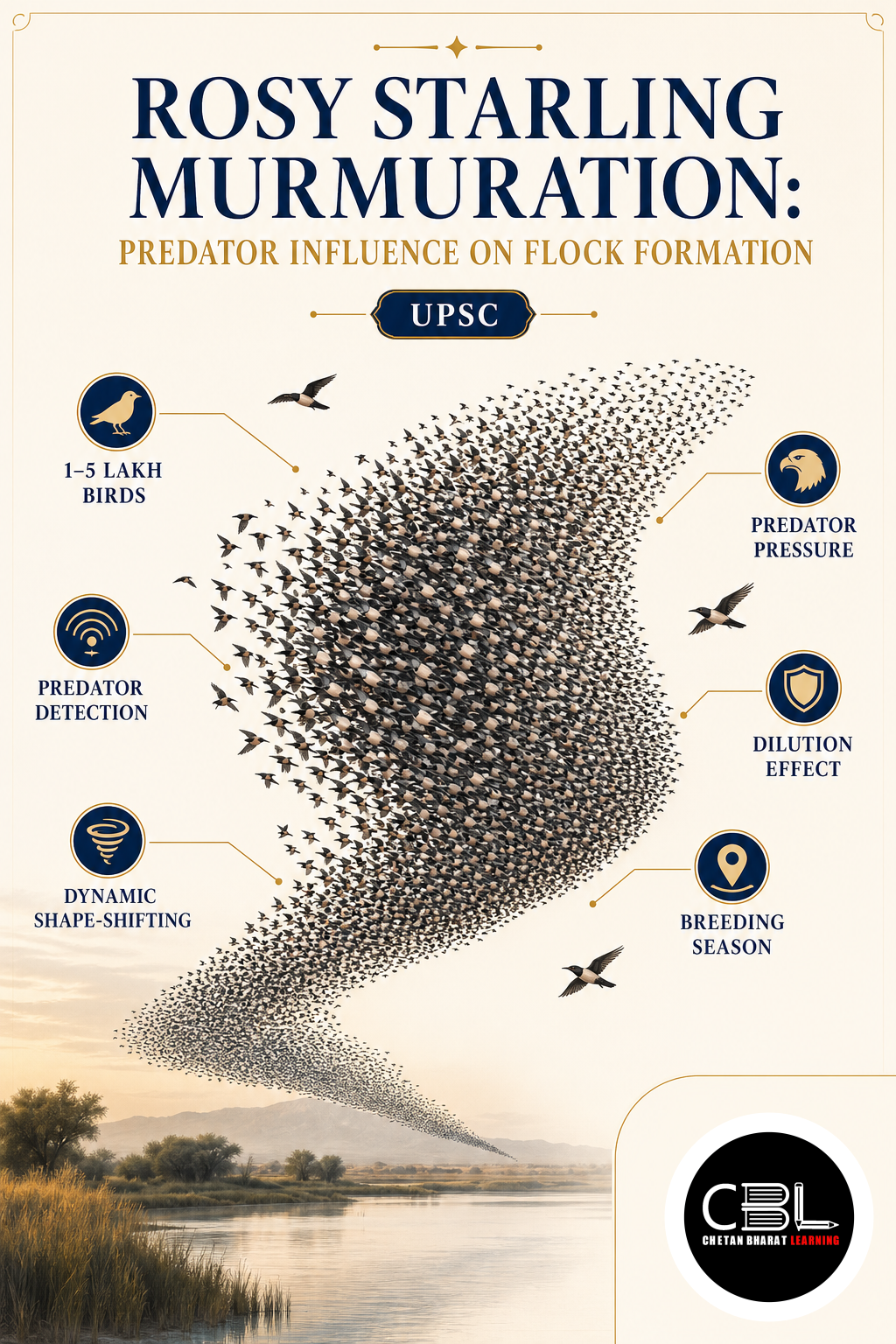
Rosy Starling Murmuration: Predator Influence on Flock Formation
Rosy Starling Murmuration has been studied for how predator presence and proximity influence the shape of their synchronized flights. The rosy starling (Pastor roseus) is a passerine bird in the starling family, known for its spectacular murmurations—large flocks that move in coordinated patterns. For more such environment updates, explore the environment archive.
Quick Facts
| Scientific Name | Pastor roseus |
|---|---|
| IUCN Status | Least Concern |
| WPA Schedule | Schedule-II |
What is Rosy Starling Murmuration?
Rosy Starling Murmuration refers to the coordinated flight of large flocks of rosy starlings, a phenomenon where birds rapidly change direction and formation in unison. A recent study found that the presence and proximity of predators can influence the shape of these murmurations. The rosy starling, also known as the rose-coloured pastor, is a passerine bird in the starling family.
The species breeds in Central and West Asia and Eastern Europe and migrates to the Indian subcontinent around July–August, staying until about March. Gujarat is a prominent hotspot for observing these starling murmurations, with Jamnagar’s Lakhota Lake being a notable site. The bird inhabits forests, grasslands, and rocky areas.
Why is Rosy Starling Murmuration in News?
Rosy Starling Murmuration is in the news because researchers have studied how predator presence affects the shape of the flock. The findings contribute to our understanding of collective animal behaviour and predator-prey dynamics.
The rosy starling is a protected species under Schedule-II of India’s Wildlife Protection Act and is listed as Least Concern on the IUCN Red List. Its spectacular murmurations attract birdwatchers and tourists, adding to its ecological and economic importance. For more details, refer to this PIB release.
Key Features of Rosy Starling Murmuration
- Coordinated Flight: Large flocks move in unison, changing direction and formation rapidly.
- Predator Influence: The presence and proximity of predators can alter the shape and dynamics of the flock.
- Migration Pattern: Migrates to India from July to March, with Gujarat being a key habitat.
- Habitat: Found in forests, grasslands, and rocky areas.
- Conservation Status: IUCN Least Concern; Schedule-II of WPA.
Challenges in Rosy Starling Murmuration
- Habitat Loss: Urbanisation and agriculture may reduce roosting and foraging sites.
- Pesticide Use: Chemicals in agriculture can affect insect populations, reducing food availability.
- Climate Change: Altered migration patterns and breeding seasons may affect populations.
- Human Disturbance: Noise and light pollution can disrupt roosting and flock formation.
- Predation: Natural predators are part of the ecosystem, but their impact on murmurations is still studied. For more on bird conservation, visit the biodiversity section.
Way Forward for Rosy Starling Murmuration
To protect Rosy Starling Murmuration and the species, conservation efforts should focus on preserving roosting and foraging habitats, especially in Gujarat and other migratory hotspots. Reducing pesticide use and promoting sustainable agriculture can maintain insect populations. Monitoring migration patterns and population trends can help identify threats early.
Public awareness about the ecological and aesthetic value of murmurations can encourage community-based conservation. Ecotourism around murmuration sites should be managed sustainably to avoid disturbance. For international best practices, refer to the BirdLife International.
Prelims Practice Corner
- What is the scientific name of the rosy starling?
(a) Sturnus vulgaris (b) Pastor roseus (c) Acridotheres tristis (d) Gracula religiosa
Answer: (b) Pastor roseus. - Which Indian state is a prominent hotspot for rosy starling murmurations?
(a) Rajasthan (b) Gujarat (c) Maharashtra (d) Tamil Nadu
Answer: (b) Gujarat, especially Jamnagar’s Lakhota Lake. - What is the IUCN status of the rosy starling?
(a) Endangered (b) Vulnerable (c) Least Concern (d) Near Threatened
Answer: (c) Least Concern. - Under which schedule of the Wildlife Protection Act is the rosy starling protected?
(a) Schedule I (b) Schedule II (c) Schedule III (d) Schedule IV
Answer: (b) Schedule-II. - What influences the shape of rosy starling murmurations?
(a) Wind speed (b) Predator presence and proximity (c) Temperature (d) Time of day
Answer: (b) Predator presence influences the formation.
Mains Practice Questions
- Discuss the ecological significance of bird murmurations and the factors that influence their formation, with reference to the rosy starling. (250 words, 15 marks)
Intro: Introduce murmurations and the rosy starling.
Body: Explain the mechanics of murmurations, their ecological roles (defence, communication), and the influence of predators. Discuss the rosy starling’s migration and habitat, and the need for conservation.
Conclusion: Emphasise the importance of preserving roosting and foraging habitats.
- What is a murmuration, and why is it a subject of scientific study? (150 words, 10 marks)
Intro: Define murmuration as a coordinated flight of birds.
Body: Explain it is studied to understand collective behaviour, predator-prey dynamics, and communication. The rosy starling is a model species for such studies.
Conclusion: Conclude that murmurations are a fascinating area of behavioural ecology.
FAQs on Rosy Starling Murmuration
- What is a murmuration?
- It is a synchronized flight of a large flock of birds, where they rapidly change direction and formation.
- Where can rosy starling murmurations be seen in India?
- Gujarat, particularly Jamnagar’s Lakhota Lake, is a notable site.
- What is the conservation status of the rosy starling?
- It is listed as Least Concern by IUCN and protected under Schedule-II of the WPA.
Related Current Affairs
Preparing for UPSC, PCS or HCS?
Talk to a mentor at Chetan Bharat Learning, Chandigarh. Free guidance on choosing the right exam and building a study plan.
Chat on WhatsAppCall 97793 53345UPSC / IAS / PCS coaching in Chandigarh · Trusted by aspirants across Punjab & Haryana
Leave a Reply
You must be logged in to post a comment.