
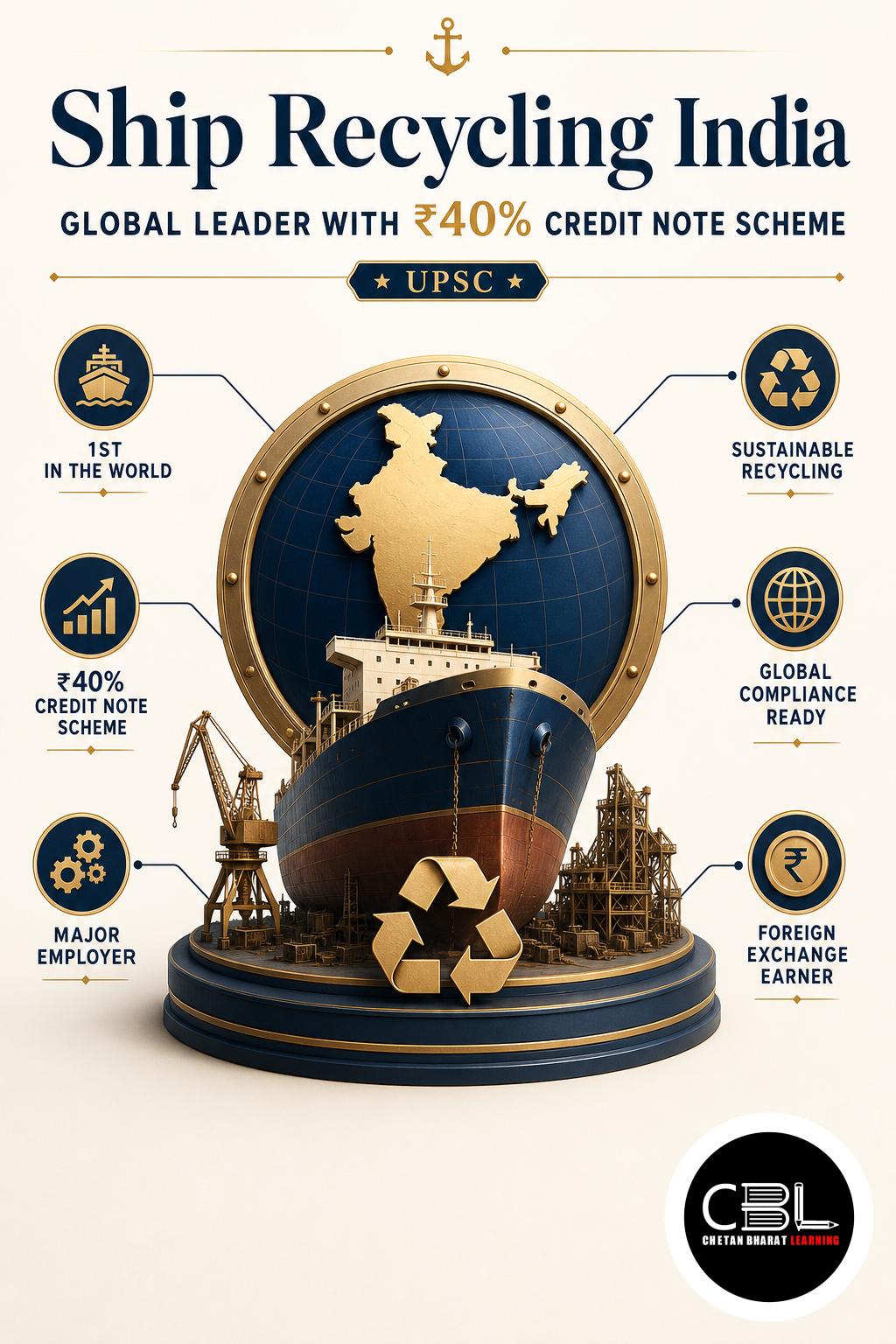

UPSC Mapping
| Prelims | Infrastructure & Economy |
|---|---|
| Mains | GS Paper 3 (Infrastructure & Environment) |
Quick Facts (2025)
| Global Rank | 1st |
|---|---|
| Recycling Volume | 2.99 million GT |
| Alang Share | ~98% |
What is Ship Recycling India?
Ship Recycling India refers to the safe and environmentally sound dismantling of end-of-life ships, followed by the recovery and reuse of materials such as steel and other components. India’s ship recycling industry is centred around the Alang-Sosiya cluster in Gujarat, which accounts for approximately 98% of the country’s ship recycling activity.
Ship recycling is an important part of the maritime lifecycle and, when undertaken with proper regulatory safeguards, contributes to the circular economy, resource efficiency, and environmental sustainability. The sector generates large-scale employment and sustains ancillary industries like transportation, steel re-rolling mills, and equipment suppliers.
Why is Ship Recycling India in News?
Ship Recycling India is in the news because India achieved the Maritime India Vision 2030 objective of becoming the world’s leading ship recycling nation five years ahead of the target. The recycling of Ex-INS Viraat at Alang showcased India’s growing capabilities in environmentally responsible ship recycling.
The government has introduced the Ship-breaking Credit Note Scheme, which incentivises ship scrapping by issuing a Credit Note equivalent to 40% of the recycled ship’s scrap value. India has aligned its domestic framework with the Hong Kong International Convention (HKC), which came into force on 26 June 2025. For more details, refer to the PIB release.
Key Features of Ship Recycling India
- Global Leadership: India ranks 1st globally with a 35.4% market share (UNCTAD, 2025).
- Regulatory Framework: Ship Recycling Act, 2019; Ship Recycling Rules, 2021; Ship Recycling Regulations, 2026.
- Alignment with HKC: India’s domestic framework aligns with the Hong Kong International Convention.
- Ship-breaking Credit Note: Credit Note of 40% of scrap value incentivises recycling at compliant yards.
- Inventory of Hazardous Materials: Mandatory identification and recording of hazardous substances on ships.
Challenges in Ship Recycling India
- Worker Safety: Ship recycling involves hazardous materials and working conditions; ensuring worker safety remains a priority.
- Environmental Compliance: Handling hazardous materials like asbestos and toxic paints requires strict environmental safeguards.
- Competition: Other countries like Bangladesh and Pakistan are also expanding their recycling capacities.
- Technology Upgradation: Modernising recycling yards to meet HKC standards requires significant investment.
- Formalisation: A large part of the workforce is informal; formalisation and social security are needed.
Way Forward for Ship Recycling India
To sustain Ship Recycling India’s leadership, the government should focus on upgrading infrastructure to meet HKC standards and promote green recycling practices. Strengthening worker training and safety protocols is essential, along with providing social security coverage for informal workers.
The Ship-breaking Credit Note Scheme should be expanded to incentivise more shipowners to use Indian yards. Investment in R&D for advanced recycling technologies can improve efficiency and reduce environmental impact. India should also engage with international bodies to promote its model of responsible ship recycling.
Prelims Practice Corner
- Q1. What was India’s global market share in ship recycling in 2025?
(a) 25.4% (b) 30.1% (c) 35.4% (d) 40.2%
Answer: (c) India’s share was 35.4% in 2025. - Q2. Which cluster accounts for approximately 98% of India’s ship recycling activity?
(a) Mumbai Harbour (b) Alang-Sosiya (c) Visakhapatnam (d) Kochi
Answer: (b) The Alang-Sosiya cluster in Gujarat is the hub. - Q3. What is the Ship-breaking Credit Note Scheme?
(a) A tax exemption for shipowners (b) A credit note of 40% of scrap value for recycling at compliant yards (c) A subsidy for new shipbuilding (d) A loan scheme for recycling yards
Answer: (b) The scheme incentivises recycling with a Credit Note of 40% of scrap value. - Q4. Which international convention governs ship recycling?
(a) MARPOL (b) Hong Kong International Convention (c) SOLAS (d) UNCLOS
Answer: (b) The Hong Kong International Convention governs ship recycling. - Q5. When did the Hong Kong International Convention come into force?
(a) 1 June 2025 (b) 26 June 2025 (c) 1 July 2025 (d) 1 January 2026
Answer: (b) The Convention came into force on 26 June 2025.
Mains Practice Questions
- Q1. Discuss the significance of ship recycling for India’s circular economy and maritime industry. How has India achieved global leadership in this sector? (250 words, 15 marks)
Answer Structure:
Intro: Introduce India’s global leadership in ship recycling.
Body: Discuss economic and environmental significance: circular economy, employment, steel recovery. Analyse regulatory framework: Ship Recycling Act, HKC alignment, Credit Note Scheme. Address challenges: worker safety, competition.
Conclusion: Suggest infrastructure upgradation and green practices for sustained leadership. - Q2. What is the Hong Kong International Convention, and how has India aligned its domestic framework with it? (150 words, 10 marks)
Answer Structure:
Intro: Define the HKC and its objectives.
Body: Explain that India aligned its framework through the Ship Recycling Act, Rules, and Regulations. The Act mandates authorisation, certification, and inspection, ensuring compliance with HKC standards.
Conclusion: Conclude that alignment has enhanced India’s credibility and global standing.
FAQs on Ship Recycling India
What is ship recycling?
It is the safe and environmentally sound dismantling of end-of-life ships and the recovery of reusable materials like steel.
Why is India a global leader in ship recycling?
India has the largest ship recycling capacity, with a 35.4% global market share, centred at Alang, and a robust regulatory framework aligned with the Hong Kong International Convention.
What is the Ship-breaking Credit Note Scheme?
It incentivises shipowners to recycle at compliant Indian yards by issuing a Credit Note equivalent to 40% of the recycled ship’s scrap value.
Related Current Affairs
Preparing for UPSC, PCS or HCS?
Talk to a mentor at Chetan Bharat Learning, Chandigarh. Free guidance on choosing the right exam and building a study plan.
Chat on WhatsAppCall 97793 53345UPSC / IAS / PCS coaching in Chandigarh · Trusted by aspirants across Punjab & Haryana
Leave a Reply
You must be logged in to post a comment.