

UPSC Mapping
| Exam | Subject |
|---|---|
| Prelims | Polity & Economy |
| Mains | GS Paper 2 (Federalism) & GS Paper 3 (Economy) |
| Key Law | SC Judgment (2024) |
|---|---|
| MMDR Act, 1957 | Mineral Area Development Authority v. SAIL |
What is the MMDR Amendment Bill?
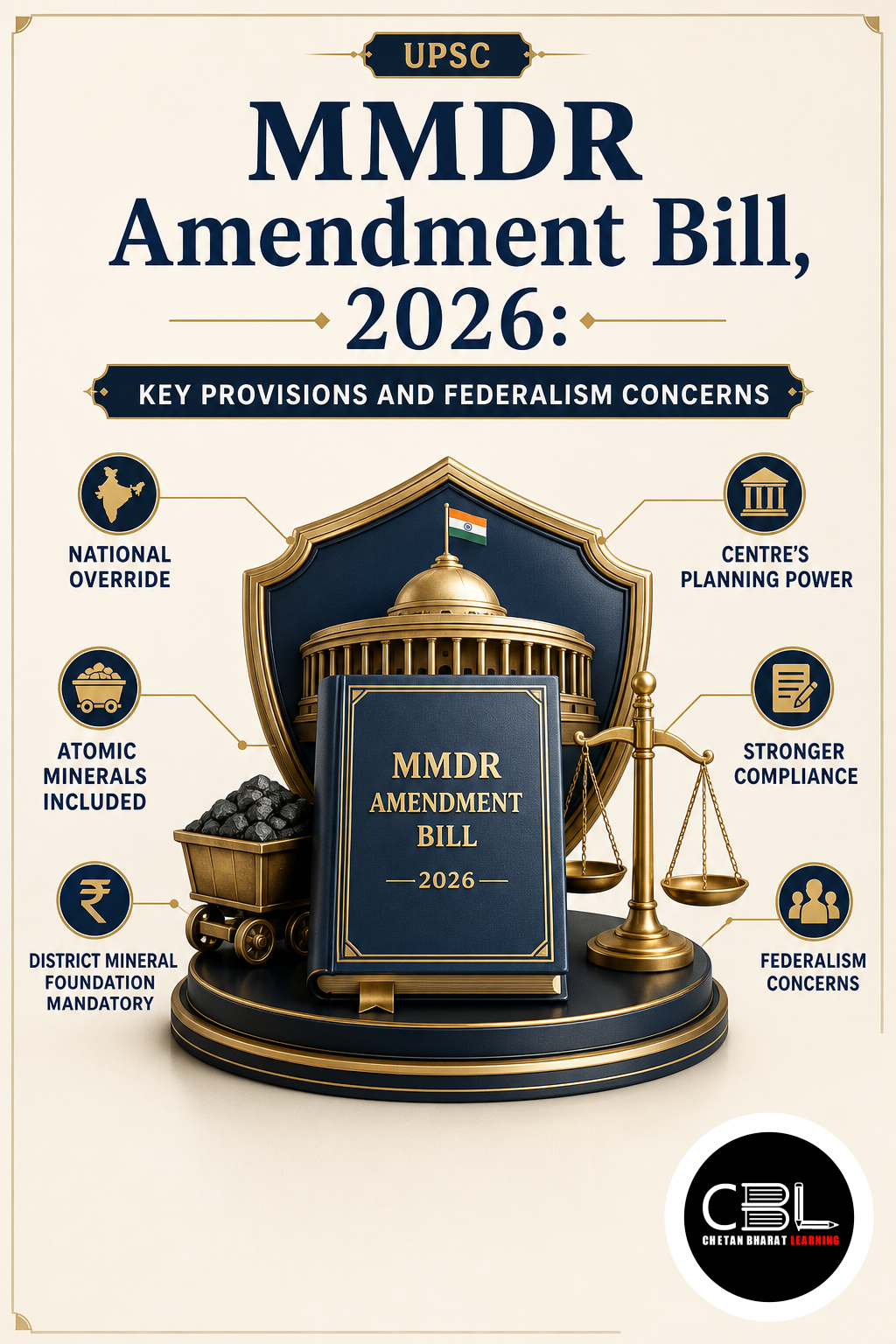
The MMDR Amendment Bill, 2026, amends the Mines and Minerals (Development and Regulation) Act, 1957, with the stated objective of standardising India’s fiscal regime and accelerating critical mineral exploration. It bars states from taxing mineral rights or mineral-bearing lands unless they conform to limits prescribed by the Central Government, effectively centralising fiscal control over the mining sector.
The Bill also standardises the definition of ‘mineral-bearing land’ and allows the Union government to directly regulate these lands based on mineral density. A retrospective clause invalidates any state-imposed tax or cess that was not recovered before the Act’s commencement, without refunding taxes already deposited with states.
Why is the MMDR Amendment Bill in News?
The MMDR Amendment Bill is in the news because it effectively nullifies the July 2024 Supreme Court ruling in Mineral Area Development Authority v. SAIL, which upheld states’ constitutional power to tax mineral rights. The Bill has drawn sharp criticism for eroding states’ fiscal autonomy under Entry 50 of the State List.
Critics argue that the Bill violates the principles of federalism and equality under Article 14 by erasing unpaid tax dues of defaulting companies while not refunding those who have already paid. For more details, refer to the PIB release.
Key Features of the MMDR Amendment Bill
- State Taxation Limits: Bars states from taxing mineral rights or mineral-bearing lands unless they conform to central limits.
- Centralised Regulation: Standardises the definition of ‘mineral-bearing land’ and allows the Union to regulate these lands directly.
- Retrospective Clause: Invalidates any state-imposed tax or cess not recovered before the Act’s commencement, without refunding already paid taxes.
- Constitutional Basis: Draws on Entry 54 of the Union List, which allows Parliament to regulate mines when expedient in the public interest.
- Critical Mineral Focus: Aims to secure domestic supply chains for critical and strategic minerals.
Challenges Associated with the MMDR Amendment Bill
- Fiscal Centralisation: Removing states’ constitutional right under Entry 50 concentrates revenue control with the Union, violating federal principles.
- Equality Violation: Erasing unpaid tax dues while not refunding paid dues creates an unfair classification under Article 14.
- Asymmetric Federalism: The Bill gives the Union near-unlimited power to impose conditions, turning state legislatures into administrative subordinates.
- Judicial Undermining: It effectively nullifies the 2024 SC ruling upholding states’ taxing power.
- State Welfare Impact: Mineral-rich states may lose revenue for development and welfare.
Way Forward for the MMDR Amendment Bill
To address concerns over the MMDR Amendment Bill, the government should engage in structured consultation with mineral-producing states to build consensus. A revenue-sharing mechanism that ensures states receive adequate compensation for lost taxing powers could mitigate federal tensions.
Ensuring that critical mineral exploration benefits both the Centre and states is essential. The retrospective clause should be reconsidered to avoid Article 14 violations. Ultimately, cooperative federalism—where the Centre and states work together on mineral governance—is preferable to unilateral centralisation.
Prelims Practice Corner
Q1. The MMDR Amendment Bill, 2026, amends which Act?
- (a) Mines Act, 1952
- (b) MMDR Act, 1957
- (c) Coal Bearing Areas Act, 1957
- (d) Mineral Concession Rules, 1960
Answer: (b) It amends the MMDR Act, 1957.
Q2. What is the primary objective of the Bill?
- (a) To increase state revenue
- (b) To standardise fiscal regime and secure critical minerals
- (c) To privatise mining
- (d) To ban mining in forests
Answer: (b) The Bill aims to standardise the fiscal regime and secure critical mineral supply chains.
Q3. Which Supreme Court judgment did the Bill effectively nullify?
- (a) Kesavananda Bharati
- (b) Mineral Area Development Authority v. SAIL (2024)
- (c) State of West Bengal v. Union of India
- (d) Samatha v. State of Andhra Pradesh
Answer: (b) The Bill nullifies the 2024 SC ruling upholding states’ taxing power.
Q4. Under which List does the Centre derive power to regulate mines?
- (a) State List Entry 23
- (b) Union List Entry 54
- (c) Concurrent List Entry 17
- (d) State List Entry 50
Answer: (b) Entry 54 of the Union List gives Parliament this power.
Q5. What does the retrospective clause do?
- (a) Refunds all past taxes
- (b) Invalidates unpaid state taxes and cesses
- (c) Increases state taxes
- (d) Repeals all mining laws
Answer: (b) It invalidates any state-imposed tax or cess that was not recovered before the Act’s commencement.
Mains Practice Questions
Q1. Critically examine the constitutional and federalism implications of the MMDR Amendment Bill, 2026. (250 words, 15 marks)
Answer Structure:
- Intro: Introduce the Bill and its objective.
- Body: Discuss the constitutional framework (Entry 54, Union List; Entry 50, State List). Analyse provisions: centralised regulation, taxation limits, retrospective clause. Evaluate criticisms: fiscal centralisation, equality violation, judicial undermining.
- Conclusion: Suggest a cooperative federalism approach with revenue-sharing mechanisms.
Q2. Discuss the implications of the retrospective clause in the MMDR Amendment Bill for the principles of fairness and equality under the Constitution. (150 words, 10 marks)
Answer Structure:
- Intro: Frame the retrospective clause.
- Body: Explain that it invalidates unpaid tax dues but does not refund taxes already paid, creating unfair classification under Article 14. Discuss how this benefits defaulting companies at the expense of compliant ones.
- Conclusion: Conclude that such provisions undermine the rule of law and fiscal equity.
FAQs on the MMDR Amendment Bill
What is the MMDR Amendment Bill, 2026?
It amends the MMDR Act, 1957, to bar states from taxing mineral rights without central limits and standardise the fiscal regime for critical minerals.
Why has the Bill faced criticism?
Critics argue it centralises fiscal powers, violates federal principles, creates inequality under Article 14, and undermines the Supreme Court’s 2024 judgment.
What is the retrospective clause?
It invalidates any state-imposed tax or cess not recovered before the Act’s commencement, without refunding taxes already paid.
Related Current Affairs
Preparing for UPSC, PCS or HCS?
Talk to a mentor at Chetan Bharat Learning, Chandigarh. Free guidance on choosing the right exam and building a study plan.
Chat on WhatsAppCall 97793 53345UPSC / IAS / PCS coaching in Chandigarh · Trusted by aspirants across Punjab & Haryana
Leave a Reply
You must be logged in to post a comment.