

UPSC Mapping
| Prelims | Education & Governance |
|---|---|
| Mains | GS Paper 2 (Education & Social Sector) |
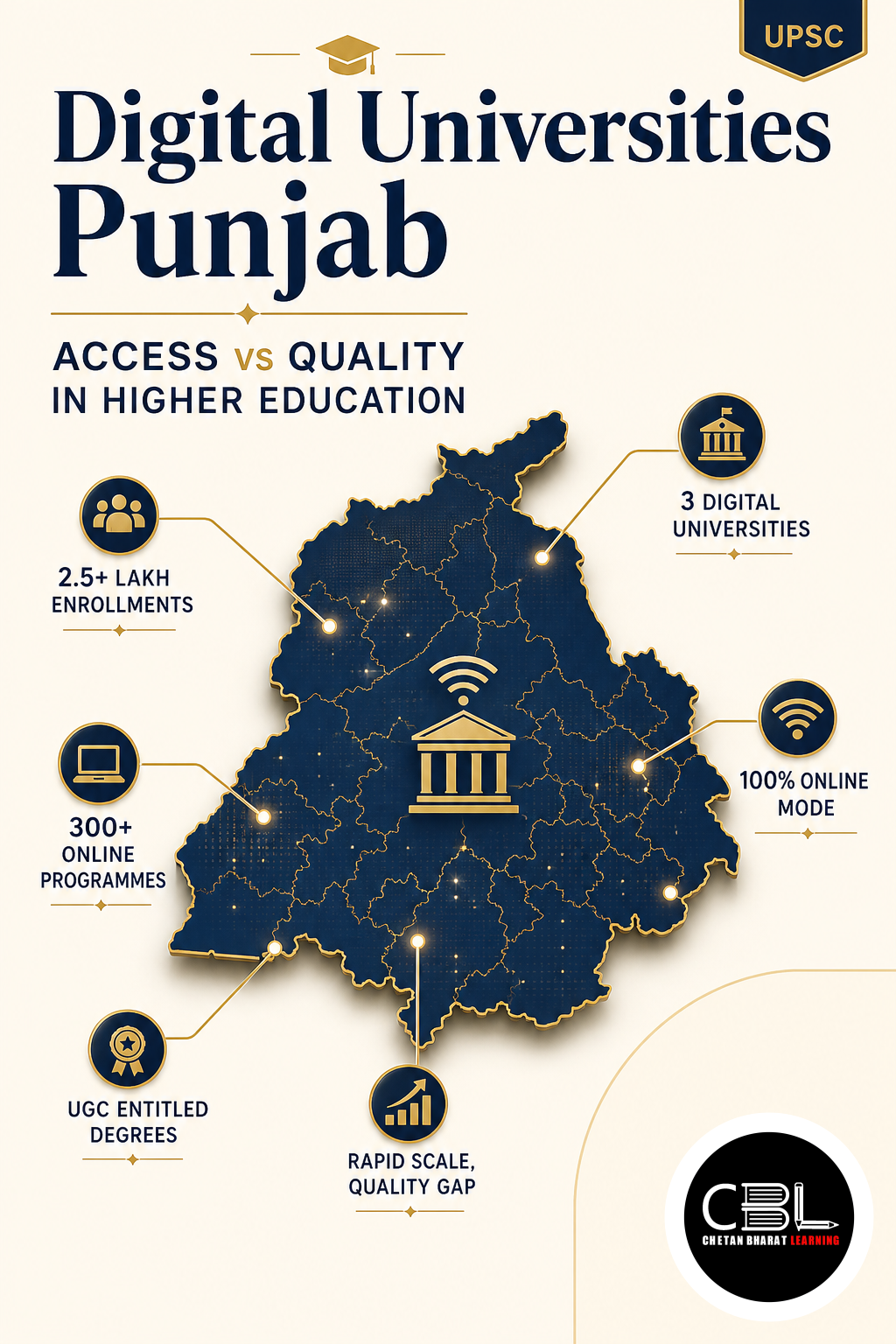
Digital Universities Punjab: Access vs Quality in Higher Education
Digital Universities Punjab are self-financed private universities that deliver education entirely through digital, distance, or open modes. The Punjab Assembly passed three Bills—Cloud University, Nab Singh and University, and Physicswallah Digital University—amid objections over practical courses. The policy aims to attract private and edtech players, allowing students to complete undergraduate, postgraduate, and professional programmes from home.
Key Features
- Fully Digital Delivery: Education through online classes, digital assessments, and virtual laboratories.
- Self-Financed: No government grants; sponsors maintain a minimum corpus of ₹20 crore.
- Wide Programme Offerings: Courses in engineering, medical sciences, humanities, management, and more.
- Technology Integration: AI-enabled learning pathways, LMS, and 24/7 student support.
- Oversight Mechanism: Governor as Visitor, Ombudsman for grievances, penalties up to ₹25 lakh.
Challenges
- Quality of Practical Education: Digital format may not suffice for laboratory-based subjects.
- Government Oversight: Concerns over effective monitoring and adherence to UGC norms.
- Equity and Access: Digital divide may exclude low-income students without reliable internet.
- Private vs Public: Critics say private focus may weaken public institutions.
- Employability: Employers may question practical skill proficiency.
Way Forward
A hybrid model with periodic in-person practical sessions, robust regulatory audits, funding for internet/devices for disadvantaged students, and industry collaboration for internships can balance access with quality. Periodic policy reviews and stakeholder feedback will ensure adaptability.
Prelims Practice Corner
Q1. How many Bills were passed to establish digital universities in Punjab?
- a) 1
- b) 2
- c) 3
- d) 4
Answer: (c) Three Bills were passed for Cloud University, Nab Singh and University, and Physicswallah Digital University.
Q2. What is the minimum corpus fund required for each digital university?
- a) ₹5 crore
- b) ₹10 crore
- c) ₹20 crore
- d) ₹50 crore
Answer: (c) Sponsors must maintain a minimum corpus fund of ₹20 crore.
Q3. Which Opposition party raised concerns about the feasibility of practical courses in digital format?
- a) AAP
- b) BJP
- c) Congress
- d) Shiromani Akali Dal
Answer: (c) The Congress raised concerns about practical courses like engineering and medical sciences.
Q4. Who acts as the Visitor for these digital universities?
- a) Chief Minister
- b) Governor of Punjab
- c) Education Minister
- d) UGC Chairman
Answer: (b) The Governor acts as Visitor with inspection powers.
Q5. What is the maximum penalty that can be imposed for violations?
- a) ₹5 lakh
- b) ₹10 lakh
- c) ₹25 lakh
- d) ₹50 lakh
Answer: (c) Penalties up to ₹25 lakh can be imposed.
Mains Practice Questions
-
Discuss the potential benefits and challenges of establishing digital universities in India, with reference to the Punjab initiative. (250 words, 15 marks)
Answer Structure:
- Intro: Introduce the Punjab Digital Universities policy.
- Body: Benefits (access, flexibility, technology); Challenges (practical education quality, digital divide, oversight, employability).
- Conclusion: Hybrid model with oversight and equity measures.
-
What are the governance and regulatory challenges in the proliferation of private digital universities in India? (150 words, 10 marks)
Answer Structure:
- Intro: Note the growth of private digital universities.
- Body: Challenges: regulatory oversight, UGC compliance, quality assurance, inspections; equity concerns from the digital divide.
- Conclusion: Need for robust regulatory framework and regular audits.
FAQs on Digital Universities Punjab
- What is the Punjab Digital Universities policy?
- It enables private digital open universities to deliver education fully online, distance, or open modes, allowing students to study from home.
- How are these universities funded?
- They are self-financed, with sponsors maintaining a minimum corpus fund of ₹20 crore; no government grants.
- What concerns has the Opposition raised?
- Feasibility of practical courses in digital format, lack of oversight, potential dilution of UGC norms, and prioritisation of private over public institutions.
Related Current Affairs
Preparing for UPSC, PCS or HCS?
Talk to a mentor at Chetan Bharat Learning, Chandigarh. Free guidance on choosing the right exam and building a study plan.
Chat on WhatsAppCall 97793 53345UPSC / IAS / PCS coaching in Chandigarh · Trusted by aspirants across Punjab & Haryana
Leave a Reply
You must be logged in to post a comment.