
UPSC Mapping
| Prelims | Polity & Economy |
|---|---|
| Mains | GS Paper 2 (Federalism) & GS Paper 3 (Economy) |
Article
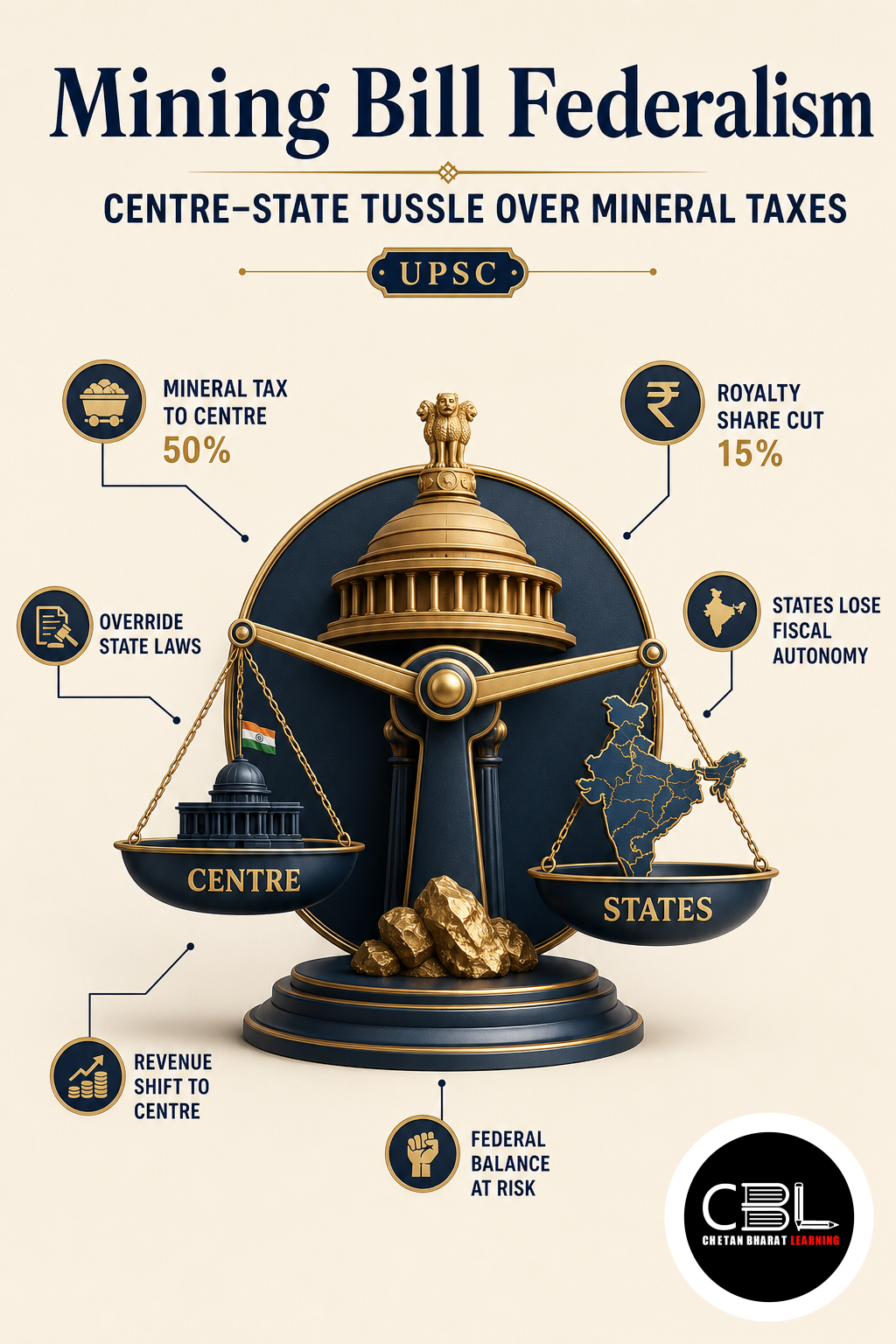
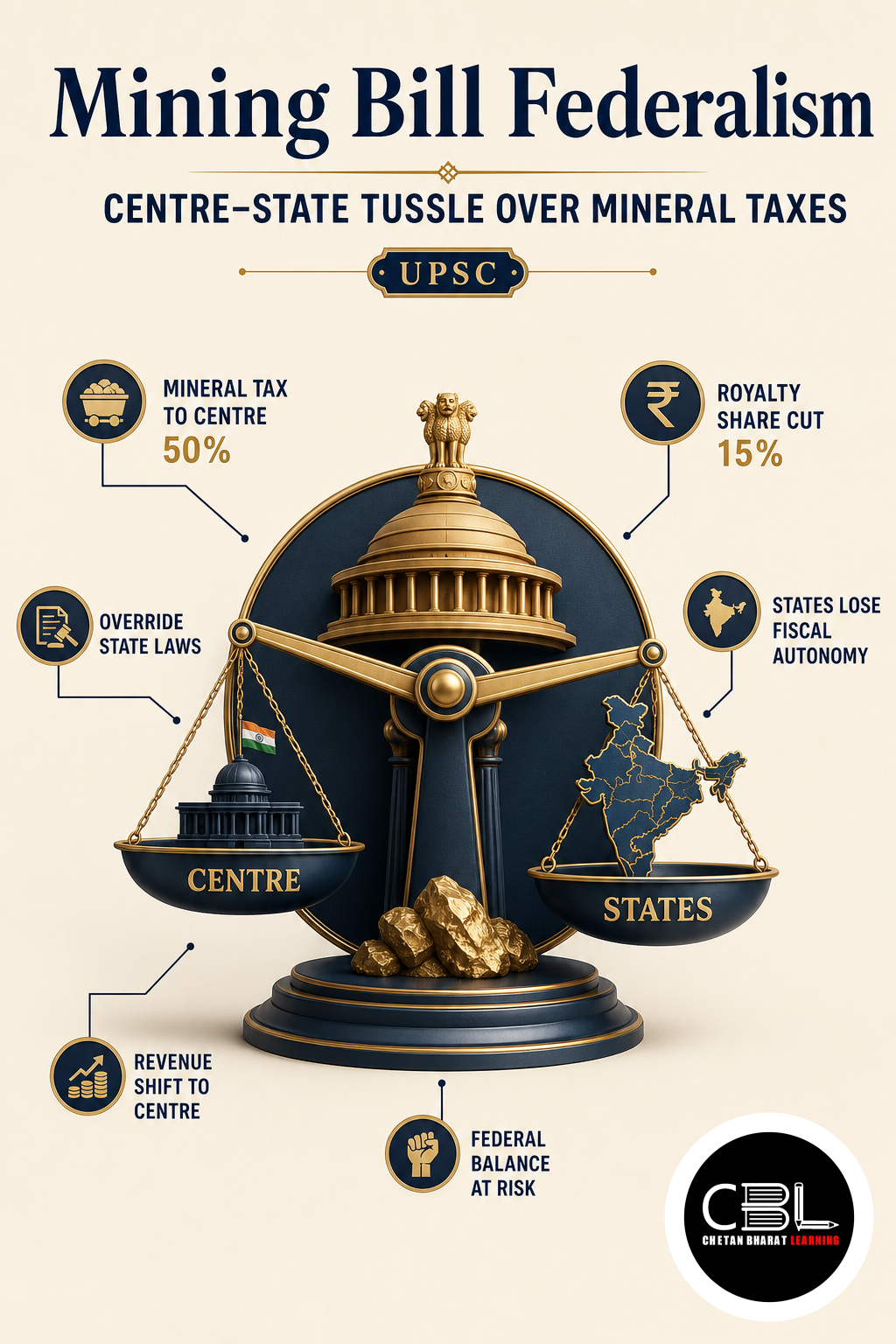
What is the Mining Bill Federalism Debate?
The Mining Bill Federalism debate centres on whether the Centre can restrict states from imposing levies on mineral-bearing lands after the Supreme Court upheld states’ taxation powers in 2024. The MMDR Act distinguishes between major minerals (regulated primarily by the Centre) and minor minerals (entrusted to state governments).
The Bill applies only to major minerals—iron ore, coal, bauxite, manganese, and copper—and would affect around 11 mineral-producing states. The government argues the amendment aims to bring uniformity in mineral prices and prevent rising costs from feeding into inflation and infrastructure expenses.
Why is Mining Bill Federalism in News?
The debate resurfaced after both Houses passed the Bill despite concerns over state revenue losses. The Union Mines Minister assured the Rajya Sabha of no revenue loss for states, noting state revenue from minerals rose from ₹13,258 crore (2014-15) to ₹71,035 crore (2024-25).
The Bill also extinguishes unpaid dues imposed before its commencement, raising fiscal autonomy concerns among Odisha, Jharkhand, and Chhattisgarh.
Key Features of the Mining Bill Federalism Debate
- Centre’s Uniformity Argument: Predictability in mineral prices prevents inflation in cement and steel.
- State’s Fiscal Concerns: Mining states bear land degradation, displacement, pollution, and infrastructure costs, requiring adequate revenue.
- Constitutional Framework: Article 246 + Union List Entry 54 gives the Centre power to regulate mines when in public interest.
- SC Judgment (2024): In Mineral Area Development Authority v. SAIL (8:1), the Court held that royalty isn’t a tax and states can levy taxes on mineral rights.
- Federalism Dimensions: Resource federalism (control), fiscal federalism (taxation and revenue), and regulatory federalism (regulation).
Challenges in Mining Bill Federalism
- State Revenue Loss: States fear reduced cess income, affecting their local cost management.
- Constitutional Tension: The Bill overrides the 2024 judgment, raising legislative vs judicial supremacy questions.
- Local Cost Burden: Environmental and social costs need local fiscal resources.
- Uniformity vs Autonomy: Central uniformity push may undermine state fiscal autonomy.
- Implementation Issues: Extinguishing pre-amendment dues could hit state revenues.
Way Forward for Mining Bill Federalism
A cooperative approach is needed: structured consultations with mineral states, a transparent revenue-sharing mechanism (e.g., a mining fund), and specific grants to compensate for local costs. Federalism encompasses resource control, regulation, taxation, revenue receipt, and environmental cost-bearing.
Prelims Practice Corner
Q1. The MMDR Amendment Bill, 2026, applies to which category of minerals?
- (a) All minerals
- (b) Minor minerals only
- (c) Major minerals only
- (d) Atomic minerals only
Answer: (c) Major minerals only.
Q2. What did the Supreme Court hold in Mineral Area Development Authority v. SAIL (2024)?
- (a) States cannot tax mineral rights
- (b) States have constitutional power to tax mineral rights
- (c) Only the Centre can tax minerals
- (d) Royalty is a tax
Answer: (b) States have constitutional power to tax mineral rights.
Q3. Under which entry in the Union List does the Centre regulate mines and minerals?
- (a) Entry 52
- (b) Entry 54
- (c) Entry 56
- (d) Entry 60
Answer: (b) Entry 54.
Q4. What is the government’s argument for the mining amendment?
- (a) Increase state revenue
- (b) Bring uniformity in mineral prices to control inflation
- (c) Privatise mining
- (d) Reduce environmental damage
Answer: (b) Uniformity to prevent price rises in cement and steel.
Q5. State revenue from the mineral sector increased from ₹13,258 crore (2014-15) to how much in 2024-25?
- (a) ₹30,000 crore
- (b) ₹50,000 crore
- (c) ₹71,035 crore
- (d) ₹1,00,000 crore
Answer: (c) ₹71,035 crore.
Mains Practice Questions
Q1. Critically examine the Mines and Minerals (Development and Regulation) Amendment Bill, 2026, in the context of Centre-State federal relations. (250 words, 15 marks)
Answer Structure:
- Intro: Introduce the Bill and its federalism dimensions.
- Body: Centre’s arguments (uniformity, inflation control) vs States’ concerns (revenue loss, local costs). Analyse constitutional framework and the 2024 SC judgment.
- Conclusion: Suggest cooperative resource federalism with revenue-sharing mechanisms.
Q2. Differentiate between royalty and tax in the context of mineral governance. Why does this distinction matter? (150 words, 10 marks)
Answer Structure:
- Intro: Define royalty and tax.
- Body: Royalty is payment for extraction rights; tax is a sovereign levy. SC held royalty is not a tax, allowing states to levy taxes on mineral rights.
- Conclusion: This distinction is central to the federalism debate.
FAQs
What is the Mining Bill Federalism debate?
It is the debate over whether the Centre can restrict states from imposing levies on mineral rights, even after the Supreme Court upheld states’ taxation powers.
What did the Supreme Court rule in 2024?
The Court ruled 8:1 that states have constitutional power to tax mineral rights and royalty is not a tax.
How many states would be affected by the amendment?
The Bill would likely affect around 11 mineral-producing states, including Odisha, Jharkhand, and Chhattisgarh.
Related Current Affairs
Preparing for UPSC, PCS or HCS?
Talk to a mentor at Chetan Bharat Learning, Chandigarh. Free guidance on choosing the right exam and building a study plan.
Chat on WhatsAppCall 97793 53345UPSC / IAS / PCS coaching in Chandigarh · Trusted by aspirants across Punjab & Haryana
Leave a Reply
You must be logged in to post a comment.