

UPSC Mapping
| Prelims | Polity & Parliamentary Procedures |
|---|---|
| Mains | GS Paper 2 (Parliament & State Legislatures) |
Quick Facts
| Bill Referred | FCRA Amendment Bill, 2026 |
|---|---|
| Committee Type | Joint Parliamentary Committee |
| Key Precedent | 2G JPC (2010-11) |
Article
The JPC Committee Bill referral—specifically the Foreign Contribution (Regulation) Amendment Bill, 2026 being sent to a Joint Parliamentary Committee—has brought parliamentary scrutiny back into focus. The referral gives the Bill a second layer of detailed examination, but raises a central question: how much difference can a parliamentary committee actually make? For more such governance updates, explore the polity and governance archive.
Smaller committees can spend more time examining a Bill, questioning officials, hearing experts and stakeholders, and examining provisions in depth. The underlying philosophy of the committee system is “influence, not direct control; advise, not command; criticism, not obstruction; scrutiny, not initiative; accountability, not prior approval.”
What is a JPC Committee Bill Referral?
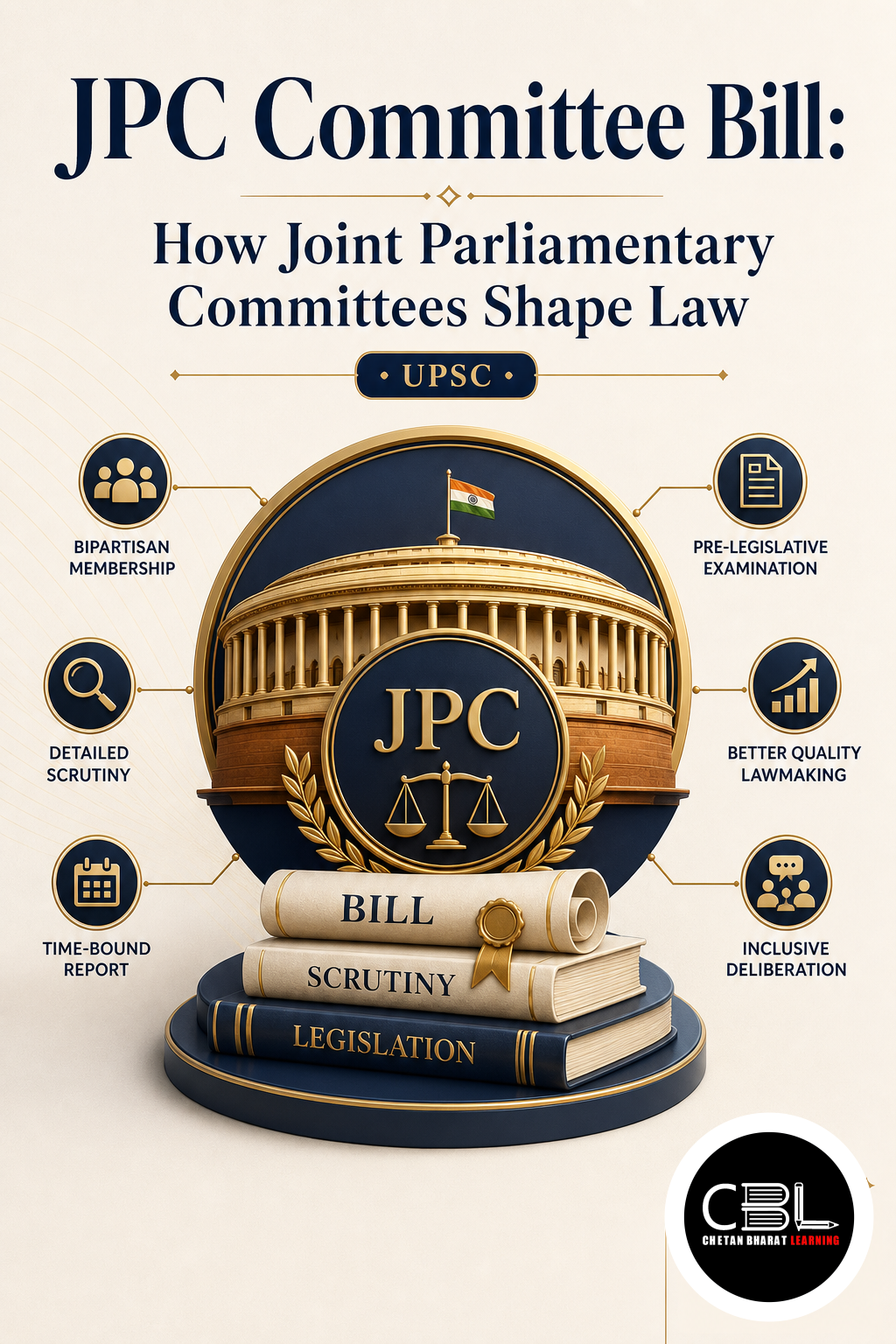
A JPC Committee Bill referral occurs when a Bill is sent to a Joint Parliamentary Committee—a committee with members from both Lok Sabha and Rajya Sabha—for detailed clause-by-clause examination. Committees were created to address a basic limitation of Parliament: the two Houses have limited time to examine an increasingly complex body of legislation and policy.
Why is JPC Committee Bill in News?
The JPC Committee Bill referral is currently in the news because the FCRA Amendment Bill, 2026, was referred to a JPC amid strong objections from the Opposition and the Church. The referral gives the Bill a second layer of scrutiny, but the government could have pushed the Bill directly through Lok Sabha given its majority.
The emerging pattern is that routine scrutiny has weakened (only about 16% of Bills were referred to committees in the 17th Lok Sabha), while JPCs have increasingly been used for particularly contentious Bills. This makes the FCRA referral significant—it signals that the government is willing to subject a politically sensitive Bill to detailed committee examination. For more details, refer to this PIB release.
Key Features of JPC Committee Bill Scrutiny
- Detailed Examination: JPCs examine Bills clause by clause, questioning officials and hearing expert testimony.
- Bipartisan Membership: Membership reflects the strength of parties in Parliament, though the chairperson is generally from the government benches.
- Dissenting Notes: Opposition members can file objections and dissent notes, creating an institutional record of alternative viewpoints.
- Non-Binding Recommendations: Committee recommendations are not binding on the government, but they carry persuasive weight and can force amendments.
- Evidence Gathering: JPCs can summon officials, experts, and stakeholders to build an evidence base for legislative decisions.
Challenges in JPC Committee Bill Scrutiny
- Majority Dominance: With the ruling party in control, the committee’s composition and chairperson often reflect government preferences.
- Limited Influence: Opposition objections rarely make it to the final law, especially for Bills central to the government’s agenda.
- Declining Referrals: The percentage of Bills referred to committees has fallen sharply—from 71% in the 15th Lok Sabha to just 16% in the 17th Lok Sabha.
- Rushed Timelines: JPCs often face tight deadlines, limiting their ability to conduct thorough examination.
- Political Pressures: Committee members may face pressure from party whips, reducing independent scrutiny.
Way Forward for JPC Committee Bill Scrutiny
To strengthen JPC Committee Bill scrutiny, a norm of mandatory committee referral for all non-money Bills should be considered. This would restore the routine scrutiny that has declined over the past decade. Providing committees with adequate time, expert staff, and resources can enhance their capacity for detailed examination.
Ensuring that dissent notes are given due consideration and that the government provides a reasoned response to committee recommendations can make the process more meaningful. Ultimately, committees do not substitute Parliament—they strengthen Parliament’s capacity for detailed scrutiny. The goal should be not simply more referrals, but more meaningful parliamentary work. For international best practices, refer to the UK Parliament.
Prelims Practice Corner
-
Which Bill was recently referred to a Joint Parliamentary Committee?
(a) Citizenship Amendment Bill (b) FCRA Amendment Bill, 2026 (c) Data Protection Bill (d) Farm Laws Repeal Bill
Answer
The FCRA Amendment Bill, 2026, was referred to a JPC.
-
What is the philosophy of the parliamentary committee system?
(a) Control and command (b) Influence, advise, scrutinise (c) Obstruction and delay (d) Prior approval of all Bills
Answer
The philosophy is influence, not control; advice, not command; scrutiny, not initiative.
-
What percentage of Bills were referred to committees in the 17th Lok Sabha (2019-24)?
(a) 71% (b) 60% (c) 25% (d) 16%
Answer
Only about 16% of Bills were referred in the 17th Lok Sabha.
-
Are JPC recommendations binding on the government?
(a) Yes (b) No, they are advisory (c) Only if unanimous (d) Only for money Bills
Answer
Committee recommendations are not binding on the government.
-
The 2G JPC (2010-11) was constituted during which government’s tenure?
(a) NDA-I (b) UPA-I (c) UPA-II (d) NDA-II
Answer
The 2G JPC was constituted during the UPA-II government.
Mains Practice Questions
Q1. Discuss the role of Joint Parliamentary Committees in the legislative process. How effective are they in scrutinising government Bills? (250 words, 15 marks)
- Intro: Define JPCs and their constitutional/statutory role.
- Body: Discuss strengths: detailed scrutiny, evidence gathering, cross-party input. Analyse limitations: majority dominance, non-binding recommendations, declining referrals. Use examples: 2G JPC, Personal Data Protection JPC.
- Conclusion: Suggest reforms for stronger committee scrutiny.
Q2. Why has the referral of Bills to parliamentary committees declined in recent years? Analyse its implications for legislative quality. (150 words, 10 marks)
- Intro: Note the sharp decline from 71% to 16% in committee referrals.
- Body: Discuss reasons: government majority, desire for swift passage, limited parliamentary time. Implications: rushed legislation, unintended consequences, weaker stakeholder consultation.
- Conclusion: Conclude that restoring committee referrals is vital for legislative quality.
FAQs on JPC Committee Bill
What is a Joint Parliamentary Committee?
A JPC is a committee with members from both Lok Sabha and Rajya Sabha, constituted to scrutinise a specific Bill or issue in detail.
Are JPC recommendations binding?
No, JPC recommendations are not binding on the government, but they can force amendments and generate public debate.
Why was the FCRA Bill referred to a JPC?
The Bill was referred amid strong objections over some provisions, allowing detailed scrutiny through expert and stakeholder consultations.
Related Current Affairs
Preparing for UPSC, PCS or HCS?
Talk to a mentor at Chetan Bharat Learning, Chandigarh. Free guidance on choosing the right exam and building a study plan.
Chat on WhatsAppCall 97793 53345UPSC / IAS / PCS coaching in Chandigarh · Trusted by aspirants across Punjab & Haryana
Leave a Reply
You must be logged in to post a comment.