

UPSC Mapping
| Prelims | Mains |
|---|---|
| Science & Technology | GS Paper 3 (Science & Technology) |
Quick Facts
| Birth | 1919 |
|---|---|
| ISRO Founded | 15 August 1969 |
| First Rocket Launch | 1963 (Thumba) |
Article
Who was Vikram Sarabhai?
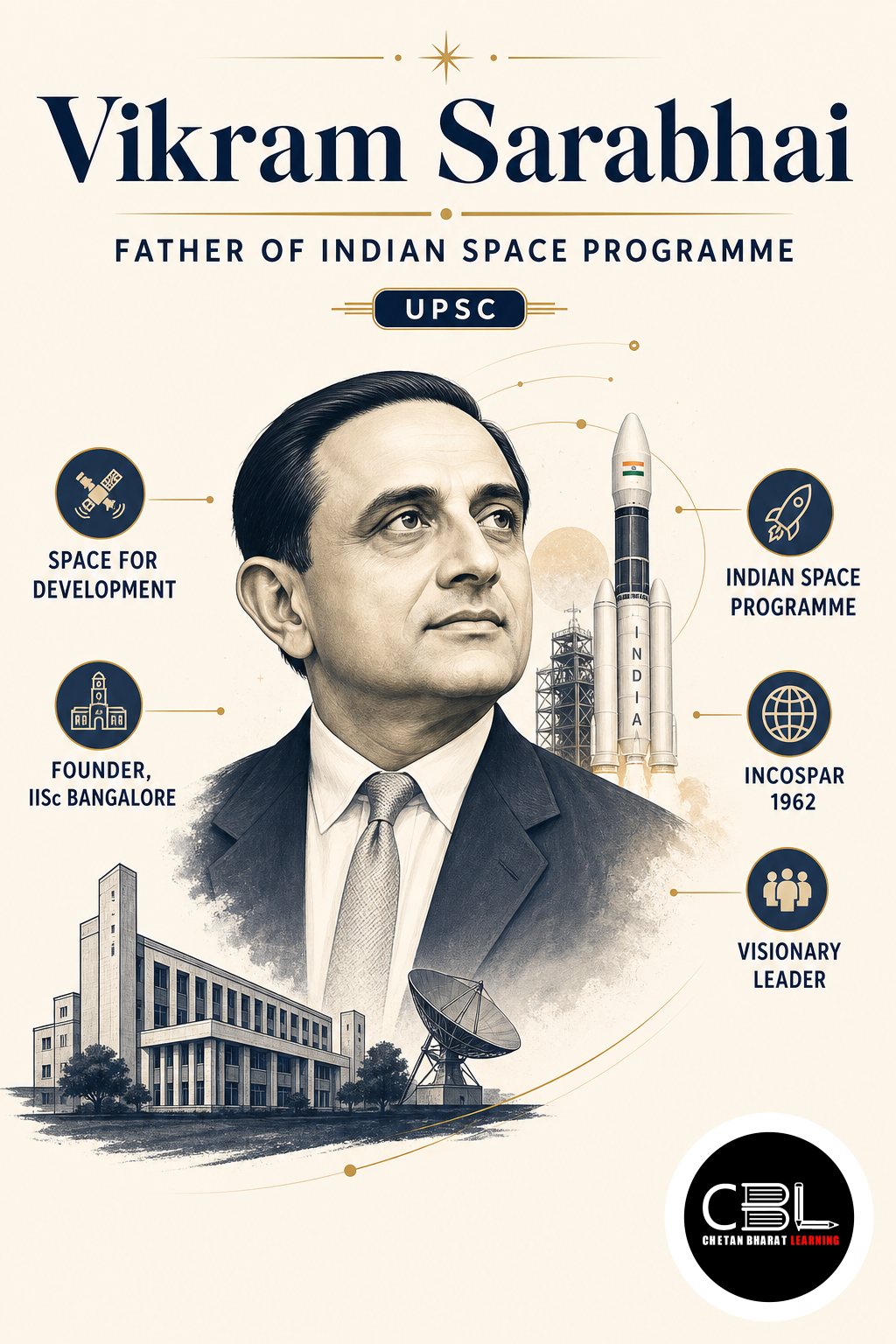
Vikram Sarabhai (1919–1971) was an Indian physicist and astronomer, widely recognised as the Father of the Indian Space Programme. He established the Indian National Committee for Space Research (INCOSPAR) in 1962, which later became the Indian Space Research Organisation (ISRO) on 15 August 1969.
He set up the Thumba Equatorial Rocket Launching Station (TERLS) in Kerala, launching India’s first sounding rocket in 1963. He conceptualised India’s first indigenous satellite, Aryabhata, and pioneered the Satellite Instructional Television Experiment (SITE) with NASA to broadcast educational media to remote villages.
Why is Vikram Sarabhai in News?
Vikram Sarabhai’s 107th birth anniversary on 12 August 2026 was observed with tributes by the Lok Sabha Speaker. His contributions to India’s space and nuclear programmes are remembered, and his legacy continues through institutions like the Vikram Sarabhai Space Centre (VSSC) in Thiruvananthapuram.
He also served as Chairman of the Atomic Energy Commission after Dr Homi Bhabha’s death, driving nuclear power development. He was elected President of the 14th General Conference of the IAEA in 1970.
Key Features of Vikram Sarabhai’s Contributions
- Space Programme: Founded INCOSPAR/ISRO, established TERLS, launched India’s first sounding rocket.
- Satellite Projects: Conceptualised Aryabhata satellite and pioneered SITE for educational television.
- Nuclear Energy: Served as Chairman of the Atomic Energy Commission, advancing nuclear power development.
- Institutional Building: Founded Physical Research Laboratory, IIM Ahmedabad, Darpana Academy, and Ahmedabad Textile Industry’s Research Association.
- International Recognition: Elected President of IAEA General Conference, received Padma Bhushan (1966) and Padma Vibhushan (posthumously, 1972).
Challenges in Vikram Sarabhai’s Era
- Technological Constraints: India had limited technological infrastructure and resources in the 1960s.
- Funding: Securing government funding for space research was a constant challenge.
- International Sanctions: India faced technology denial regimes, forcing indigenous development.
- Succession: After his untimely death, sustaining momentum required strong leadership.
- Balancing Priorities: He had to balance space research with other developmental priorities.
Way Forward for Vikram Sarabhai’s Vision
To honour Vikram Sarabhai’s vision, India must continue to invest in space research, planetary exploration, and satellite applications for societal benefit. The Gaganyaan human spaceflight programme and Chandrayaan-4 lunar mission are steps in this direction.
Commercialising space technologies and fostering private sector participation can accelerate innovation. International collaborations should be deepened. Sarabhai’s dream of using space technology for national development—education, health, and agriculture—remains relevant.
Prelims Practice Corner
Q1. When was ISRO founded?
(a) 15 August 1969 (b) 1 January 1970 (c) 15 August 1972 (d) 1 January 1975
Answer: (a) ISRO was founded on 15 August 1969.
Q2. Where was India’s first sounding rocket launched?
(a) Sriharikota (b) Thumba (c) Kolar (d) Bengaluru
Answer: (b) The first sounding rocket was launched from Thumba Equatorial Rocket Launching Station in Kerala.
Q3. What was the Satellite Instructional Television Experiment (SITE)?
(a) A satellite navigation system (b) A project to broadcast educational TV to remote villages (c) A military satellite programme (d) A weather satellite
Answer: (b) SITE used satellites to broadcast educational media to remote villages.
Q4. Which honour did Vikram Sarabhai receive posthumously?
(a) Padma Shri (b) Padma Bhushan (c) Padma Vibhushan (d) Bharat Ratna
Answer: (c) He received Padma Vibhushan posthumously in 1972.
Q5. Which space centre is named after Vikram Sarabhai?
(a) Satish Dhawan Space Centre (b) Vikram Sarabhai Space Centre (c) ISRO Satellite Centre (d) Liquid Propulsion Systems Centre
Answer: (b) The Vikram Sarabhai Space Centre (VSSC) in Thiruvananthapuram is named after him.
Mains Practice Questions
Q1. Discuss the contributions of Vikram Sarabhai to India’s space and nuclear programmes and their relevance to contemporary India. (250 words, 15 marks)
- Intro: Introduce Vikram Sarabhai and his legacy.
- Body: Discuss his role in founding ISRO, TERLS, Aryabhata, SITE, and the Atomic Energy Commission. Analyse his vision for using space technology for development.
- Conclusion: Emphasise the need to carry forward his vision with modern space missions and commercialisation.
Q2. What is the significance of the Satellite Instructional Television Experiment (SITE) in India’s development? (150 words, 10 marks)
- Intro: Explain SITE as a pioneering experiment in using satellites for education.
- Body: Discuss its objective to broadcast educational content to rural villages, bridging the urban-rural divide. Highlight its success and its role in tele-education initiatives.
- Conclusion: Conclude that SITE demonstrated the power of space technology for social development.
FAQs on Vikram Sarabhai
Who is known as the Father of the Indian Space Programme?
Dr Vikram Sarabhai is universally regarded as the Father of the Indian Space Programme.
What were his major achievements?
He founded ISRO, established TERLS, launched India’s first sounding rocket, conceptualised Aryabhata, pioneered SITE, and served as Chairman of the Atomic Energy Commission.
Which space centre is named after him?
The Vikram Sarabhai Space Centre (VSSC) in Thiruvananthapuram is named in his honour.
Related Current Affairs
Preparing for UPSC, PCS or HCS?
Talk to a mentor at Chetan Bharat Learning, Chandigarh. Free guidance on choosing the right exam and building a study plan.
Chat on WhatsAppCall 97793 53345UPSC / IAS / PCS coaching in Chandigarh · Trusted by aspirants across Punjab & Haryana
Leave a Reply
You must be logged in to post a comment.